






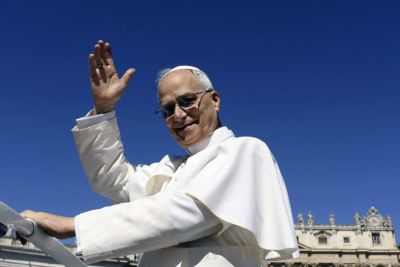
Pope Leo XIV visits the Blue Mosque in Istanbul, on Nov. 29, 2025. (Credit: Berk Ozkan/AFP)






Pope Leo XIV visited Istanbul’s Blue Mosque on Saturday, the city’s emblematic landmark and a major Ottoman monument. He was given an overview of its history but, unlike his predecessor Francis, did not pray inside.
On the third day of his visit to Turkey, the first American pope in history entered the symbolic 17th-century site — known for its finely tiled walls — in white socks and accompanied by Istanbul’s mufti.
This gesture of friendship toward Sunni Islam, the country’s majority faith, marks Leo XIV’s first visit to a Muslim place of worship since his election in May, following in the footsteps of Benedict XVI in 2006 and Francis in 2014. Surrounded by Muslim dignitaries, the pontiff toured the mosque in silence, broken only by camera shutters and the caw of a crow flying beneath the domes. He did not pause for prayer.
“The pope visited the mosque in silence, in a spirit of reflection and listening, with deep respect for the place and the faith of those gathered there in prayer,” the Vatican press office said.
The Sultanahmet Mosque, known as the Blue Mosque for its tiles, is one of Istanbul’s main tourist attractions. It was built on the site of the emperors’ former 'sacred palace' under Ottoman Sultan Ahmed I. Unlike his predecessors, Leo XIV did not visit Hagia Sophia, the former Byzantine basilica located about 300 meters away, which became a museum and was converted back into a mosque in 2020 by President Recep Tayyip Erdogan. Pope Francis said he was “deeply saddened” by that decision.
Outside, despite the cold and gray skies, a small crowd of several dozen people — mostly tourists — greeted the motorcade with cheers. “It’s positive, and above all courageous. The pope’s journeys are always wonderful; he brings peace with him,” said Roberta Ribola, an Italian woman in her 50s from Brescia.
“To interact with him”
Behind her, Sedat Kezer, a grilled-corn vendor, welcomed the visit. “People from different cultures meet. Especially since foreigners are plagued by Islamophobia. When you say ‘Allahu Akbar,’ they get scared,” he said.
“But the pope would seem more sincere if he mingled with the public. No one can see him or interact with him,” he added, pointing to the heavy security that has surrounded the pope since his arrival Thursday in Ankara, keeping him at a distance from crowds.
Pinned behind the barriers, Bekir Sarikaya complained: “The pope has no business here,” upset that his parents, “who traveled 1,000 kilometers to come,” could not pray. His wife disagreed, noting, “We can visit churches in Istanbul, so I think he has the right to visit our mosques.”

Shortly afterward, Leo met the heads of churches and Christian communities at the Syriac Orthodox Church of Mor Ephrem.
In the afternoon, he is scheduled to join in prayer at the patriarchal Church of St. George before meeting Ecumenical Patriarch Bartholomew I at the patriarchal palace along the Golden Horn. The two spiritual leaders will sign a joint declaration, the contents of which have not been disclosed. The day will conclude with a Mass at Istanbul’s Volkswagen Arena, where 4,000 worshippers are expected.
On Friday, the pope called for unity and fraternity among Christians of different denominations during celebrations marking the 1,700th anniversary of the First Ecumenical Council of Nicaea, a foundational event for Christianity.
After Paul VI (1967), John Paul II (1979), Benedict XVI (2006) and Francis (2014), Leo is the fifth pope to visit Turkey. From Sunday to Tuesday, he will continue his trip with a much-anticipated visit to Lebanon.
