






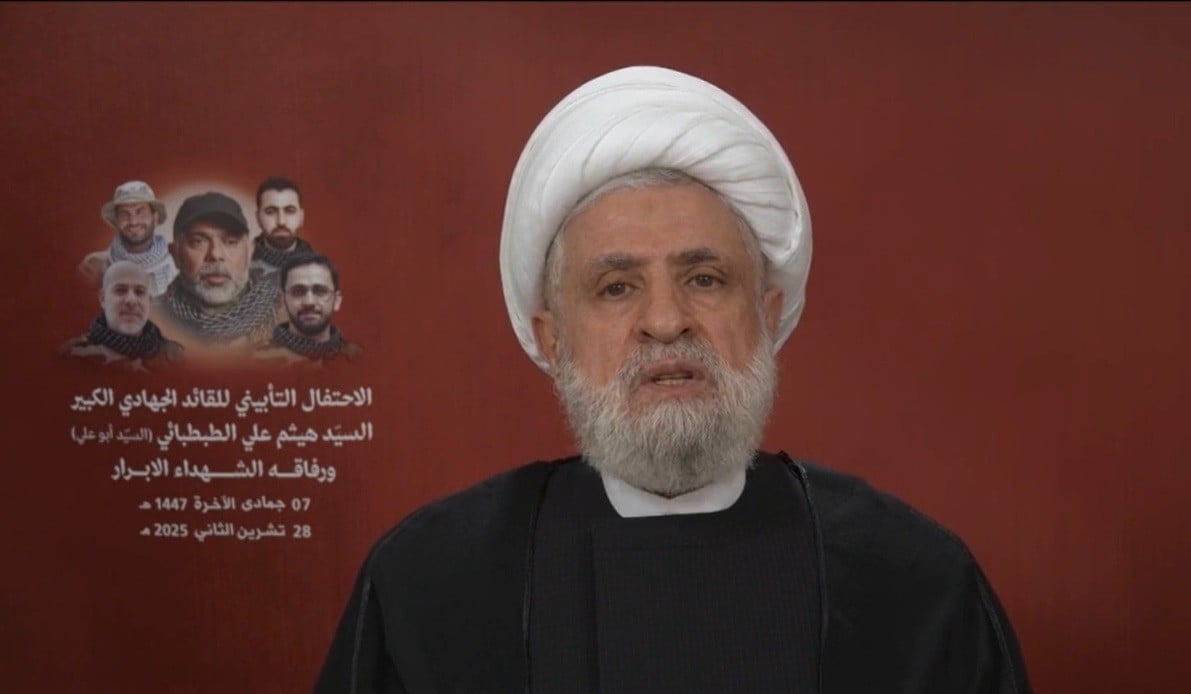
The Secretary General of Hezbollah during his speech on Nov. 28, 2025. (Credit: Al-Manar channel screengrab)






BEIRUT — Hezbollah said it has “the right to retaliate” for the killing of its former chief of staff, Haytham Tabataba'i, in an Israeli strike last Sunday in Beirut’s southern suburbs, but that the party will “decide the timing,” suggesting a response is not imminent.
In his first public statement since Tabataba'i’s death, Hezbollah Secretary-General Naim Qassem spoke at a ceremony honoring the five members killed in the attack. The event came a day after the first anniversary of a fragile truce in Lebanon between Hezbollah and Israel.
“What will we do after this assassination? I have written down the statement so that it is neither extrapolated nor changed; it must be conveyed exactly as it is. And it is: We condemn this aggression and this heinous crime, we have the right to retaliate, and we will decide the timing,” Qassem said. He also assured that the party would recover from Tabataba'i’s loss, while also praising his career and achievements.
Israel violated the truce once again on Thursday in a drone strike that targeted a van in Kantara, Marjayoun district, killing the driver. In the afternoon, Israeli artillery fired shells near Labbouneh, southeast of Naqoura, and near Blida and Aitaroun in the Bint Jbeil district. Earlier in the day, a drone hit an uninhabited house in Houla, Marjayoun district. Israel justifies these actions — and the continued occupation of its army of several sites in southern Lebanon — by citing Hezbollah’s refusal to hand over its weapons to the Lebanese state.

'Threats of a major war'
Qassem, the successor to the party’s former leader Hassan Nasrallah — also killed in an Israeli strike on Sept. 27, 2024 — reiterated Hezbollah’s stance on its arsenal. “Our weapons are not the problem; they kept Lebanon free for 44 years,” he said, adding that the party is “ready to discuss a defense strategy, but not under Israeli pressure or under terms that would nullify the truce agreement.”
His comments were aimed at both Tel Aviv and Lebanese officials pushing for Hezbollah’s disarmament. “Israel's servants in Lebanon, I see them as a minority, but they play a negative role,” he said.
Qassem dismissed Israeli threats of a wider war if Hezbollah does not disarm by the beginning of the new year. “The priority right now is sovereignty and liberation,” he said, describing “the threats of a major war” as “political pressure.”
“I’m telling you this threat changes nothing. Is it real? So far, no. It's possible there will be war in the future; both options are possible. Israel is making its calculations, but knows that with such people and such Resistance, there is no possibility of victory. We are a people who know neither failure nor surrender. Israel does not just want to fight us but to commit genocide. Listen to Israel's defense minister, Katz, talk about Greater Israel,” he added. “We will not give up our dignity; let everyone make a courageous decision to uphold dignity. We will remain free on our land and will not allow Israel to decide our fate,” Qassem continued, demanding Israel withdraw from southern Lebanon before any paradigm shift can be considered.
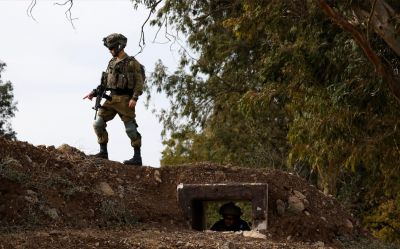
He also criticized the effectiveness of the cease-fire monitoring committee, also known as the Mechanism, calling it a “border guard,” and cited Israel’s occupation of parts of southern Syria since the fall of Bashar al-Assad as justification for Hezbollah’s continued armament. “Compromises encourage the enemy,” he said.
Qassem also criticized what he described as the government’s inability to “protect” and “liberate” southern Lebanon, saying Hezbollah’s strength compelled Israel to negotiate the November 2024 truce. “All of Lebanon is responsible for the country's defense, primarily the government, because it approved this agreement and said it wanted to take the lead in defending Lebanon. I say: you cannot take these rights without fulfilling your primary duty, which is to protect citizens,” he concluded.

