



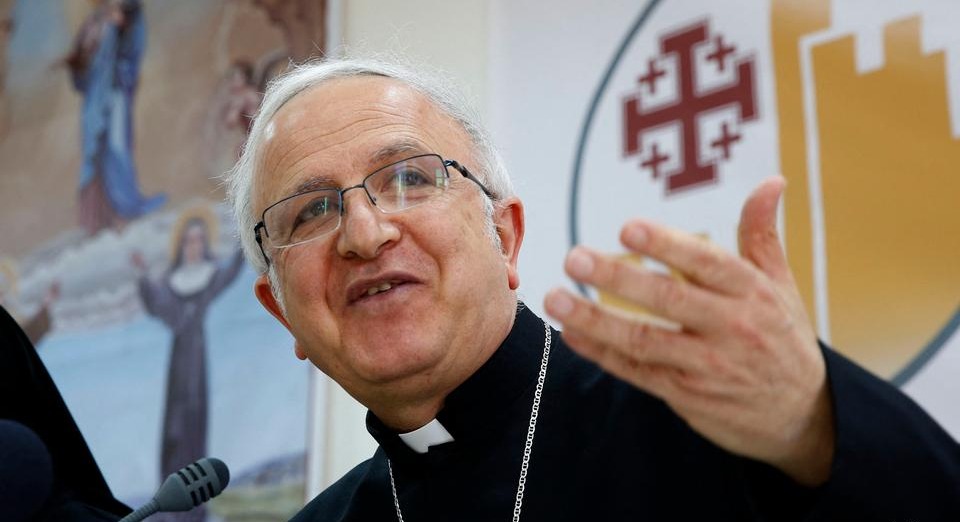
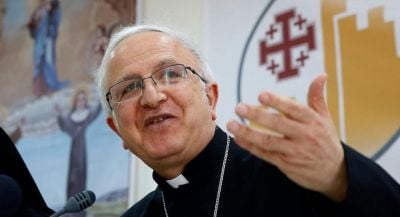
Auxiliary Bishop William Shomali of the Latin Patriarchate of Jerusalem during a press conference in Jerusalem on May 6, 2015. (Credit: Gali Tibbon/AFP)






Inside the imposing building of the Latin Patriarchate of Jerusalem, at the foot of the wall surrounding the Old City and just a few meters from the Church of the Holy Sepulchre, William Shomali watches over the large, empty hall on the second floor. “This is where we usually receive the pilgrims. But right now, they’ve all gone,” he said.
Originally from the occupied West Bank town of Beit Sahur, Bishop Shomali, in his 70s, is the Auxiliary Bishop for the Latin Church of Jerusalem, which was founded by the Crusaders. After spending most of his life between the holy city and Bethlehem — where he studied philosophy and theology — and later earning a doctorate in liturgy in Rome, he now travels freely around his homeland thanks to a Vatican passport.
“I live here as a foreigner,” he said. Yet, he is still a Palestinian like any other.
However, he is not completely free to speak his mind. Just the day before this interview, far-right Israeli groups opened a legal case against the former Grand Mufti of Jerusalem, Sheikh Akram Sabri, for “inciting hatred.”
Despite the tense atmosphere, the prelate believes that speaking out is a duty. “You have to choose your words carefully, but remaining silent would be cowardice.”
Speaking to L'Orient-Le Jour, Shomali shares his thoughts on the situation of Christians in Palestine, the Vatican’s policies and the future of Christian communities in the Middle East
L'Orient-Le Jour: You’re speaking to us from the Old City of Jerusalem. What is the atmosphere like today?
William Shomali: The alarm that used to sound to signal incoming missiles during the war has stopped ringing. There is a relative return to calm. A visitor from abroad might even think the situation is back to normal. If you walk through the city, the shops are open. One sign betrays the underlying unease: usually, at this time of the year, the streets of Jerusalem and Bethlehem are bustling with life.
Today, they are almost deserted. Pilgrims are afraid to come: they see images of Gaza on TV, but also footage of violence by the settlers in the West Bank. It’s impossible to deny that there is a serious problem: you can feel it in the air.
As soon as you leave the Old City, it becomes visible. Around us, the Palestinian villages in the West Bank are isolated. You can’t move freely. There are checkpoints, barriers and a military presence. Soldiers stop cars and search the trunks.
L'OLJ: Pope Leo XIV is about to make his first trip abroad, to Turkey and then Lebanon. Are you part of this visit?
W.S.: All of us in the Holy Land will be listening to the message of the Holy Father. We are awaiting it. Our Patriarch, Pierbattista Pizzaballa, will take part in the event as a member of the Council of Catholic Patriarchs of the East. Our faithful will also follow the live broadcasts on television.
This visit is of interest to all Christians in the Middle East. We are united by geography, history and culture. Our future is also interconnected: what he says about peace concerns not only the Palestinians and Israelis, but also the Syrians and Iraqis. The Pope’s message is not just for Christians. The Holy Father is coming to Lebanon to support the entire Lebanese people during these difficult times.
Perhaps some here would have preferred for the Pope to come directly to the Holy Land. But everyone is aware that the situation does not allow for it. There is the security atmosphere. The Holy Father could never have gone to Gaza, for example. But there is also the general atmosphere. There is a lot of violence and hatred. Hearts are troubled. Whatever he says, his words would have been misinterpreted.
L'OLJ: Under what conditions do the Christians in Gaza live?
W.S.: There are currently 550 Christians in Gaza. Before the war, there were 1,017. Many have left after obtaining visas for Australia or Canada. Others are waiting for visas. I don’t know how many will remain by the end of the war, but I know that many wish to leave. We are responsible — spiritually, morally and humanely — for all those who stay. Even if only one remains, we will be at their service.
On the ground, the living conditions are difficult. A handful of faithful, whose homes were spared by the war, have been able to return to their homes after the cease-fire, despite the risks. But the vast majority are still living within the premises of the Latin and Orthodox parishes.
Families are settled in the school of the Church of the Holy Family or that of Saint Porphyrius Orthodox church. Inside a classroom, a curtain separates the families. It’s not very comfortable, but there is water thanks to a cistern connected to a spring. Food is provided either through the money we send or via the trucks we deliver. Aid is also distributed to the neighbors, who are just as hungry as our parishioners.
A lot of effort was required to set up this system. We received donations from all over the world. We also had to coordinate with everyone — both the Israelis and the Palestinian officials inside the city. The security checks are extremely burdensome. It doesn’t always work. We can’t dispatch trucks every day. But once a month, or every three weeks, we manage to deliver a shipment of food, blankets and medicine.
L'OLJ: Michel Sabbah was the first and only Palestinian appointed Latin Patriarch of Jerusalem, serving from 1987 to 2008. The current patriarch, Pierbattista Pizzaballa, is from Lombardy and is a member of the Franciscan order. What meaning does this choice carry?
W.S.: Of the 10 patriarchs of Jerusalem appointed since the Latin Patriarchate was restored in 1848, seven have been Italian, including the current patriarch. Appointing an Italian is not the exception but the rule.
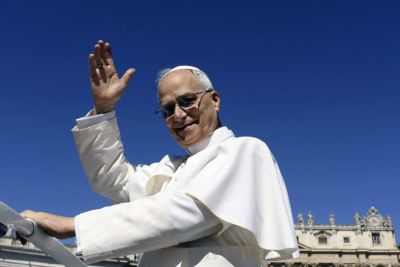
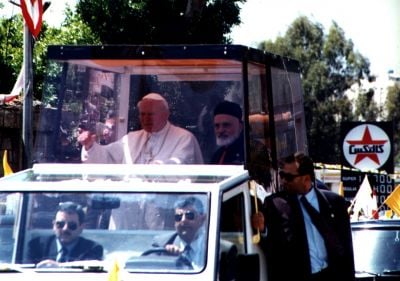
The patriarchate was founded by Italian and French missionaries, and there are many Italian priests and communities in the Holy Land. Rome selects from among the best. Pope John Paul II expressed a desire for an Arab and Palestinian patriarch and appointed Michel Sabbah. After him, the patriarch was Jordanian, Fouad Twal. When the current prelate was chosen in 2020, an Arab was among the names presented to Rome.
Pierbattista Pizzaballa was chosen for his deep knowledge of the Holy Sites, his intelligence and his competence. But beyond the cultural, theological and pastoral reasons, there is also a political factor: an Italian patriarch enjoys greater freedom to speak, travel and move around. His words carry more weight.
An Arab patriarch, for example, would not have been able to visit Gaza as Cardinal Pizzaballa did twice during the current conflict. Therefore, this choice is both a pastoral and strategic one.
L'OLJ: How to define the Vatican’s policy towards Palestinians?
W.S.: The Holy See has always defended the oppressed, the weak and the persecuted, wherever they may be. It is also on the side of justice. It believes that the Palestinians have the right to a sovereign state. Not because it is partisan, but because it stands for justice.
During the war, Pope Francis called the priest in Gaza almost every day. It was a very strong act of solidarity. The Israelis listened to what he said, but he did it anyway. He also made several statements in which he spoke of the suffering of the people of Gaza and called for an end to the war. He said what he had to say, with truth and respect. Some believe it wasn’t enough. Others considered him antisemitic because he spoke some uncomfortable truths.
L'OLJ: Could the Holy See have done more?
W.S.: The Pope does what he can. Only God is all-powerful; the Church is not. It is simply an instrument. The Vatican, the smallest state in the world, derives its strength from its spiritual and moral authority.
When the Pope speaks, millions of believers listen because he stands for impartiality, justice and honesty. Sovereigns, kings and prime ministers seek to meet with him. The Pope sends messages to the powerful of this world. While these messages are not always accepted, they are always heard.
It’s also important to recognize that the Vatican operates on two levels: there are the Pope’s public statements, and the more discreet efforts that don’t rely on loud cries or alarms. Often, the true impact of its actions is only known later, and is not immediately visible or audible.
L'OLJ: Do you have an example?
W.S.: There is the classic example of the Cuban crisis, when the world was on the brink of a third world war. Pope John XXIII intervened discreetly with both Washington and Moscow to prevent the war. But we only learned of it afterward.
Another example is often cited: Poland’s peaceful transition from communism, without bloodshed. However, we later discovered the significant behind-the-scenes role played by Pope John Paul II, who worked tirelessly to help find a peaceful solution. What the Pope says to the sovereigns who visit him is not made public. Not everything is spread across the newspapers the following day.
L'OLJ: In practice, how does the Church encourage Christians to stay in Palestine?
W.S.: The majority of Christians in Palestine work in institutions linked to the Church — schools, universities, hospitals, pilgrimage sites, etc. Helping them earn a living and secure a future for their children is one way to encourage them to stay.
Without employment, no one would want to stay in Jerusalem or Bethlehem. During the war, we also helped those without work so they could pay rent, medical expenses, and cover basic necessities. It’s also a way of encouraging them not to lose hope.
L'OLJ: Are the Christians of the Eastern Churches doomed in the long run?
W.S.: The future is in God’s hands. But some figures are telling. When the Latin Patriarchate of Jerusalem was restored in 1848, there were only 21,500 Christians in Palestine, out of a population of 250,000. They represented nine percent of the population.
Today, the number of Christians between the Jordan River and the Mediterranean — meaning in Israel and Palestine — is almost 200,000. In addition, there are around 100,000 foreign, non-Arab Christians. So, there are a total of 300,000 Christians today in the Holy Land, but they now represent only two percent of the population.
It’s a paradox. But it also makes me believe that there will always be Christians in the Middle East.
This article originally appeared in French on L'Orient-Le Jour and was translated by Joelle Khoury.
 Israeli army carries out demolition at Jabal Amel School in Houla as strikes continue