






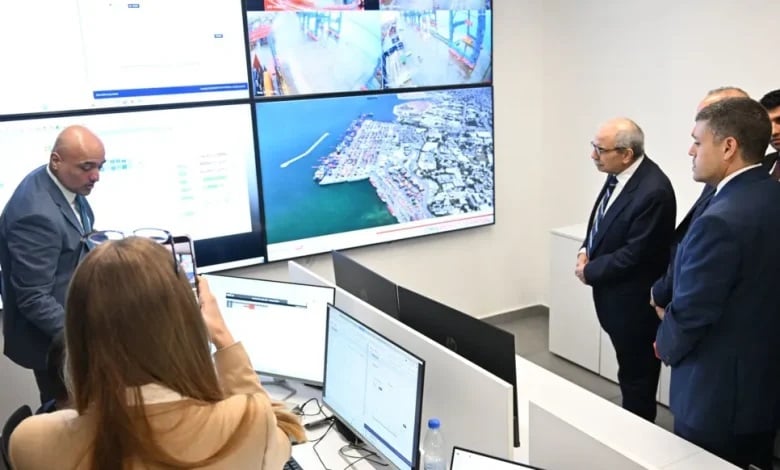
Prime Minister Nawaf Salam visits the port of Beirut on Nov. 25, 2025. (Credit: NNA)






BEIRUT — Prime Minister Nawaf Salam, accompanied by Public Works and Transport Minister Fayez Rasamny, on Tuesday outlined a development plan for the Port of Beirut aimed at “putting it back on the transportation map of the Arab world.”
At a news conference, Salam said that his government was preparing for the possibility of a new large-scale Israeli offensive against Lebanon, amid tensions following the assassination of Haytham Abu Ali Tabtaba’i on Sunday.
Asked about the security situation, Salam said it was “clear that Israel is taking an escalatory line.”
“We are in a situation of war, the intensity of which is increasing, taking the form of a one-sided war of attrition. We are taking precautions to deal with any escalation and anything that may result from it on the humanitarian, social, or other levels,” he said.
Salam added that he had spoken with Army Commander Rodolph Haykal on Monday. He would continue to “work to mobilize more Arab and international support to stop these attacks and work toward an Israeli withdrawal” from the occupied territories in southern Lebanon.
Salam then detailed his Cabinet’s goals for the port, an emblematic site in the capital more than five years after it was devastated by the twin explosions of Aug. 4, 2020.
“Within the government, we are working on Lebanon’s economic recovery, and the key pillar of any growth is the development of the Port of Beirut — both the memory and the future of the city,” he said.
He said a series of expansion and renovation projects are underway across the port. “These works take time, but there is a clear vision for the future of the port, including modernizing work mechanisms, rebuilding the silos, and implementing several internal development measures,” he said.
He added that efforts are also underway to restore the port’s role in regional transport, and expressed “full confidence” in the port’s board of directors.
Salam said discussions are ongoing with the World Bank to develop a broad plan to rethink Lebanon’s transportation systems. “Last week, I concluded an agreement with the World Bank for it to work with us on a study of transportation between Lebanon and its Arab environment, through maritime and air ports and land routes, and to consider restoring railroad service,” he said.
He also addressed the investigation into the Aug. 4 disaster, saying he hoped “justice will soon be served,” while stressing that he does not intend to interfere in judicial work. “Everyone has the right to see justice served as soon as possible,” he said.
Hampered by repeated political interference, the probe into the blast — which killed more than 235 people and injured over 7,000 — has been stalled for months. Investigating Judge Tarek Bitar was heard by the Beirut Court of Justice in early November.

