



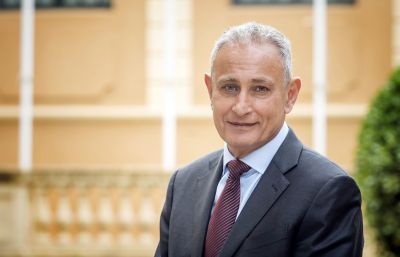
Union for the Mediterranean Secretary-General Nasser Kamel. (Credit: UfM)






Thirty years ago, in 1995, the Euro-Mediterranean cooperation process emerged to encourage dialogue and joint action on both sides of the Mediterranean.
Thirty years later, the Union for the Mediterranean (UfM) is holding its 10th regional forum, dubbed “Together for a stronger Euro Mediterranean partnership” in Barcelona from Nov. 22 to 28, during which the European Union plans to announce the main lines of its new Pact for the Mediterranean.
After leading this institution for six years and just before his term ends, Secretary-General Nasser Kamel explains to L’Orient-Le Jour why Mediterranean countries share such a closely linked fate.
L’Orient-Le Jour: What strengths and weaknesses still shape the Euro-Mediterranean partnership 30 years later?
Nasser Kamel: In 1995, leaders in the southern and northern countries chose to work together and create a shared space for political, economic and structural cooperation. At that stage, they laid the groundwork for a cultural identity that had always existed but now grew from a political decision to confront challenges and shape a more unified, integrated and peaceful region.
This process sparked hope, although it still falls short of its real potential and continues to face delays caused by ongoing geopolitical tensions in the region.
Among the flaws, we must mention the taboo issue, the Palestinian question. We all hoped to reach a fair and just solution, but that has not happened, and the region has faced other major upheavals.
At the sector level, the greatest weakness remains the regional economic situation, as shown in the report we recently prepared with the Organization for Economic Co-operation and Development. Despite progress in recent years, we still fall short of our potential for economic integration both within the EU and between the EU and the southern Mediterranean.

L’OLJ: What main points shape the UfM’s new strategic vision in the European Union’s new Mediterranean Pact? What new elements will it include, and what concrete effects should we expect?
N.K.: The priorities remain the same. We will continue to address environmental and climate challenges, the impact of heavy tourism, which brings benefits but also demands strict environmental management, and the imbalances between the southern and northern countries.
The method will change. UfM will focus more on linking different countries and economies, because only collective action can confront climate change.
Creating an economic link seems obvious to me because economic interaction remains weak. We must speed up investment if we want concrete projects.
L’OLJ: How has the union helped Mediterranean voices reach global climate summits?
N.K.: The reports that the UfM presented at two consecutive climate COPs, prepared with Medecc experts, stand as the only ones that examine the impact of climate change on a specific region.
Both reports show that the Mediterranean region suffers on average 20 percent more than the rest of the world. The effects appear clearly in rising sea levels and the erosion of coastal farmland, which creates an obvious threat to coastal cities such as those in Egypt and Lebanon.
Before COP27 in Egypt, we brought together ministers from 43 member countries, knowing that not all of them belong to the same negotiating groups at summits based on their level of development and that they sometimes have conflicting interests in the fight against climate change. But this meeting showed that there is agreement on the principles, policy and actions to be taken. This agreement forms an important foundation for international negotiations on this issue.
L’OLJ: Within the framework of UfM member countries, what has been Lebanon’s contribution (positive or negative) so far? How could its role evolve in Mediterranean cooperation in the future?
N.K.: Lebanon, despite its problems in the energy and other sectors, has continued to participate in our activities over the past few years. That in itself is very positive. But circumstances have prevented it from taking full advantage of its participation in the UfM.
However, I see things changing. The current government has a fairly dynamic vision, both internally and regionally. Lebanon's main asset is its human capital. With all this potential, it can contribute enormously to the UfM. And we can be of use to it in many sectors and projects.
L’OLJ: On a personal level, as your term as head of the UfM is coming to an end, what are your thoughts on the importance of strengthening inter-Mediterranean relations, particularly between the southern and northern countries?
N.K.: I have always believed that this region has enormous potential for interdependence, even with the contradictions that may exist between its member states. Take, for example, the rapid population growth in the south, which is the opposite of the situation in the north. But challenges can be turned into opportunities.
Our fate is deeply intertwined, economically, geopolitically and in all the issues we address. We are obliged to work together, and I remain optimistic about future Mediterranean cooperation.
This article was originally published in L'Orient-Le Jour and translated by Joelle El-Khoury.

 7 p.m. recap: Houthis strike Riyadh airport again; Yemeni forces claim Bab al-Mandeb gains; Abbas postpones Palestinian polls