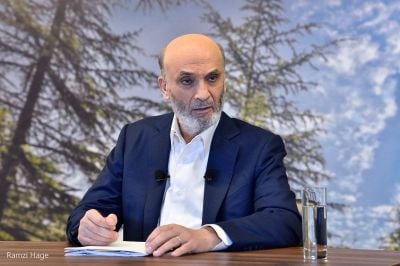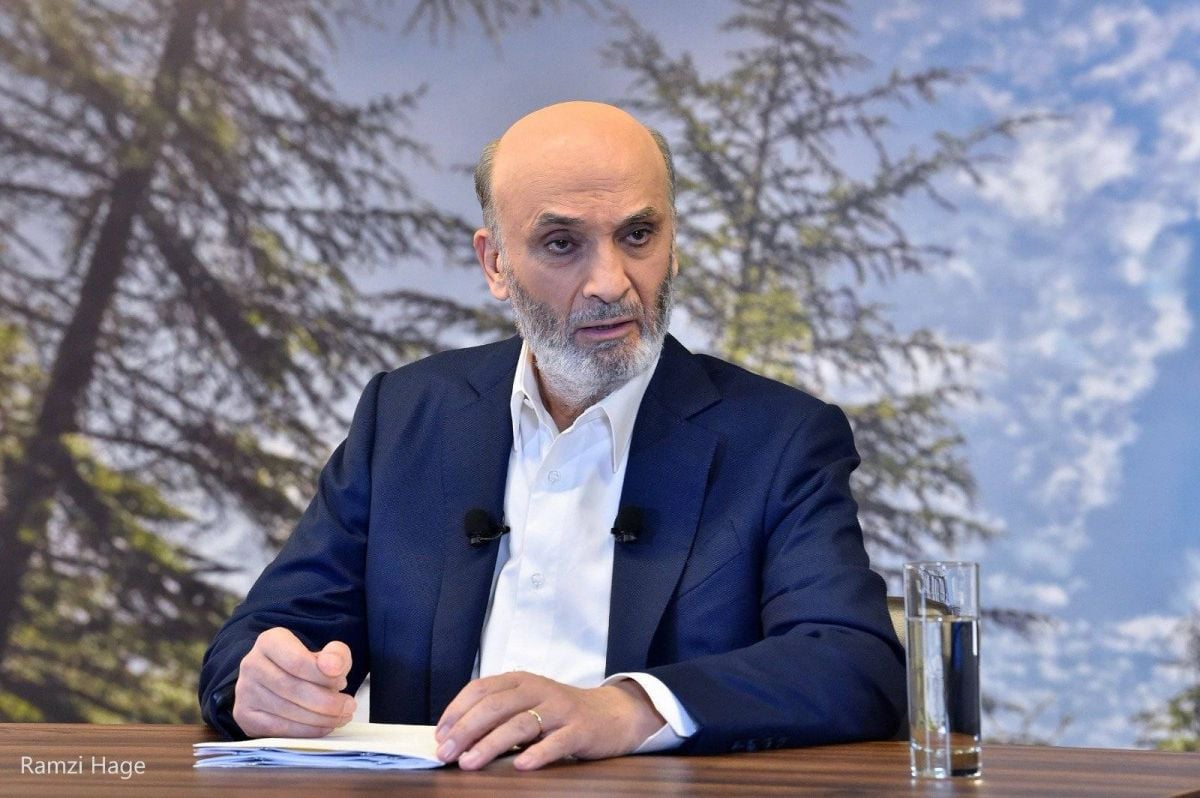
The leader of the Lebanese Forces, Samir Geagea. (Credit: Archive photo X/@DRSamirGeagea)






The leader of the Lebanese Forces (LF), Samir Geagea, said that “things are heading toward an increasingly significant escalation,” as pressure mounts on Lebanese authorities to disarm Hezbollah and begin negotiations with Israel.
“This moment is delicate and dangerous, as it could tip into something worse. But we can also recover if we act correctly,” Geagea emphasized in an interview on Friday with al-Qahera News, noting that “things are heading toward an increasingly significant escalation.”
“Saying Hezbollah respected the cease-fire is false”
Commenting on the cease-fire agreement, the Christian leader said, “It is true that Israel did not respect the agreement, but saying that Hezbollah respected it is false.” The Nov. 27, 2024 cease-fire agreement “stipulates that Lebanon must dismantle all illegal military and security organizations, seize their weapons, and hand them over to the Lebanese Army. That is the part that concerns Lebanon. As for the part concerning Israel, it consists of withdrawing from Lebanon and not attacking,” he added.
The LF leader further stated that “the problem is not with the principle of conducting direct or indirect negotiations with Israel,” noting that “it is a decision that belongs to the ministerial majority within the Council of Ministers.” For him, “the problem is that we must first agree on what we want to negotiate.” In this context, he stressed that reserving the monopoly on weapons for the state is a “political, not military, issue.” “The Lebanese Army has nothing to do with the progress being made. The matter is in the hands of the political authority,” he clarified, while the army is criticized for its “delay” in implementing Hezbollah’s disarmament.
On the eve of Independence Day, and a few days after the Trump administration canceled meetings in Washington with Army Commander Rodolph Haykal, President Joseph Aoun affirmed on Friday from southern Lebanon that he was ready to fully and effectively engage Lebanon in the peace process. He followed these remarks with a five-point initiative addressed “to the entire world,” including “final negotiations” on the border with Israel.
The Shebaa Farms, a ‘pretext’
Samir Geagea also addressed the issue of the occupied Shebaa Farms, saying that Hezbollah uses it as a “pretext” to justify maintaining the status quo. This piece of the Syrian Golan annexed by Israel, disputed among Damascus, Beirut, and Tel Aviv, has long served as Hezbollah’s justification for retaining its arsenal, arguing that the liberation of southern Lebanon remains incomplete without these roughly twenty square kilometers. The LF leader clarified that this is an obvious legal issue between Lebanon, Syria, and the United Nations, and that resolving it would help settle the Shebaa Farms crisis.
Asked about reports that certain parties “complain” about the president and the Lebanese state to the Americans, blaming them for this failure, Geagea rejected the notion. “I would have hoped that no Lebanese official would make such statements. Is it conceivable that the Americans expect someone in Lebanon to tell them what is happening? That is extreme naivety,” he said. “Everything that is said today, when you read the press — especially that of the ‘resistance’ — revolves around ‘informers’ and ‘denunciators.’ They always need an enemy, a release valve, someone to blame, as if no one knows what is happening in Lebanon, as if there were no ‘mechanism’ committee, as if there were no American officers in Lebanon who certainly know more than I do and more than all of us,” the LF leader criticized.
Regarding the parliamentary elections scheduled for May 2026, the Christian leader said that Parliament Speaker Nabih Berri “confuses his position as head of the Amal movement, where he has a well-defined opinion, which is his right, and his function as president of Parliament, where he must remain impartial in management.” He added: “When an urgent bill is submitted to him, he must present it to the plenary assembly.” These remarks come as Berri categorically refuses to put on the agenda of any plenary session an amendment to the electoral law requested by several parties to allow the Lebanese diaspora to vote for all 128 members of parliament, while Article 112 of current legislation limits their vote to only six seats.