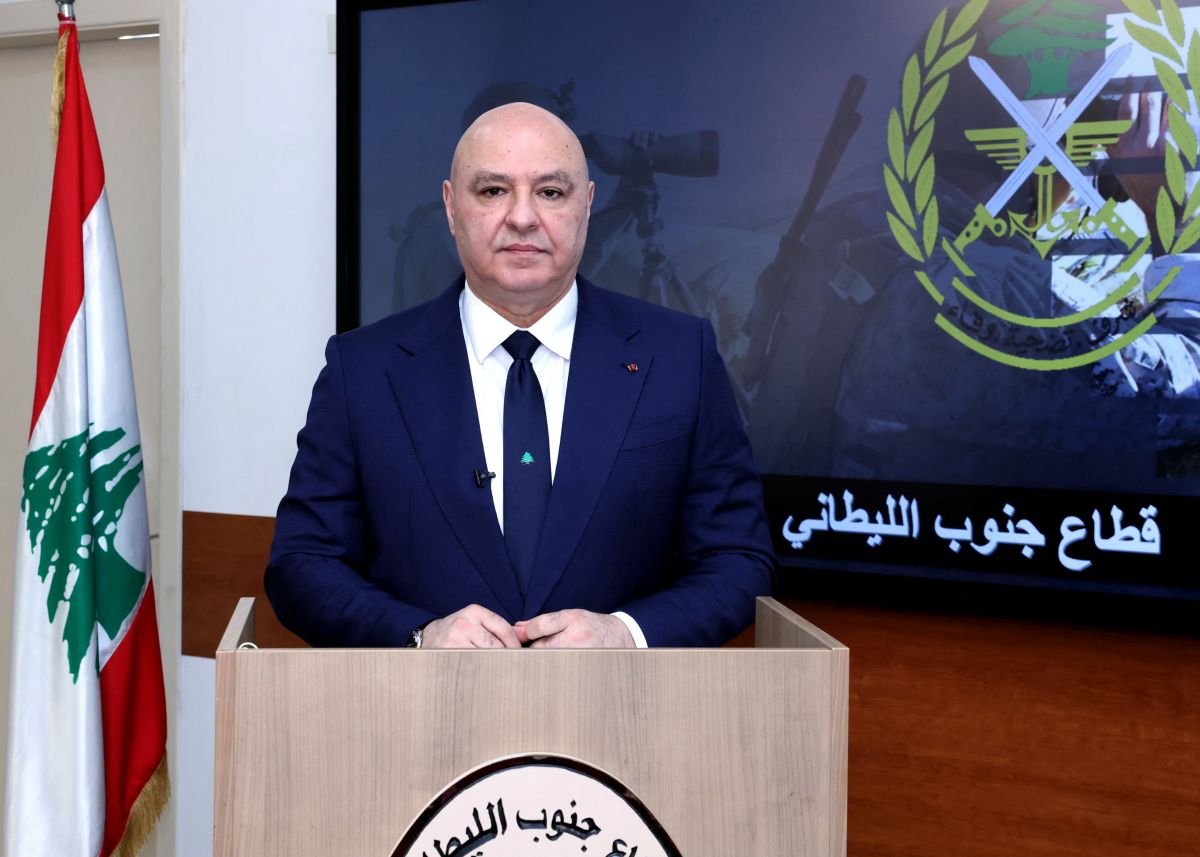
Lebanese President Joseph Aoun addressing the nation on the eve of Independence Day in a televised speech from the headquarters of the Lebanese Army’s South Litani Sector Command in Sour. Photo provided by the Lebanese Presidency.






Reactions were quick on Saturday following the clear message delivered Friday evening by President Joseph Aoun to the Lebanese people, but especially to the United States and Israel, on the eve of Independence Day, just days after the Trump administration canceled meetings in Washington with Army Commander Rodolph Haykal. From southern Lebanon, the head of state affirmed that he was ready to fully and effectively engage Lebanon in the peace process. He followed these remarks with a five-point initiative addressed “to the entire world,” including “final negotiations” on the border with Israel.
While some praised the president’s remarks, others — including the head of the Free Patriotic Movement (FPM, Aounist) Gebran Bassil — considered them insufficient in the absence of practical measures on the ground.
“We appreciate the responsible and thoughtful statements made by the President, who seeks to uphold Lebanon’s rights and prevent a civil war, but that is not enough,” Bassil said. “The initiative he proposed must be transformed into a government proposal, as the government itself had promised a national defense strategy,” he added. He further stressed: “This initiative, which reflects a sense of responsibility and awareness, must come from the Lebanese government and be a national initiative for which the Lebanese government bears responsibility. The government promised the Lebanese people to implement a national defense strategy. Where is that strategy?”
‘Clear vision for the liberation of the South’
Former leader of the Progressive Socialist Party (PSP), Walid Jumblatt, praised the head of state’s clear vision on this Independence Day. “From Sour, President Joseph Aoun presented a clear vision for the liberation of the South, the sovereignty of the state, and the monopoly on arms. From Sour, the president established the best path and the best vision for the future,” the Druze leader emphasized on X.
Christian leader Michel Moawad, a member of a traditional political family, thanked the president on X for his “patriotic positions on this day dear to the Lebanese,” and for remaining faithful to the mission of his father, former President Rene Moawad, assassinated on Nov. 22, 1989, “who wanted Lebanon to be a free and independent homeland, a strong and just state, capable of protecting the dignity and future of its children.”
“It is now the responsibility of all of us — state, institutions and political forces — to continue on this path to build the state for which President Rene Moawad sacrificed himself: a sovereign and lawful state that holds the monopoly on weapons and strategic decisions and applies the law to all its citizens without leniency or concession; a state that ends the state of war imposed on Lebanon since the Cairo Agreement, along with its consequences — occupations, wars, tutelage and assassinations — that have destroyed our homeland and exhausted the Lebanese; a state that unites all its citizens, because national reconciliation, as President Moawad said, excludes no one, not even those who insist on excluding themselves; a state of institutions, stability, growth, and prosperity that the Lebanese deserve and aspire to,” Moawad emphasized.
Dissident FPM MP Simon Abi Ramia also expressed his “unconditional support for the president’s speech,” considering that Joseph Aoun’s initiative is neither “a proposal to be debated” nor “a negotiating paper,” but a “line of demarcation between a sovereign state, with the help of the international community to end the occupation, and states that … contribute to the continuation of the occupation, the erosion of sovereignty, and the maintenance of Lebanon as open ground for war and continuous aggression.”
On Nov. 18, the United States canceled meetings in Washington with the Lebanese Army Chief, as the Trump administration was “exasperated” by General Rodolph Haykal’s comments about “Israeli violations of Lebanese sovereignty that hinder the army’s deployment in the South.” It was also reportedly unhappy with the army’s slow progress on Hezbollah’s disarmament, according to statements on X by several U.S. senators. Following the president’s speech, U.S. President Donald Trump said he was ready to invite Joseph Aoun to the White House.