




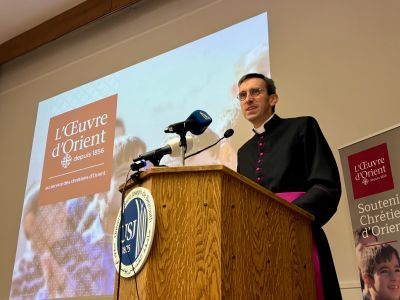
The new Director General of L’Œuvre d’Orient, Mgr Hugues de Woillemont, during the press conference organized at Saint Joseph University to present the new report on Nov. 17, 2025. (Credit: Philippe Hage Boutros/L’Orient-Le Jour)






L’Œuvre d’Orient, a French Catholic organization, released a report Monday quantifying the country's debt from 2014 to 2023 to 254 semi-private schools, hospitals, orphanages and care centers for the elderly and people with disabilities.
Even before the 2019 crisis or the war between Israel and Hezbollah broke out, Lebanese leaders often delayed expenses or payments to keep the budget balanced on paper.
This practice involves a less well-known group of creditors compared to Eurobond holders and public works contractors: private nonprofit institutions, which supplement or substitute the government in delivering essential public services to the community in areas like education, health and social services.
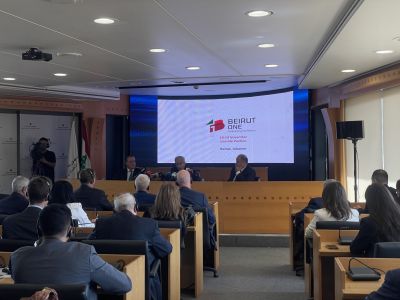
By the end of 2023, this debt had surpassed $147 million, owed to 254 institutions with which the state had worked from 2014 to 2023.
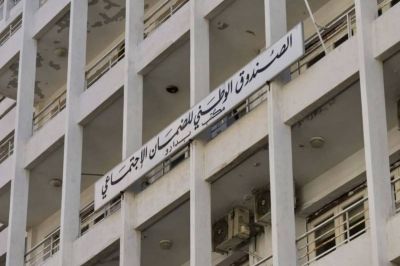
The report details a total of 314 contracts signed by the Health, Education and Social Affairs Ministries, along with several public funds, including the National Social Security Fund (NSSF).
The amount was adjusted for inflation and increased by including a standard annual penalty of 2 percent, along with the six-month LIBOR rate, which served as a benchmark for the cost of money before its discontinuation in September 2024.

Without these adjustments, its nominal value doesn't even reach $10 million, according to the report's authors.
“This report is a snapshot at a given moment of a loss, but since then, the numbers have fluctuated: New arrears have accumulated and some bills have been reimbursed at a rate lower than their real value,” explains Vincent Gelot, head of the Lebanon and Syria office of L’Œuvre d’Orient, who led the report.
The harm to these institutions isn’t limited to the calculation of debt or to recognizing "poorly paid" debts at below-market rates, which couldn’t be quantified because the state took several years to adjust the official rate to reflect the depreciation of the Lebanese lira. It also shows that most of these institutions’ contracts still haven’t been revalued.

'Unprecedented multiconfessional nature' of debt
Mgr de Woillemont described the report as “unprecedented,” not only for its findings but also for the “multiconfessional nature” of the data collected.
Finalized in November 2024, this document was prepared with the support of Patriarch Bechara al-Rai, in partnership with Caritas-Lebanon and the General Secretariat of Catholic Education in Lebanon.
It was presented on Monday at a conference held at Saint Joseph University in Beirut. The timing, one day after "World Day of the Poor" and less than two weeks before Pope Leo XIV's first visit to Lebanon, is no coincidence.
According to the new director general of L’Œuvre d’Orient, Mgr Hugues de Woillemont, the report was also sent to Vatican Secretary of State Pietro Parolin.
More than half of the institutions are affiliated with Christian organizations — including the psychiatric hospital of the Franciscan Sisters of the Cross (Deir al-Salib), which the Pope will visit on Dec. 2.
The rest are divided among Sunni organizations (al-Makassed), Shiite organizations (al-Mabarrat), Druze (al-Irfan Foundation) or secular groups (Arcenciel).
Some of the participating institutions are partners of L’Œuvre d’Orient.

The goal of the initiative is to highlight an issue that is poorly understood in Lebanon and to continue engaging with the government to find a solution.
It also aims to raise awareness among international donors and the Lebanese government about the condition of institutions that perform public service functions delegated by the state but whose financial stability is at risk — some of which have closed since late 2023.
“The Lebanese state speaks little of these partnerships with donors, based on our discussions with participants,” says Gelot.
He also acknowledges that some of these institutions have had to ask their service users for additional contributions to stay operational despite late payments from the state.
Long process
Asked about the delay between completing and releasing the report, the head of the Lebanon-Syria office explained: “The work was long and painstaking.
“We had to go through all contracts and bills from the 254 institutions, then share results with each and with their oversight authorities, which was done starting in May. The recent war and uncertainty also delayed publication.”
The report is rich in detail:
Of the $150 million identified, $64,233,500 (44 percent) involves 144 contracts from the Education Ministry, $26,979,943 (18 percent) concerns 107 contracts from the Social Affairs Ministry, and $56,586,863 (38 percent) falls under the health sector — $31,010,879 for 25 contracts with the Health Ministry and $25,575,984 for 38 contracts with public funds, including the NSSF.
These shortcomings impact nearly 150,000 vulnerable people annually, according to the report’s authors.
The Education Ministry has the largest backlog, while the Social Affairs Ministry has recently settled most arrears owed through the end of 2023, maintaining the old exchange rate of 1,507.5 Lebanese lira to the dollar (compared to 89,500 lira today).
The situation in the health sector is more complicated due to interactions between the Ministry and public funds.
We contacted the involved ministries and organizations.
Finance Minister Yassin Jaber told us he does not have exact figures, but said some institutions have contacted the Finance Ministry about the status of deposits blocked at banks at the start of the crisis — a problem the country must address by law to recover the financial system’s losses.
An expert close to the Finance Ministry, who asked to remain anonymous, notes that the Ministry has not compiled these figures, which come from multiple sources and need to be adjusted for the current exchange rate before comparing them with market value.
The source also acknowledges that some information might be missing due to poorly documented contracts and the administrative autonomy of certain public institutions, which limits the Ministry’s ability to see the amounts owed.
The Education Ministry said it will respond, while the Health Ministry, the Social Affairs Ministry and the NSSF have not yet replied.
This article was translated from L'Orient-Le Jour.
 Israeli army carries out demolition at Jabal Amel School in Houla as strikes continue