







Hezbollah Secretary-General Naim Qassem delivering a speech on Nov. 17, 2025. (Credit: al-Manar live broadcast)






BEIRUT — In a speech delivered Monday, on the anniversary of Israel's assassination of Hezbollah communications chief, Mohammad Afif, party leader Naim Qassem called on the Lebanese government to make public a clear plan for how the country will respond to Israel's daily violations of the November 2024 cease-fire agreement.
"Israeli hostilities are the problem — not the Resistance, not the Lebanese state's institutions, nor the army," Qassem said, accusing those who claim otherwise of "handing the country over to Israel."
Qassem mentioned Israel's attacks — which have been steadily escalating — against UNIFIL, the Lebanese Army, and civilians, which he said "clearly show that we are facing serious and widespread aggression."
"We must confront this by every diplomatic and political means, and consider every measure to put an end to this aggression," the Hezbollah leader said. "The Lebanese government is responsible for this consideration, and the Lebanese state as a whole is responsible for setting out roadmaps so we can confront this aggression."
On Sunday, Israeli soldiers in a Merkava tank opened fire on U.N. peacekeepers near an illegally occupied outpost on Lebanese territory in the Khiam area, in Nabatieh district. There were no casualties as a result of the attack, which UNIFIL warned was "a serious violation of [U.N.] Security Council Resolution 1701."
More news about UNIFIL
UNIFIL is reducing number of peacekeepers in south Lebanon, says spokesperson

Hezbollah has consistently rejected the government's project to disarm it countrywide, insisting that progress first be made toward bringing an end to Israel's attacks on southern Lebanon.
The Lebanese Army has, since September, been implementing a Cabinet-approved plan to disarm Hezbollah south of the Litani River and, according to army chief Rodolph Haykal, this process is 80 percent complete and has been carried out with Hezbollah's support.
Access to the remaining 20 percent of weaponry and military infrastructure is hindered by the ongoing Israeli occupation in the South, Haykal pointed out in his latest progress report presented to Cabinet earlier this month.
"Anyone who claims the Resistance is a problem because it does not surrender is in reality accepting to hand the country over to Israel, something we will not accept," Qassem said on Monday.
"I am addressing the government, and we are part of this government. We want it to succeed in building Lebanon and liberating it. The government is mistaken when it chooses the path of concessions, hoping to end the aggression," he continued. "We are partners in this country; we have a say, and with us stands a large part of the Lebanese people as well as allied political forces."
Qassem to the government: Try saying 'no'
"What is happening in Lebanon today is not simply a non-compliance with the cease-fire agreement, but a blatant aggression aiming to control Lebanon and strip it of its strength," Qassem said, calling on Lebanese to "come together as in 2000," during the Israeli withdrawal from southern Lebanon.
Qassem made note of UNIFIL's recent statement denouncing Israel's construction of tall concrete wall inside of Lebanon, cutting off access to more than 4,000 square meters of land . Israel has only admitted to having built a reinforced barrier along the demarcation line with Lebanon.
Addressing the Lebanese government, Qassem asked: "How many times have you tried concessions and made unilateral offers that led nowhere?"
"The [Israeli] presence south of the Litani despite continued aggression is a concession. Announcing the willingness to negotiate is a concession. Adopting the principles of [U.S. envoy Tom] Barrack's shameful roadmap is a concession," Qassem said, referring to American pressure on Lebanon, expressed via its former envoy to the region, to speed up the process of acquiring a monopoly on arms.
"Try saying 'no' based on Lebanon's rights, and we will all be united," Qassem added. "Together, we will build our independence, liberate our land, regain the path to independence, and Christians and Muslims from all parts of Lebanon will be of one heart and one hand in the face of the Israeli enemy and its American supporters to defend our rights."

"Lebanon only gained its independence on Nov. 22, 1943, at the cost of suffering, demands, courageous positions, and detentions," said the Hezbollah chief. "Independence means liberating the land and refusing any foreign tutelage. We believe in Lebanon's independence across all its territory and refuse to let Lebanon lose a single centimeter, but that it remain proud, noble, liberated and free of all tutelage, whatever it may be."
"American tutelage over Lebanon is a very great danger and does not serve the country's stability," Qassem warned. "The United States are aggressors, support Israeli aggression and guide Israel on the boundaries of aggression to adapt them to their political objectives and diplomatic pressures."
"If you want to know the greatest misfortunes to hit Lebanon, look to the United States," Qassem said, accusing the U.S. of "sowing internal discord" during the October 2019 thawra (revolution), of contributing to the economy's collapse, blocking electricity from Egypt and Jordan and disrupting oil supplies.
Pressure on al-Qard al-Hassan
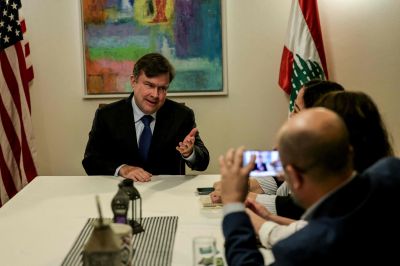
Qassem also addressed pressure on Hezbollah's financial arm, al-Qard al-Hassan. During a visit to Lebanon last week, a U.S. delegation called for the closure of all branches of al-Qard al-Hassan, which is linked to Hezbollah and sanctioned by the United States, within Lebanon. Washington is seeking to strengthen measures to prevent the party from receiving Iranian funds or any other sources of financing.
"This is a social institution open to all in these difficult times to make life easier for everyone, the poor and the needy. No one has the right to stop good, help, and solidarity," he said. "I advise the government, the governor of the Bank of Lebanon, and all relevant parties to end measures that hinder the work of Hezbollah and all Lebanese."
As for the polarizing debate on diaspora voting procedures that has frozen several Parliament meetings in recent months, Qassem called for opponents of the 2017 electoral law to "stop paralyzing Parliament, as this paralysis has no justification."
He also denounced a lack of "justice and equality" if the diaspora is allowed to vote for all 128 parliamentarians. Defending Parliament Speaker Nabih Berri, who has prevented amendments to the electoral law from being put on the agenda, he decried "a criminal attack against him that has no justification."
"Nabih Berri is the pillar of Lebanon's stability, preventing unrest, and building an independent and liberated state," he argued.
Qassem also praised the late Afif, who was killed in Israeli bombardment last November. "When they killed Mohammad Afif, it was because he succeeded in promoting the idea and narrative of resistance as desired by Hezbollah, a narrative reflecting the reality of Islamic resistance and its public," Qassem said.
"We also pay tribute to the upright journalists who were martyred in Lebanon, from all media institutions, and who worked clearly to expose and reveal the Israeli enemy. These martyrs also deserve our salute," he said. After Afif's death, Hezbollah announced the appointment of Youssef Zein as head of media relations.
