


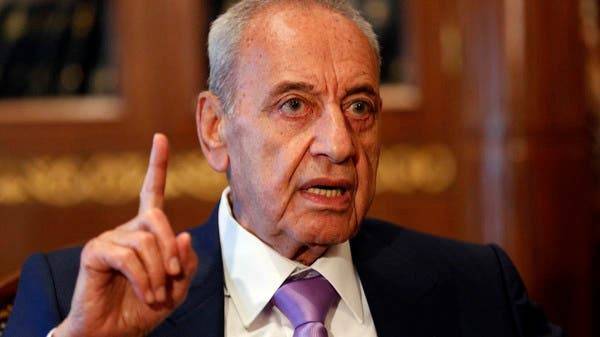
Parliament Speaker Nabih Berri. (Credit: AFP)






During his meeting with the council of the Press Editors Syndicate, chaired by Joseph Kossaifi, Parliament Speaker Nabih Berri made a statement in response to a question.
“This is undoubtedly the most difficult period Lebanon has ever faced. God knows I’ve been through some tough times,” he said.
This implies that the situation is indeed serious, especially since it came from Berri, who has been at the heart of Lebanese politics for over 40 years.

His overall message, however, was to warn the Lebanese people about the threats to their country and to promote unity.
“Give me internal unity and we will no longer fear anyone, neither Israel nor anyone else,” he added.
Berri said he has no enemies in Lebanon, “only adversaries, which is normal in a democratic system.”
While affirming that he does not fear internal discord, he stated that he opposes isolating any Lebanese component whatsoever.
“Lebanese politics is now like the weather: Each region has its own,” he quipped.
But that did not prevent him from paying tribute to the Lebanese people, who showed solidarity when nearly 1.4 million people had to flee their homes during the last war and were welcomed by their fellow citizens.

Commenting on the campaign currently being waged against him, Berri attributed it to the conflict over the electoral law.
“In any case,” he said, "the campaign against me is being waged by only one party. I will not respond to it in any way."
He then pointed out that the conflict over the electoral law is not surprising, given that it is crucial, quasi-constitutional and mentioned four times in the Constitution.
However, he said, the Cabinet formed two committees on the subject, failed to comply with their decisions, and then passed the buck to Parliament.
“But so far,” he added, “I have not yet received the draft [amendment to the electoral law], and I am being asked to resolve this issue before I receive it.”
However, Berri was categorical: The legislative elections will take place on the scheduled date.
He also explained that he had proposed a compromise: his camp would renounce the election of six MPs for the diaspora, in exchange for the other camp renouncing the expats' vote abroad.
But he is convinced that there can be no electoral law without an agreement between all parties.
Asked whether he is really threatened by potential U.S. sanctions, Berri replied that “for 12 years, certain parties have been trying to push the Americans to impose sanctions, and have not succeeded."
But isn't today's campaign aimed at pushing him to distance himself from Hezbollah?
“I am calling for unity, so how could I possibly cause further divisions? It’s beyond imagination!” he replied.
Regarding the situation in the South and the Nov. 27, 2024, cease-fire agreement, Berri emphasized that for more than 11 months, the “resistance” has not launched a single attack against Israel, and the Lebanese Army has deployed nearly 9,000 officers and soldiers in the south of the Litani River.
“It is therefore fulfilling its duty under the eyes of the whole world, the mechanism and UNIFIL,” he said.
“But can anyone tell me where and when the Israelis have complied with the provisions of this agreement? This is their true aggressive nature. But what is understandable is that the Lebanese position is not unified on the issue of Israeli aggression.”
Could Israel start a new war?
He replied that the Israelis “have never stopped their war against Lebanon. But no one can predict their intentions. That is why what is needed is unity within the Lebanese position.”
Asked whether Hezbollah’s statements about the limits of their patience and the reports that the party is rebuilding its forces might be a pretext for Israel, Berri replied that there was nothing unusual about such statements.
In his view, “it is normal for a political group or organization to restructure and reorganize itself from time to time.”
“Hezbollah has the right to rebuild itself after the Israeli aggression. But the rumors that it is procuring weapons by sea, land or air are unfounded lies. How could it do so, when the supply routes are cut off?” he said.
Regarding the negotiation process launched by President Joseph Aoun, he stated that the cease-fire monitoring committee, i.e., the mechanism, already exists.
Three Lebanese officers and three Israeli officers are a part of it, as well as representatives from the United States, France and the U.N.
“Negotiations can therefore take place through this channel, as was the case with the Blue Line and the maritime border demarcation. Civilian experts can even be included if necessary. But we refuse political negotiations,” he said.
In this regard, he pointed to the negotiations taking place with Syria and Syria’s demand for Israeli withdrawal before talks begin. “Why is this not the case with Lebanon?” he asked.
He also referred to the case of the Syrian Democratic Forces (SDF), which has established the right to retain its weapons under state sponsorship. “Why can’t this process be applied in Lebanon?” he also asked.
Regarding Saudi Arabia‘s recent opening to Lebanon, Berri said that Lebanon is the country of all Arabs.
“We extend our hand to all Arabs and we have always done so,” he replied, adding that his relationship with the Saudis has never been broken.
This article was translated from L'Orient-Le Jour by Joelle El Khoury.

 7 p.m. recap: 1 person killed near border with Lebanon; 200 kilos of explosives carried by mules; Riyadh shuts its airspace