





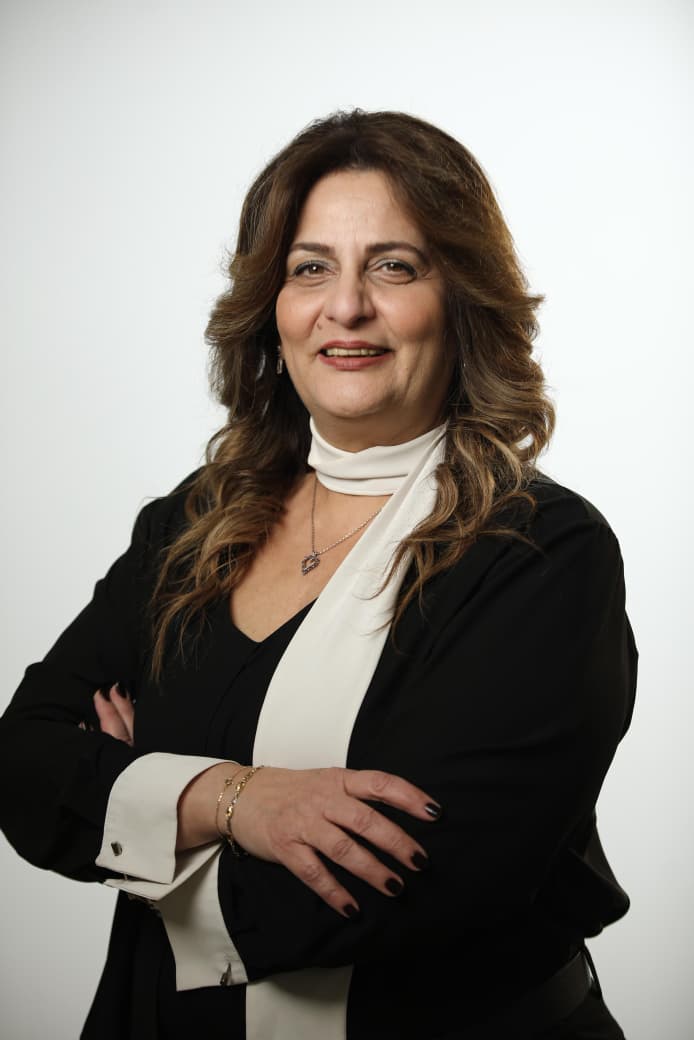
On Oct. 17, Huguette Abou Mrad was elected vice-president of Resuff. (Credit: Person photographed)






Over the past 30 years, female leadership in Lebanon has made significant progress: Huguette Abou Mrad, the new vice president of the Francophone Network of Women Leaders in Higher Education and Research (Resuff), notes that women now occupy leadership roles not only in academia but also within companies and public and private institutions.
"Progress is undeniable," she states. However, she stresses that the road ahead is still long.
She emphasizes that discrimination and stereotypes still significantly impact recruitment, career choices and women’s professional growth.
Obstacles persist, whether it is harassment — sexual or psychological — or prejudices that hinder the recognition of their abilities.
Among persistent stereotypes, the idea that female emotionality is an obstacle remains incessant. Abou Mrad rejects the notion that women are too emotional to succeed in the professional world.
She recalls her mediation training, where it became clear that negotiations led by women often took longer but resulted in more durable, lasting agreements than those led by men. This, she emphasizes, is not about female superiority, but rather "shows that they have something different to bring to the world of leadership."
In Lebanon, the path to female academic leadership remains fraught with obstacles, even as modest progress is being made. The obstacles, she explains, stem as much from persistent stereotypes as from the uneven distribution of daily tasks between men and women.
Highlighting the many constraints women face, she emphasizes that female leadership still lacks support from men. Even determined women "go to great lengths," but often find themselves overtaken.
"If a woman feels she has 80 percent of the required skills, she hesitates to apply, whereas a man with 50 percent doesn’t hesitate for a second," she notes. The result is that self-censorship persists, fueled by social pressure.
Despite these obstacles, the vice president sees signs of hope. At several universities, including Antonine University and Saint Joseph University, "women are being promoted and encouraged to hold higher positions." Some institutions, she says, demonstrate a genuine desire to establish equality, which remains fragile but is genuinely present.
"Yet, often, when you reach the top of the pyramid, the path is blocked and you see only men," she observes. She stresses the importance of raising awareness and training: learning to manage emotional intelligence, combating harassment, creating equality and support units.
Attempts are being made, initiatives are multiplying, and new networks are strengthening these efforts. These, according to her, are key steps to promote change, but "it’s still not enough."
Change, she adds, must originate from both institutions and women themselves: "Maybe they’re not applying enough for governance positions."
The driving role of Resuff
To Abou Mrad, change cannot become reality without a structured framework and collective commitment. This is precisely the role of Resuff. This network acts as a real lever to make gender equality and female leadership tangible, not just an ideal.
"This is not philosophy or theory," she stresses. "It’s practical action."
As the coordinator of the We4Lead (Women’s Empowerment for LEADership and Equity in Higher Education Institutions) program at Antonine University, she explains that Resuff operates through gender-equality cells, which serve as genuine observatories of equality and equity. "Gendered data speaks volumes: It allows us to see whether institutions are on track to achieve equity," she says.
This information then serves as a foundation for awareness campaigns and free training on gender equality and the fight against stereotypes, especially in higher education and university leadership.
According to her, Resuff must remain a living entity and continue to grow: "You always need new blood, new perspectives." For this reason, the network brings together members from five continents, offering a wealth of viewpoints and ideas to advance the cause of women in academia.
Discussing women researchers and teachers in the MENA region, the leader underscores the persistent challenges they face. "A woman can definitely be a researcher, even if she’s a mother," she states, challenging another stubborn stereotype. She explains that the main barriers are availability, frequently restricted by family duties and societal perceptions.
A message to Lebanese policymakers and university leaders
"Slogans are useless, and so are good intentions," Abu Mrad says. "We need concrete action and a real roadmap."
For her, the conviction has to come from both sides: "Women must be convinced — but so must the man facing her." She adds: "It’s not you or me, but you and me. Together, let’s look at the same goal: an equality that benefits both."
She also calls for a solid legislative framework: "We absolutely need laws to ensure good representation of women, because words often disappear, only written commitments remain," she adds.
"The goal is to show there is equality and that women have potential; freeing up speech is where true change begins," she concludes.
This article was translated from L'Orient-Le Jour.

 Evening recap: Netanyahu announces West Bank offensive; 7 killed in Jordan church shooting; tents burned in south Lebanon
 US strike on Iran this weekend? ‘Absolutely,’ says Barrack; ‘I have no idea,’ says Trump