






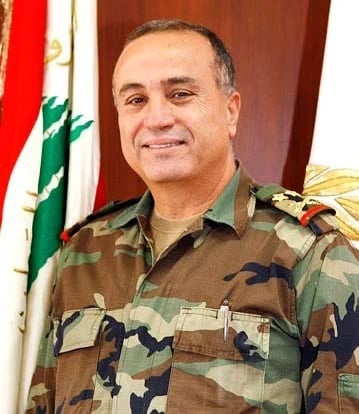
Defense Minister Michel Menassa. (Credit: Lebanese Army)






Defense Minister Michel Menassa stated Tuesday night that "indirect negotiations with Israel could begin via the 'mechanism' responsible for monitoring the cease-fire," at a time when the risk of an Israeli military escalation in Lebanon is becoming increasingly imminent.
"The 'mechanism,' set up to implement and monitor the cessation of hostilities agreement, is preparing to play a negotiating role to pave the way for indirect talks aimed at establishing security and stability on the southern border," Menassa said in an interview with Télé-Liban.
He clarified that "indirect negotiations can begin through this mechanism, given the need to end the war that has affected the Lebanese on economic, military and financial levels."
Asked about the statement by U.S. envoy Tom Barrack, who called on Lebanese President Joseph Aoun to communicate with Israeli Prime Minister Benjamin Netanyahu, the minister said, "That cannot happen."
These negotiations, requested by Washington, are seen as inevitable by Aoun. According to L'Orient-Le Jour, the expansion of the 'mechanism' to include civilians, a suggestion made by U.S. envoy Morgan Ortagus, is supported in principle by the various Lebanese power centers.
The formula Lebanon plans to accept would see the army use "civilian and technical figures" to study certain files. This vague formula may not be enough for Israel, which has instead called for "diplomatic and official figures."
Disarmament south of Litani
Menassa also said the Lebanese Army is continuing the implementation of its plan for the disarmament of Hezbollah "south of the Litani in successive stages," noting that "the move to the second stage will depend on a report from army command at the end of the first stage, with no fixed timetable since the terrain and on-the-ground missions dictate the situation."
He also mentioned "significant difficulties on the ground, particularly in mountainous areas and valleys, where the army is carefully searching for tunnels and weapons caches," stressing that "time is less important than accomplishing the mission and protecting human lives."
Regarding relations with Hezbollah, he specified that there was "communication similar to that with other Lebanese parties, and the military plan primarily aims to restore Lebanese sovereignty over all territory," considering "national cooperation necessary to ensure the success of these efforts."
‘Defending Lebanese sovereignty’
Commenting on Israeli attacks, Menassa declared that "the army is committed to defending Lebanese sovereignty and responding to any incursion," after Aoun called on it to "confront" any Israeli incursion following last Thursday's deadly incursion in Blida.
On international support, the minister announced that Lebanon has received "$230 million in unconditional U.S. aid, as well as €12.5 million in European aid intended for non-military equipment purchases."
He also mentioned contacts with Greece and Kuwait to "provide the army with additional weapons and equipment to fully carry out its southern missions after the withdrawal of UNIFIL," the United Nations Interim Force in Lebanon, scheduled for the end of 2026.
Menassa emphasized "the need for internal unity and support for the military institution." The international community ties its aid to Lebanon to the monopoly of arms by the state.
French President Emmanuel Macron said he is "determined" to organize, by the end of 2025, a support conference for the Lebanese Army and another focused on Lebanon's reconstruction.
‘Positive development between Lebanon and Syria’
On the regional front, the defense minister also stated that "Lebanon-Syria relations are experiencing positive developments on security and political levels," recalling "the signing of a security cooperation agreement with his Syrian counterpart at a meeting held in Saudi Arabia, aimed at calming the situation on the eastern border and controlling smuggling operations."
He noted that "cooperation between the two countries extends to other areas, including a judicial agreement in progress for the extradition of wanted persons," adding that "the political will is present on both sides to reach border demarcation, despite Syria's delays on technical matters."
On the fight against drug and captagon pill trafficking, he specified "security coordination between the Lebanese and Syrian armies has significantly reduced smuggling operations," even as the border between the two countries remains porous.
Addressing arms in Palestinian camps, Menassa said that "heavy and medium weapons have been removed from five camps, and operations continue in the remaining camps," in accordance with the government's decision to disarm armed factions in the country.
Returning to the murder of young Lebanese Elio Abou Hanna, who was shot dead by an armed Palestinian patrol in the Shatila camp, he confirmed that "the investigation is ongoing and its results will be announced as soon as it is completed."
Asked about the reinstatement of compulsory military service, Menassa stated that "the Defense Ministry is studying its reactivation in a new form that would encourage young people to join the army, with a revised methodology adapting it to current circumstances."