


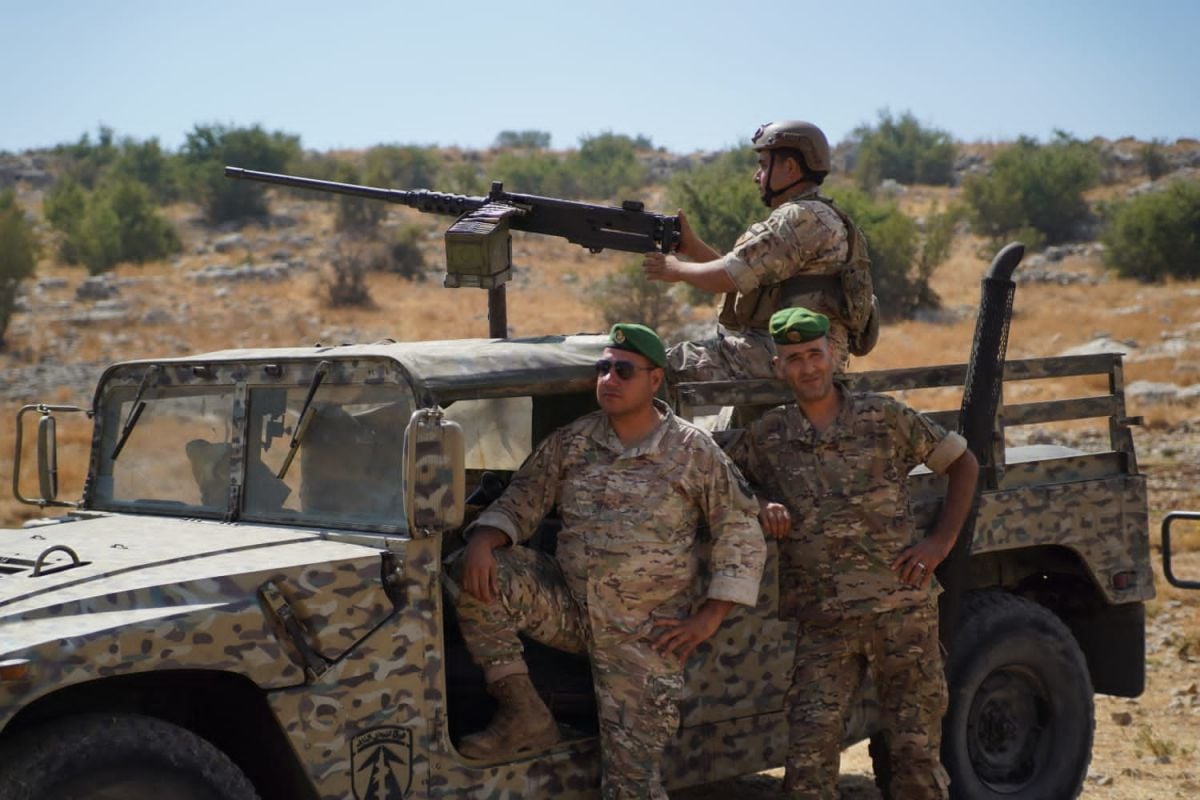
Lebanese soldiers pose in front of their vehicle in Kfar Shuba, south Lebanon, on Aug. 26, 2023. (Credit: Mohammad Yassine/L'Orient-Le Jour)






The Lebanese Army reportedly detonated so many Hezbollah arms depots that it has now run out of explosives, Reuters reported Tuesday, citing military sources.
According to those sources, the army’s stockpile of explosives has been depleted since June. While waiting for American deliveries of new explosive charges and other equipment — which could take several months — soldiers are now sealing discovered sites rather than destroying them, the same sources said.
The Pentagon approved $14.2 million in explosive charges and demining equipment on Sept. 10 to help the army “reduce Hezbollah’s capabilities.” That sum is in addition to a $190 million aid package approved by the U.S. administration at the start of October.
International pressure is mounting on Lebanese authorities to restore the state’s monopoly on arms one year after the cease-fire with Israel. In September, the government endorsed a plan drawn up by the army to disarm militias, primarily Hezbollah.
U.N. Resolution 1701, which provides the framework for the cease-fire between Israel and Hezbollah, calls for a complete Israeli withdrawal from Lebanese territory in parallel with the disarmament of militias, starting with the area south of the Litani.
Nine arms depots found in September
In September, searches led to the discovery of nine new arms depots, two officials said. Dozens of tunnels used by Hezbollah were also sealed, while new soldiers are gradually being recruited for deployment in the South.
Ten people interviewed — including Lebanese officials, security sources, diplomats and a Hezbollah official — said the army hopes to complete its operations in the region by the end of the year.
Despite these gains, the army’s main goal is “to avoid any outbreak of violence” and “to buy time for political leaders to agree on the fate of the group’s arsenal in other regions,” said a second Lebanese official close to Hezbollah and two security sources.
The army remains concerned that “a clash with the party’s grassroots could reopen internal rifts,” such as those that divided the military during the 1975–90 Civil War.
The army’s plan, presented to the government, includes five stages for restoring exclusive state control over weapons. It begins with continued operations by the military in the area south of the Litani, then extends to the region between the Litani and Awali rivers, followed by Beirut and its suburbs, then the Bekaa Valley and finally the rest of Lebanon.
Lacking its own intelligence on the locations of Hezbollah’s caches, the army relies on information passed by Israel to the U.S.-chaired cease-fire monitoring committee, which also includes France, Lebanon and the U.N. Interim Force in Lebanon (UNIFIL).
By the end of May, the army was receiving so many tips that it “could no longer keep up with the pace of inspections,” according to the same sources. When soldiers found a depot, they kept any munitions compatible with their own weapons and destroyed rockets, launchers and other materiel, the sources said.
Even amid the cease-fire, the Israeli army still occupies six positions in southern Lebanon and carries out near-daily strikes reaching as far as the Bekaa Valley. Several Lebanese officials said these violations could delay the army’s activities.

 1 p.m. recap: Salam in Nabatieh; up to 10,000 more US troops heading to Middle East