





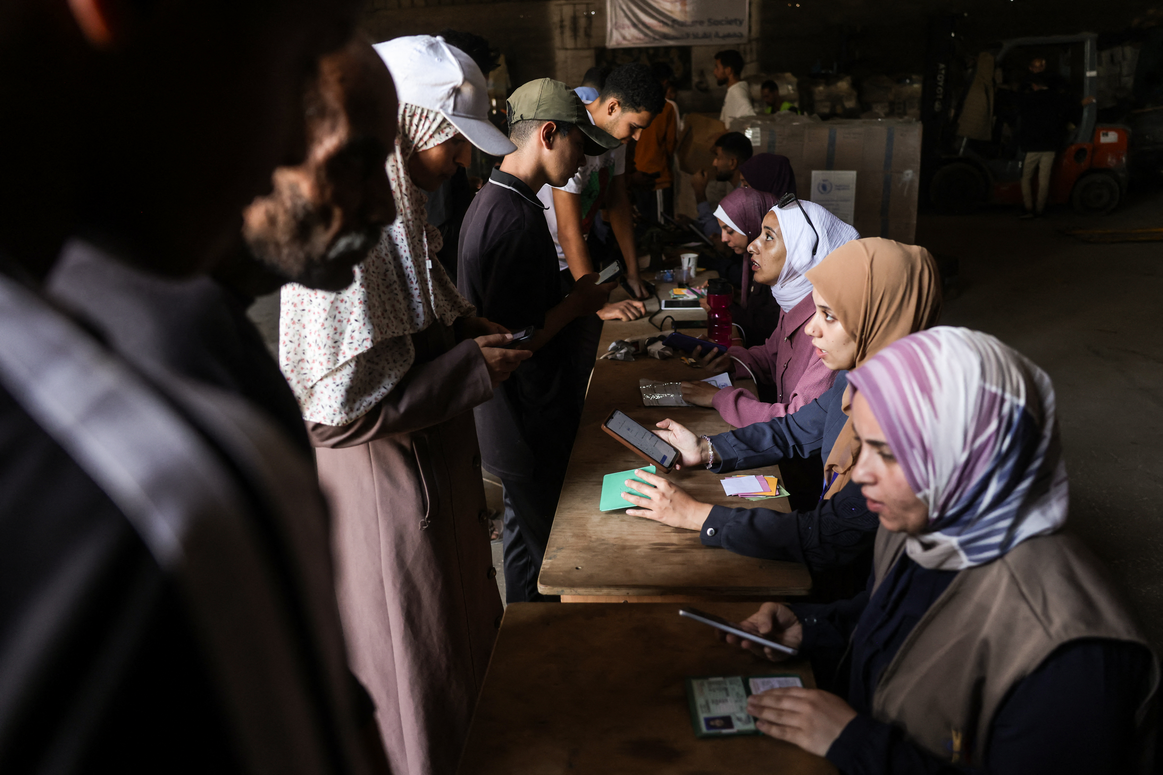
Palestinian citizens of the Gaza Strip have their IDs checked as they arrive at a distribution center to collect a food ration box provided by the World Food Program (WFP), in the village of al-Zawayda, in the center of the Gaza Strip on Oct. 27, 2025. (Credit: Bashar Taleb/AFP)






JERUSALEM — The families of Israeli hostages on Monday demanded that the next steps in the U.S.-brokered Gaza cease-fire be put on hold until Hamas returns the remaining bodies of dead captives.
"Hamas knows exactly where every one of the deceased hostages is held. Two weeks have passed since the deadline set in the agreement for the return of all 48 hostages, yet 13 remain in Hamas captivity," the Hostages and Missing Families Forum said.
Both Hamas and several senior U.S. officials have made it clear that there are significant technical challenges involved in retrieving the bodies of deceased hostages, due to the extent of destruction across the Strip resulting from two years of Israeli bombardment.
"There are challenges in locating the bodies of Israeli captives because the occupation has altered the terrain of Gaza," Lead Hamas negotiator Khalil al-Hayya said in a statement to media on Saturday.
"Moreover, some of those who buried the bodies have been martyred or no longer remember where they buried them."
Egypt sent recovery crews and heavy earth-moving equipment into Gaza over the weekend, with Israeli approval, to help with the recovery operation.
"The families urge the Government of Israel, the United States administration and the mediators not to advance to the next phase of the agreement until Hamas fulfills all of its obligations and returns every hostage to Israel," the hostages' families said.
On Oct. 10, a cease-fire between Israel and Hamas took effect, ending the Gaza war, which was triggered when Hamas attacked southern Israel, taking 251 people hostage.
The attack resulted in 1,221 deaths, while Israel's subsequent assault on Gaza killed at least 68,527 people, according to figures from the territory's health ministry.
Under the terms of the cease-fire deal, brokered by the United States and mediators Qatar and Egypt, Hamas has released its remaining 20 living hostages and the remains of 15 of the 28 which Israel had already confirmed dead.
Hamas says it is committed to the cease-fire and insists it is trying to return 13 more bodies — 11 more Israelis and two workers from Thailand and Tanzania — but that the search has been hampered by the destruction wrought on Gaza by Israel during the war.
No firm timescale has been put on the next stages of the plan, but U.S. President Donald Trump's administration is working to set up an international security force with troops from Arab and Muslim nations to police the truce.
The U.S. military has also sent up a coordination center in southern Israel to monitor the cease-fire and to coordinate aid and reconstruction, but aid agencies are pushing for greater access for humanitarian convoys inside Gaza.
Israel has withdrawn its forces from Gaza's main cities but still controls around half of the territory from positions on a so-called "Yellow Line," and it continues to refuse to allow aid through the Rafah border crossing with Egypt.
JERUSALEM — The families of Israeli hostages on Monday demanded that the next steps in the U.S.-brokered Gaza cease-fire be put on hold until Hamas returns the remaining bodies of dead captives.
"Hamas knows exactly where every one of the deceased hostages is held. Two weeks have passed since the deadline set in the agreement for the return of all 48 hostages, yet 13 remain in Hamas captivity," the Hostages and Missing Families Forum said.Both Hamas and several senior U.S. officials have made it clear that there are significant technical challenges involved in retrieving the bodies of deceased hostages, due to the extent of destruction across the Strip resulting from two years of Israeli bombardment."There are challenges in locating the bodies of Israeli captives because the occupation has altered the terrain...

 7 p.m. recap: Iran warns Egypt, Israeli soldiers vote in south Lebanon, Haret Hreik responds to Kataeb