


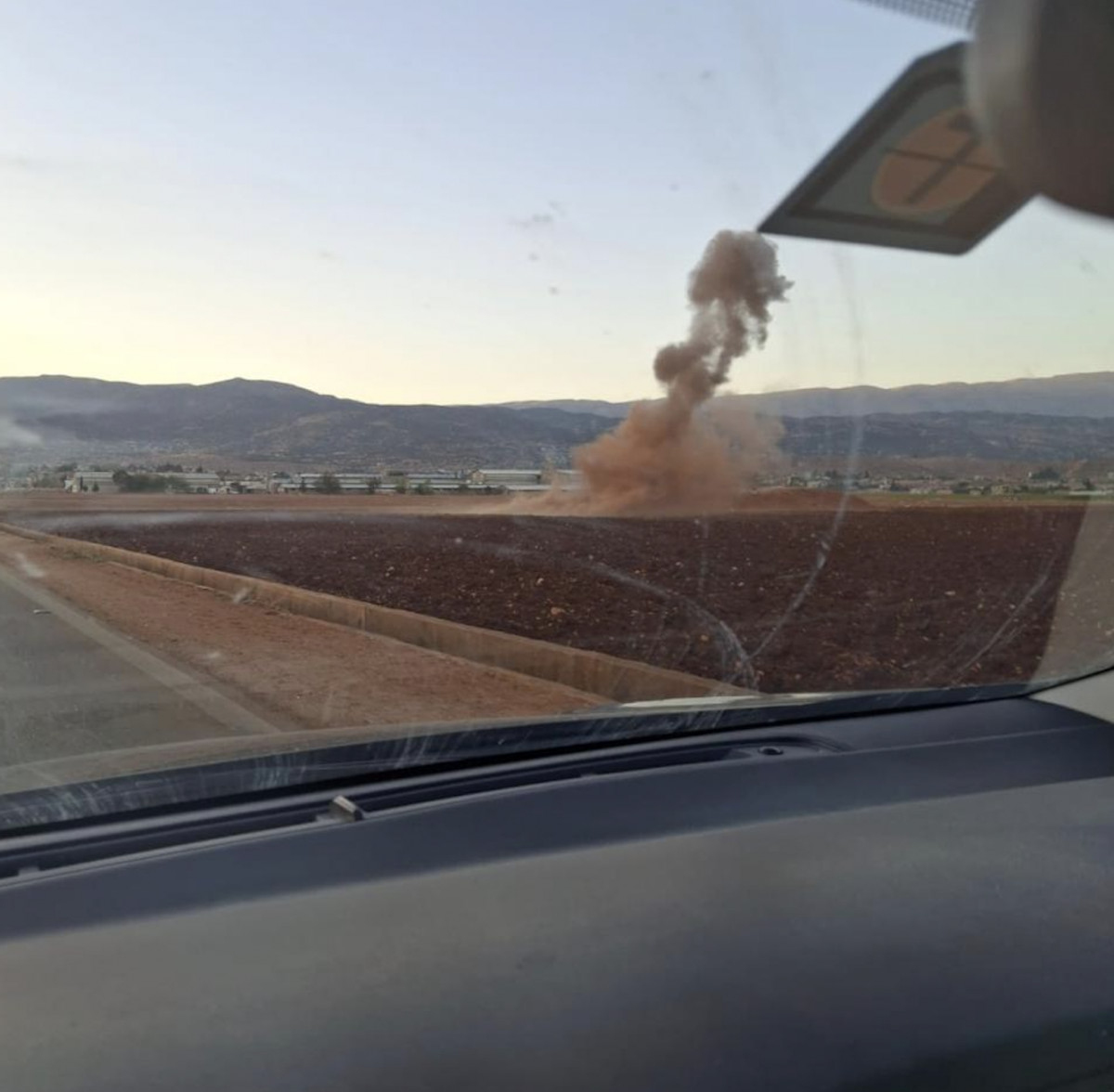
Smoke rises following Israeli strikes on a car on the al-Aswad road in Bouday, in the Bekaa. (Credit: Sarah Abdallah)






Israeli military pressure on Lebanon has continued to grow since the end of the week.
On Sunday, the Israeli army carried out targeted strikes on three vehicles — two in the Bekaa valley and one in southern Lebanon — killing two Hezbollah officials.
It also carried out an attack on a locality west of Baalbeck, killing at least one person of Syrian nationality.
This brings the number of people killed by Israel in Lebanon since Thursday to 12.
In the early afternoon, an Israeli drone fired two missiles at a car at the northern entrance to the border town of Naqoura (Sour district), near the fishermen's port, killing the driver.
He was identified as Abdel Sayyed, a Hezbollah official and owner of a gas station near the headquarters of the United Nations Interim Force in Lebanon (UNIFIL), on Naqoura's main road, according to our correspondent in the South.
Notably, a spokesperson for the U.N. force confirmed to L'Orient-Le Jour that an Israeli drone that crashed in Kfar Kila (Marjayoun district) was shot down by U.N. peacekeepers while they were patrolling the area.
The force said the act was "a counter-measure" against the drone, which was "acting aggressively" toward the peacekeepers.
According to information from our correspondent in the region, the battalion involved in this incident is reportedly French.
UNIFIL declined to confirm this.
A statement detailing the incident will be issued by the force's command soon.
It is a particularly rare move by U.N. peacekeepers.
On Oct. 17, 2024, during the open war between Hezbollah and Israel, a German navy vessel participating in UNIFIL neutralized a drone off the Lebanese coast.
Later in the day, another Israeli drone strike hit a car in the locality of Nabi Sheet (Baalbeck district), near the office of General Security in the locality, killing the driver.
He was also a Hezbollah official, belonging to the Moussawi family, our correspondent in the region reported.
Commenting on these two deadly strikes carried out "within an hour," the Israeli army claimed credit for first killing the "local Hezbollah representative in Bayada," a locality near Naqoura, and then "an arms trafficker and smuggler" of the party in the Bekaa, in a message posted on X by Arabic-language spokesperson Avichay Adraee in the evening.
The first was "in charge of relations between the party and local residents in economic and military spheres, and reportedly participated in attempts to rebuild Hezbollah's military capabilities in the village" of Bayada. The second was "an arms trafficker and smuggler," said to have been involved in "purchasing, transporting and smuggling weapons and military equipment from Syria to Lebanon, playing a key role in the reconstruction and arming of Hezbollah," according to the Israeli army.
In the late afternoon, three consecutive Israeli drone strikes hit a car on the al-Asswad road in Bouday, a village in the Bekaa about 15 kilometers west of Baalbeck, without causing casualties, our correspondent reports.
Early in the evening, another drone strike in the Bekaa, this time on the town of al-Hafir, west of Baalbeck, killed two people and wounded one, our correspondent reports.
One of the deceased, named Ahmad Taha, was reportedly a Syrian national.
The Israeli army has not yet commented on this strike.
Netanyahu does not need green light to 'strike enemies'
This string of deadly bombings has continued since Thursday, and Israeli Prime Minister Benjamin Netanyahu, under U.S. pressure to honor the cease-fire in Gaza, made it clear he intends to continue striking his “enemies,” in Lebanon as well as Gaza, “at his discretion.”
On Sunday, he said he does not need any green light to strike “Israel’s enemies,” since Israel is an “independent state.”
“Our security policy is in our own hands,” he said during a cabinet meeting, adding, “We respond at our discretion to attacks, as we have seen in Lebanon and very recently in Gaza.”
This statement was made as, on the same day, one of the U.S. administration’s envoys to Lebanon, Morgan Ortagus, visited an observation post of the Israeli army’s Northern Command near the Lebanese border, according to several Israeli media outlets.
She was accompanied by several other American and Israeli officials, including Israeli Defense Minister Israel Katz.
In addition, a person was moderately injured in the border locality of Aitaroun (Bint Jbeil district) on Sunday, following the explosion of a suspicious device left over from the war. The blast was triggered by a fire lit by local villagers.
The Israeli army also continued to attack work machinery. Overnight Saturday to Sunday, around 3:40 a.m., an Israeli drone dropped a bomb on a backhoe belonging to the South Council, used to clear rubble in the border locality of Blida (Marjayoun district). The strike caused significant material damage, but no casualties, our correspondent reported.
Radwan force fighter killed Saturday
Saturday was also marked by several deadly strikes, the last of which killed in Qleileh, according to the Israeli army, a “fighter of the Radwan force,” Hezbollah’s elite unit, according to a post on X by its Arabic-language spokesperson, Avichay Adraee.
The victim, killed while riding a motorcycle, was identified as Mohammad Akram Arabiya, a name also mentioned in a tribute statement from Hezbollah.
Lebanon's Health Ministry confirmed his death Saturday evening.
The Israeli army accused him of “encouraging attempts to rebuild Hezbollah’s combat capabilities and contributing to efforts to rebuild its infrastructure,” the message continues.
Another man, also a Hezbollah member according to the party, was killed in a separate targeted strike early Saturday afternoon in the Jibsheet region.
 7 p.m. recap: Houthis threaten Riyadh, Netanyahu talks of prolonged war against Hezbollah'; Israel arrests 2 men in Syria