






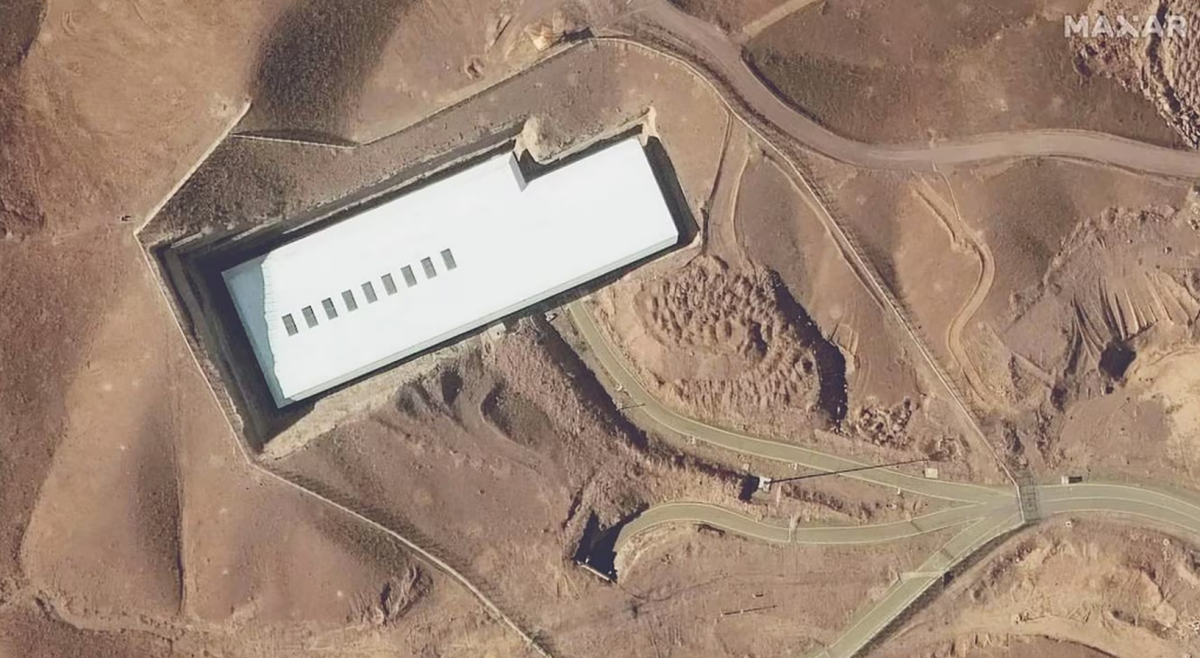
A satellite photo taken by Maxar Technologies on Feb. 12, 2025, showing the Fordo uranium enrichment facility in Iran. (Satellite Image 2021 Maxar Tech/AFP)






The site in question is located south of Natanz, one of Iran's main nuclear centers, which Israel and the United States hit last June. According to satellite imagery analyzed notably by the Washington Post, since then Tehran has expanded construction of an underground military facility at Kuh-e Kolang Gaz La, or Pickaxe Mountain, in the Zagros mountains.
Plans for the site, unveiled by the Islamic Republic in 2020, included a production plant to assemble centrifuges and high-speed machines for uranium enrichment, to replace a site destroyed earlier that year by an act of sabotage, according to Tehran. In July of the same year, suspicious explosions and fires hit the advanced centrifuges facility at Natanz.
A site with no clear purpose
Recent activity detected since the Israel-Iran war, which reportedly has not affected the site, points to possible fortifications against future attacks or infiltration. A security wall over one kilometer long has been built around the western part of the site's perimeter, alongside a road, while the entrance to a tunnel on the east has been reinforced.
The accumulation of debris also suggests ongoing underground work, as heavy equipment and construction vehicles have been seen in the satellite images. The site's purpose remains uncertain, and inspectors from the International Atomic Energy Agency (IAEA) have not had access to the site. Its director, Rafael Grossi, recently stated that Tehran had brushed aside his questions about the site earlier this year, the Washington Post notes.

Right from the start of construction, estimated at December 2020, the site's size and depth raised suspicions among experts, hinting at clandestine use as either a uranium enrichment plant or storage of highly enriched uranium. Analysts following construction under Kuh-e Kolang Gaz La estimate that the facility may be even deeper than Fordo, considered Iran's most deeply buried nuclear facility, located about a hundred meters underground.
Since the June war, the fate of 400 kilograms of uranium enriched to 60 percent remains unknown, although Iranian President Massoud Pezeshkian stated last week that the material, buried under rubble, was still inaccessible. This information cannot be independently verified, especially as the signing of a preliminary agreement on September 9 between the IAEA and Tehran for resuming international inspections has not come to fruition, notably because of a European-led process to reinstate international sanctions on Iran.
preparation for a new confrontation?
Although the activation of the "snapback," effective since September 28, does not entirely shut the door to negotiations, Israel and the United States have warned that they will use force again if the Islamic Republic tries to reconstitute its nuclear program. Facing the risk of new strikes, Iran is reportedly starting to rebuild missile production sites targeted by Israel during the war, according to an Associated Press report that notes a key element needed for such manufacturing — planetary mixers used to produce solid fuel — was destroyed by Israel. Inside Iran, a debate rages between hardliners, who call for a change in doctrine concerning nuclear policy, even as a fatwa by Ali Khamenei bans the development of an atomic bomb, and those who remain open to talks with Western powers to avoid another military confrontation.
Surface and underground construction at Kuh-e Kolang Gaz La does not mean Tehran is rushing to rebuild its nuclear program or embarking on a frantic race for the bomb, the analysts quoted in the Washington Post currently judge. Commercial satellite images from the Natanz, Fordo and Isfahan sites, targeted by the U.S. military on June 22, also show only limited activity around these nuclear facilities.
A report from the Institute for Science and International Security earlier this month, partly based on IAEA data, concluded that the Israeli-U.S. attacks had destroyed or rendered inoperable nearly all 22,000 centrifuges at the three sites, according to the American daily.
