


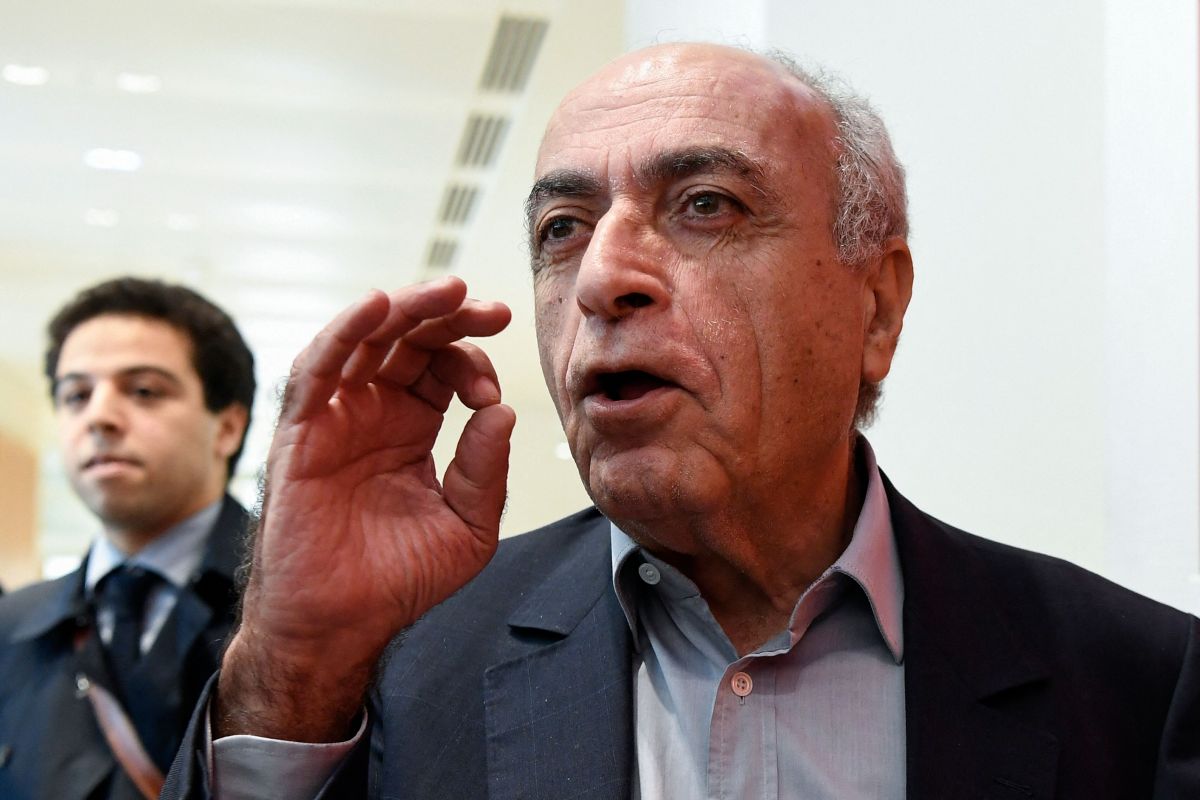
The Franco-Lebanese businessman Ziad Takieddine, on October 7, 2019, at the Paris courthouse. Bertrand Guay/AFP






On Thursday, former French President Nicolas Sarkozy was convicted of criminal conspiracy in the so-called Libyan financing case linked to his 2007 presidential campaign. He was fined €100,000 and sentenced to five years in prison, with a deferred committal order and provisional execution. This means that, within weeks — and despite his appeal — Sarkozy will likely be taken into custody, marking a first for a former French president.
At the center of the case was the controversial Franco-Lebanese businessman Ziad Takieddine, who died two days before the verdict. The court cited a "body of serious, precise and consistent evidence," including elements tied to Lebanon. Takieddine was identified as the key intermediary in the "corruption pact" between Sarkozy's team and Libya’s former dictatorship.
The National Financial Prosecutor's Office (PNF) had sought a six-year prison sentence and a €3 million fine for Takieddine. His death two days before the trial spared him from sentencing. He died in North Lebanon after being hospitalized while serving a prison sentence in Tripoli over a financial dispute with his lawyer, according to his family. Takieddine had taken refuge in Lebanon shortly before his 2020 conviction in another case, known as "Karachi," as the country does not extradite nationals to foreign jurisdictions.
Takieddine's pivotal role
The Libyan financing case began in 2011, following reporting by French outlet Mediapart. Investigators alleged that Sarkozy and his closest associates entered a "corruption pact" with Muammar Gaddafi’s regime, aiming to fund Sarkozy’s 2007 campaign in exchange for diplomatic, legal and economic concessions for Libya.
According to the court, the criminal conspiracy saw Takieddine appointed by Sarkozy’s team to act as the intermediary with the Libyan regime: arranging meetings, negotiating returns and transferring funds. The court concluded Sarkozy could not have been unaware of these activities.
To support its ruling, the court announced that it did not rely on Takieddine’s inconsistent statements — at times claiming he delivered €5 million in cash to Sarkozy, and at other times saying that the former French president did "not receive a cent." The court later interpreted these contradictions as likely witness tampering, which led to the indictment of several individuals, including Sarkozy and his wife, Carla Bruni-Sarkozy, in October 2023 and July 2024.
Instead, the court emphasized Takieddine’s records and notes, corroborated by other evidence. Excerpts of the judgment published by Le Monde showed that meetings took place in Tripoli, Libya, in 2005 and 2006, attended by Sarkozy aides Claude Guéant and Brice Hortefeux, Takieddine, and Libya’s second-in-command Abdallah Senoussi, Gaddafi’s brother-in-law. Senoussi reportedly sought to overturn his life sentence for the 1989 UTA DC-10 bombing, which killed 170 people, including 54 French nationals, according to AFP. The verdict described these meetings as "aimed at setting up corruption at the highest possible level."
Libyan funds in Lebanon
Financial traces of the "corruption pact" were mostly found in Lebanon, in an account held by Takieddine, totaling €6 million, according to an anti-corruption investigation. Between 2005 and 2006, three Libyan wire transfers were made to Takieddine’s Rossfield company account, shortly after Guéant and Hortefeux’s trips to Tripoli, Libya. Of these funds, €2 million came directly from Senoussi.
The court determined that part of the money covered Takieddine’s personal expenses, while the account also functioned as a "clandestine clearing house," with unusual withdrawals coinciding with Sarkozy’s presidential campaign, according to Mediapart. For instance, €440,000 was transferred in 2006 to a Bahamas account for Sarkozy associate Thierry Gaubert, coinciding with an "NS Campaign" entry in Gaubert’s agenda on Jan. 23, 2006 — the day before the funds arrived. Simultaneously, at least €1.2 million was withdrawn from a Swiss account by Takieddine before the election, "unrelated to his lifestyle," according to the judges.
However, despite strong evidence of cash circulation, the court found no definitive proof that these funds directly financed Sarkozy’s campaign. The former president was acquitted of four other charges, including "passive corruption," "illegal campaign financing," and "receiving misappropriated Libyan public funds."
Despite his central role in the corruption pact, Takieddine’s reputation in his native village of Baakline in the Lebanese mountains remained intact. He was buried on Thursday, the same day Sarkozy’s sentence was announced. Residents of the Druze village paid tribute to a "generous" benefactor devoted to his region.
This article was originally published in French in L'Orient-Le Jour.

 7 p.m. recap: 1 person killed near border with Lebanon; 200 kilos of explosives carried by mules; Riyadh shuts its airspace