





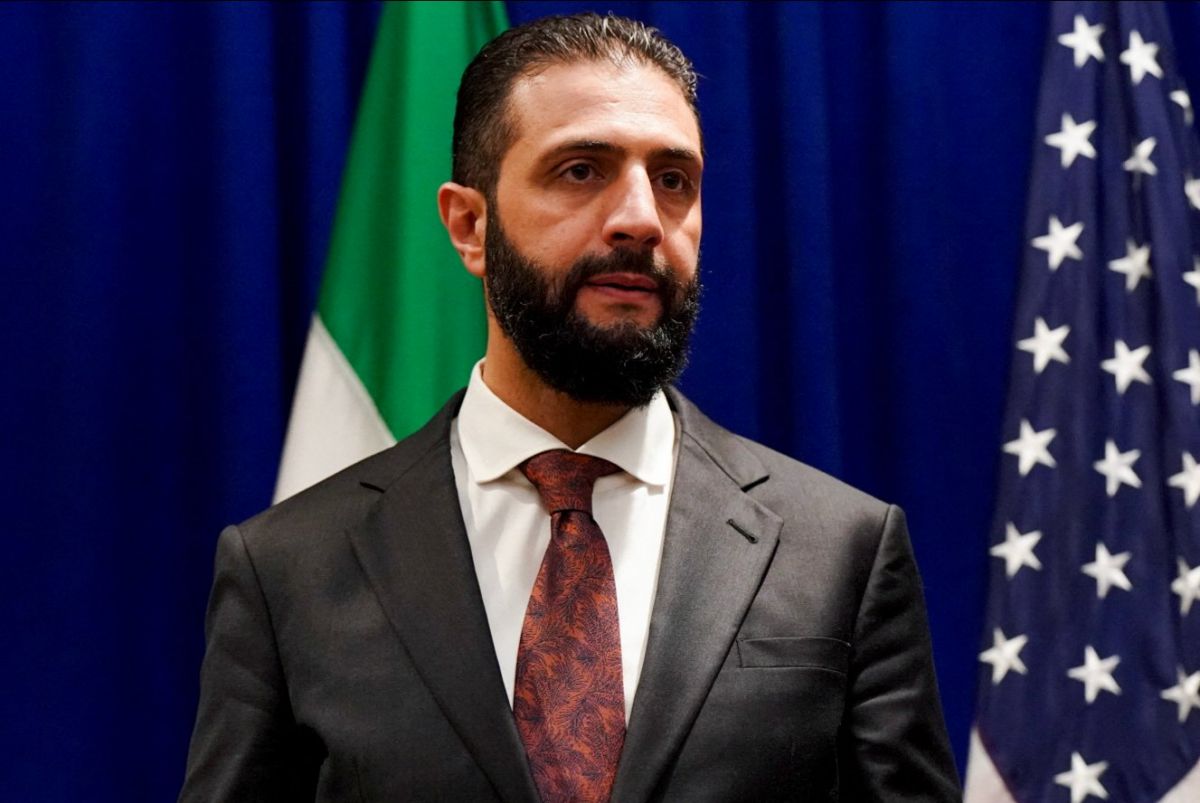
Interim Syrian President Ahmad al-Sharaa arrives for a meeting with U.S. Secretary of State Marco Rubio at the Lotte New York Palace Hotel on the sidelines of the United Nations General Assembly meeting, Sept. 22, 2025. (Credit: Bing Guan/AFP)






The interim Syrian president on Wednesday called from the podium of the United Nations for an end to Israeli strikes on his country, warning that they threaten to spark “new crises and struggles in our region.”
Syria has been the target of repeated Israeli attacks and incursions since the fall of Bashar al-Assad's regime on Dec. 8, 2024.
He had already warned on Tuesday evening of further turmoil in the Middle East if Israel and the transitional government he represents could not reach a security agreement. “We are not the ones creating problems for Israel. We are afraid of Israel, not the other way around,” said Sharaa at an event organized in New York by the American think tank, the Middle East Institute.
“There are multiple risks associated with Israel delaying negotiations and continuing to violate our airspace and enter our territory,” he said. He rejected any discussion regarding the partition of his country, as Israel continues its incursions and claims to be defending the interests of the Druze minority. “Jordan is under pressure, any discussion of partitioning Syria will harm Iraq, will harm Turkey,” he said. “This will bring us all back to square one,” he added, noting that Syria had only just emerged from a decade and a half of war.
"Necessary" agreement but insufficient progress “Israeli policies contradict the international position of support for Syria,” added Sharaa. “To address this, Syria remains committed to dialogue (...), and we call on the international community to stand by us in the face of these aggressions,” continued the interim president, the first Syrian leader to speak at the U.N. podium since 1967.
The Syrian president had earlier emphasized that the security agreement was “necessary,” adding that it needed to be concluded, among other reasons, so that Israel “respects the airspace and territory of Syria,” according to Israeli media reports.
American envoy Tom Barrack, for his part, said Tuesday that a "de-escalation" agreement was close, according to which Israel would be required to halt its attacks on the country while Syria would agree not to move machinery or heavy equipment near the Israeli border.
Speaking to reporters on the sidelines of the U.N. General Assembly meetings in New York, Barrack said this agreement would be “a first step toward a security arrangement that the two countries are currently negotiating.”
U.S. President Donald Trump has sought “to obtain an agreement between the two parties that was supposed to be announced this week, but the progress made so far is considered insufficient, and the Rosh Hashanah holiday, the Jewish New Year celebrated this week, has slowed the process,” the envoy explained, according to statements relayed by Haaretz.
Syria and Israel technically remain at war, but have opened direct negotiations to reach a deal that Damascus hopes will end Israeli airstrikes and prompt the withdrawal of Israeli troops that entered southern Syria. Since the Assad regime’s fall last December, representatives of both countries have met multiple times.
On Monday, Sharaa ruled out any immediate recognition of Israel. Hoping to reassure the American administration, from which he seeks the complete and permanent lifting of sanctions, the Syrian president promised in New York to “fight sectarianism” and “prosecute all those involved in the bloodshed.”
“We have set up commissions to establish the facts and granted access to United Nations investigative missions,” he said regarding the interfaith massacres in recent months.

 Evening recap: Netanyahu announces West Bank offensive; 7 killed in Jordan church shooting; tents burned in south Lebanon
 US strike on Iran this weekend? ‘Absolutely,’ says Barrack; ‘I have no idea,’ says Trump