






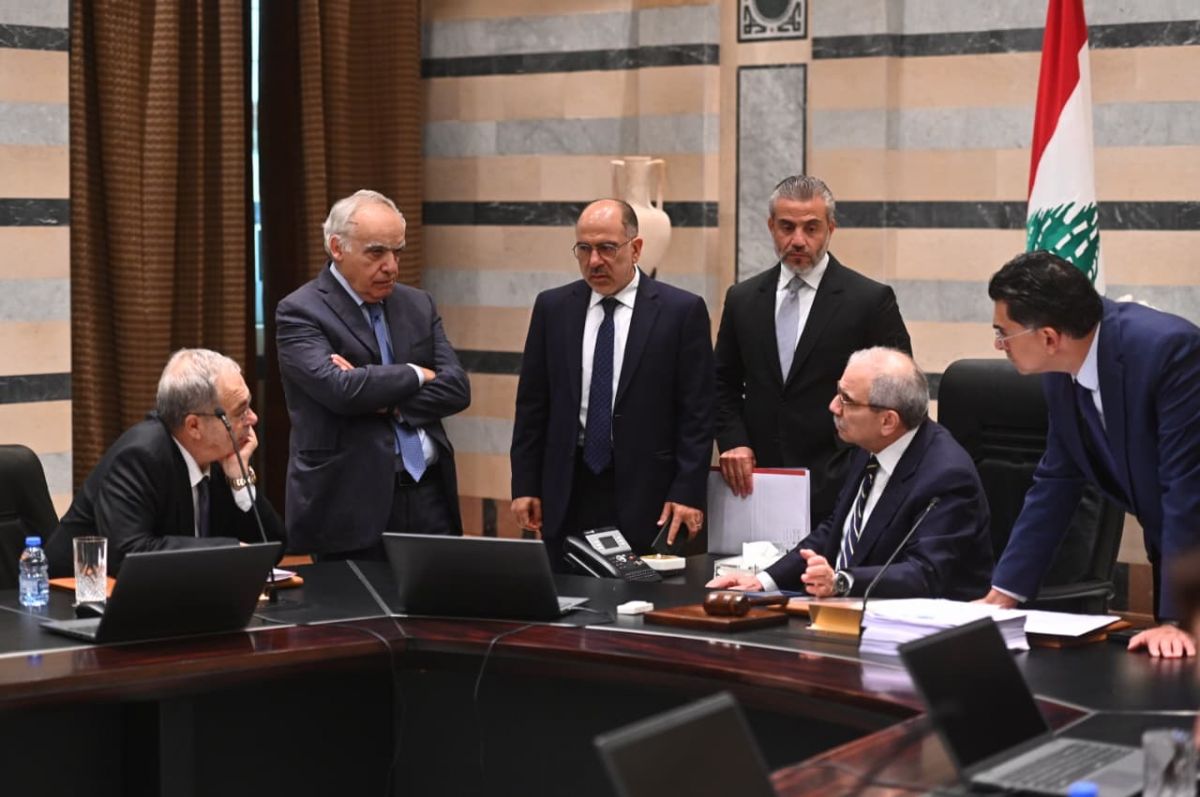
Several ministers surround Prime Minister Nawaf Salam during a meeting at the Grand Serail on Sept. 22. (Credit: Mohammad Yassin/ L'Orient-Le Jour)






Cabinet on Monday approved the 2026 budget bill during a session at the Grand Serail, presenting it as a text focused on strengthening tax collection and combating evasion, in the context of a persistent economic crisis.
"The 2026 budget is not intended to increase taxes or create new ones," said Information Minister Paul Morcos after the meeting.
"Its aim is to fund public spending, by reinforcing tax obligations, tracking down taxpayers not registered with the tax administration, prosecuting those who do not declare or pay their taxes within the legal deadlines and by providing revenue reports in the 2026 budget bill with accurate estimates to avoid a real deficit when implementing this budget."
However, Morcos clarified that "it was not possible to include a salary adjustment for all public sector employees and retirees in the 2026 budget." He added that "the government is determined to take steps to ensure fairness for public sector employees."
Taxes
For his part, Industry Minister Joe Issa-al-Khoury stated after the session that "the budget was adopted without the imposition of new taxes or fees."
"A provision will be included in the budget bill regarding the issue of retired military personnel, in order to address their demands," he added.
A delegation of retired military personnel, led by former General Chamel Roukoz, met with Salam on Monday morning on the sidelines of a protest organized by former soldiers denouncing the deterioration of their living conditions after six years of economic crisis and demanding financial aid from the government. The delegation was able to secure several concessions from the authorities and a promise to improve their retirement pensions.
Before the meeting, Minister of Administrative Development Fadi Makki indicated that the state's revenues "would come from taxes."
However, according to news agency Al Markazia, relaying remarks by Finance Minister Yassin Jaber, "there would be no additional taxes to guarantee budget revenues." The Cabinet is instead counting on the fight against tax fraud, customs smuggling, the creation of shell companies and enhancing collection.
Last Friday, Morcos noted that this issue dominated the discussions, with the goal of ensuring balance between revenues and expenditures and avoiding any deficit.
Yet according to Al Markazia, the budget bill indeed includes increases, notably in VAT and in transaction and administrative formalities. The agency, however, does not specify whether these are new taxes listed in the budget by the Cabinet, or an increase in existing rates and taxes that may also have been proposed.
Article 31
Morcos indicated that among the articles reviewed for verification and amendment was Article 31 of the budget, "which was subject to certain interpretations and ambiguities."
This article, along with Articles 29 and 30, allows public entities selling goods and services (Ogero or Electricité du Liban), customs, as well as certain taxpayers, to collect on behalf of the Treasury an amount equivalent to 3 percent of the transaction (sale of service or customs clearance). Employer organizations believe that companies already paying their taxes will be penalized by this measure.
This argument is frequently raised by the private sector, which contends that the state does not do enough to address informal businesses in a business environment characterized by political clientelism.
The wording of this article has therefore been changed: "The Customs Directorate will collect 3% of the value of each import operation carried out by a taxpayer who has not fulfilled their income tax and VAT declaration obligations during the three years preceding the year of import."
"This provision is intended to strengthen the tax obligation and combat shell companies that import on behalf of third parties and then disappear," Morcos explained. "It only affects taxpayers who have not fully complied with their tax obligations within the legal deadlines."
The government had hoped to complete the review of the text last week. "We are waiting for the arrival of an International Monetary Fund [IMF] delegation next Monday, which is why we are trying to finalize the budget bill," said Jaber.
The IMF announced that a team of experts would visit Beirut at the end of September to continue discussions around a "comprehensive reform program" aimed at reviving the ailing economy.
Engulfed in an unprecedented crisis since 2019, Lebanon renewed its request for access to an IMF assistance program last February. This move revived a process begun in 2020 but never completed, largely because parts of the political and banking classes resisted any solution that would saddle the state — and thus the taxpayer — with the bulk, or all, of the accumulated financial losses. The dynamic appears to have shifted since the arrival of Aoun and Salam in power, though nothing has yet been finalized.
The 2026 budget bill is an adjustment budget that takes into account the country's limited leeway amid ongoing financial and security crises, postponing major reform efforts. The Cabinet must send it to Parliament at least 15 days before the start of the ordinary fall session if it wants to be able to promulgate it by decree after Jan. 31 of the year of execution, should Parliament not have adopted it by then.

