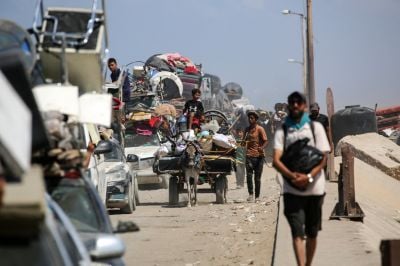
Palestinians from Gaza City move south with their belongings along the coastal road near the Nuseirat refugee camp in central Gaza Strip, Sep. 19, 2025. (Credit: Eyad Baba / AFP)






The director of Al-Shifa Hospital in Gaza City, Mohammed Abou Salmiya, was on duty in the emergency department on Saturday when the bodies of his brother and sister-in-law, killed in an Israeli strike, were brought in. “I am shocked and devastated to see the bodies of my brother and his wife,” the doctor said. “Anything is possible now, as you receive your loved ones killed or injured. The crimes of the occupation [Israel] continue, and the number of martyrs keeps rising.”
Al-Shifa Hospital, the largest in the Gaza Strip and one of the few still operational in the territory, has been receiving the dead and injured daily since the start of the war triggered by the Hamas attack on Israel on Oct. 7, 2023.
The influx of victims has increased further since the start of an Israeli offensive on Gaza City on Sep. 16, aimed at annihilating the Palestinian Islamist movement.

Early on Saturday, an ambulance rushed into the hospital compound, sirens blaring. Barely had four bodies, wrapped in white shrouds, been placed under a tree on the ground when another ambulance arrived with injured people, including a young boy. “Death is kinder,” sighed Mohammed Nassar, 38, a resident of the Tel al-Hawa neighborhood, watching a continuous flow of people leaving the area to escape the bombings.
According to the Israeli army, 480,000 people have fled the area since late August, and 450,000 according to the Gaza Civil Defense, a first-aid organization operating under Hamas authority. Carrying their meager belongings on trucks, in cars, on donkey-drawn carts, or on their shoulders, thousands of Palestinians take the road south every day.
‘No money’
Exhausted, Mohammed Nassar says he has neither the strength nor the means to flee. “For my wife, my three daughters, and me, we will wait until the last moment. I don’t have the money to leave,” he confided.
The Civil Defense reported at least 11 deaths in strikes on Gaza City on Saturday. The Israeli army did not immediately respond to AFP’s requests for comment. Due to media restrictions in Gaza and the difficulties of accessing the area, AFP is unable to independently verify the information from the different parties.
“The Israeli army wants to forcibly move everyone in order to destroy Gaza City and turn it into another Beit Hanoun or Rafah, unlivable for the next hundred years,” says Nassar, referring to other areas of the territory that have been reduced to ruins since the start of the conflict nearly two years ago.
Despite the calls to leave and the bombings, many families refuse or are unable to flee. For some, the journey is too expensive; others do not know where to go.
Several residents who have fled Gaza City said it took them more than twelve hours to reach the southern areas designated by the Israeli army. Transportation costs have skyrocketed: truck owners now charge between $1,500 and $2,000 for the trip, according to testimonies collected by AFP.
“We want to evacuate, but we have no money,” said Raeda al-Amareen to AFP, awakened before dawn by the sound of explosions. “We don’t even have 10 shekels to buy bread. What can we do? We will stay — either we die, or someone finds a solution for us.”
The army has urged the population to move to what it calls a “humanitarian zone” in Al-Mawasi, on the southern coast, where it claims aid, medical care, and humanitarian infrastructure would be provided. But the area, initially presented as safe, has also been targeted several times by strikes, according to witnesses and local sources, fueling distrust among Gaza residents.