






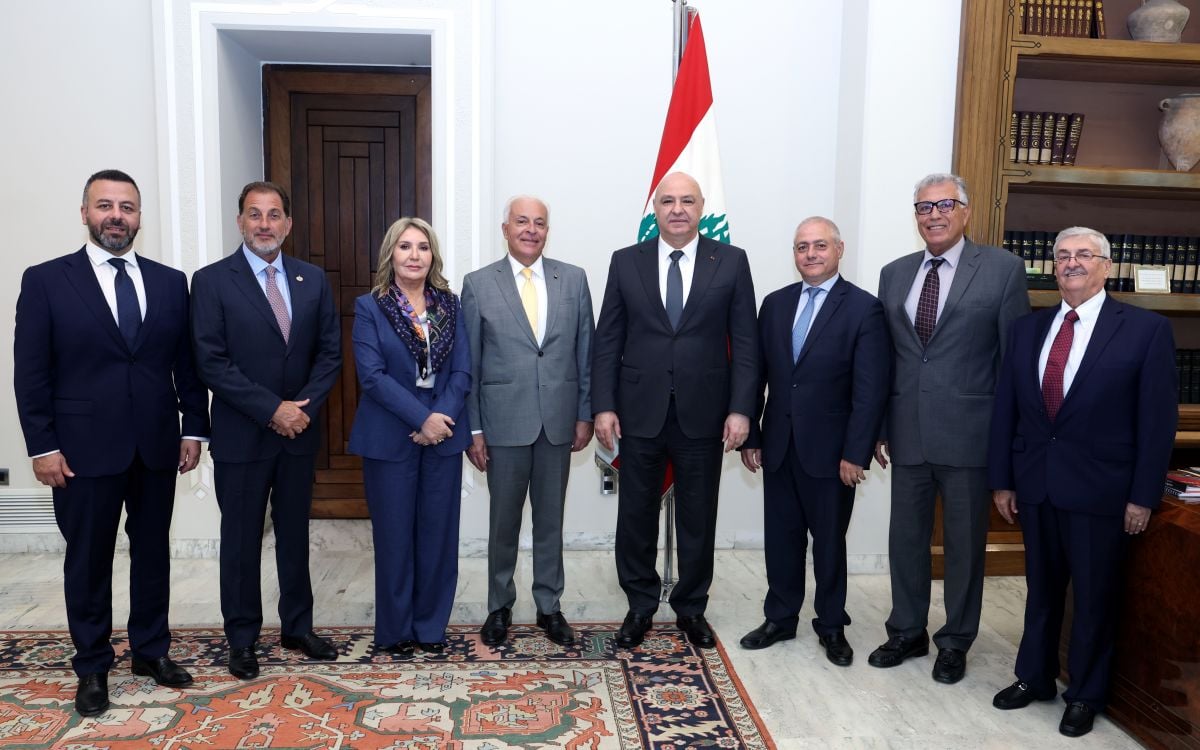
President of the Republic Joseph Aoun with a LARP delegation. (Credit: Presidency's X account.)






BEIRUT — President Joseph Aoun stated Wednesday, during a meeting with a delegation from the Lebanese American Renaissance Partnership (LARP), that it is "natural" for the diaspora to take part in the decision-making process, as the parliamentary tug-of-war over the electoral law continues between Parliament and the Grand Serail.
After a parliamentary committee decided to let the government make the call, Cabinet on Tuesday handed the issue back over to Parliament.
"The role of the Lebanese diaspora is essential to supporting their homeland, and it is natural that they have the right to participate in the decision-making process," Aoun said as he received the LARP delegation in Baabda.
Founded in 2006, LARP states on its website that it is dedicated to "promoting public policies and targeted programs" to "bridge the gap between Lebanon and its diaspora."
The issue of expatriate voting has sparked a standoff in the Lebanese Parliament, with lawmakers divided on the matter.
On June 30, Parliament Speaker Nabih Berri blocked a proposed amendment that would have allowed expatriates to vote for all 128 MPs, as was the case in 2018 and 2022. The head of the legislature wants to enforce an article in the current electoral law, adopted in 2017, stipulating that six MPs would be added to the 128 and would be elected exclusively by the diaspora.
The problem: The law is vague on how to implement the proposed six-seat system and does not specify any concrete mechanism for its application.
On July 31, about fifty protesters staged a sit-in ahead of the opening of the parliamentary session outside Beirut's Municipality building, with a clear demand: Full voting rights for Lebanese expatriates.
President Aoun also told the LARP delegation that "Lebanon is back on the world map and is showing foreign visitors that it is a safe country."
In this context, he stressed that "economic indicators are encouraging" and that "the summer was successful on various levels."
Still, while the summer season seemed promising, tourism sector stakeholders remain unsatisfied. The season ultimately fell short of expectations. "We hoped to match the performance of summer 2018. In the end, we only reached 70 to 80 percent of that level, and only for a single month," Jean Beyrouthy, president of the union of beaches and seaside resorts and secretary-general of the Federation of Tourism Syndicates, told L'Orient-Le Jour in an article published on Sept. 11.
