






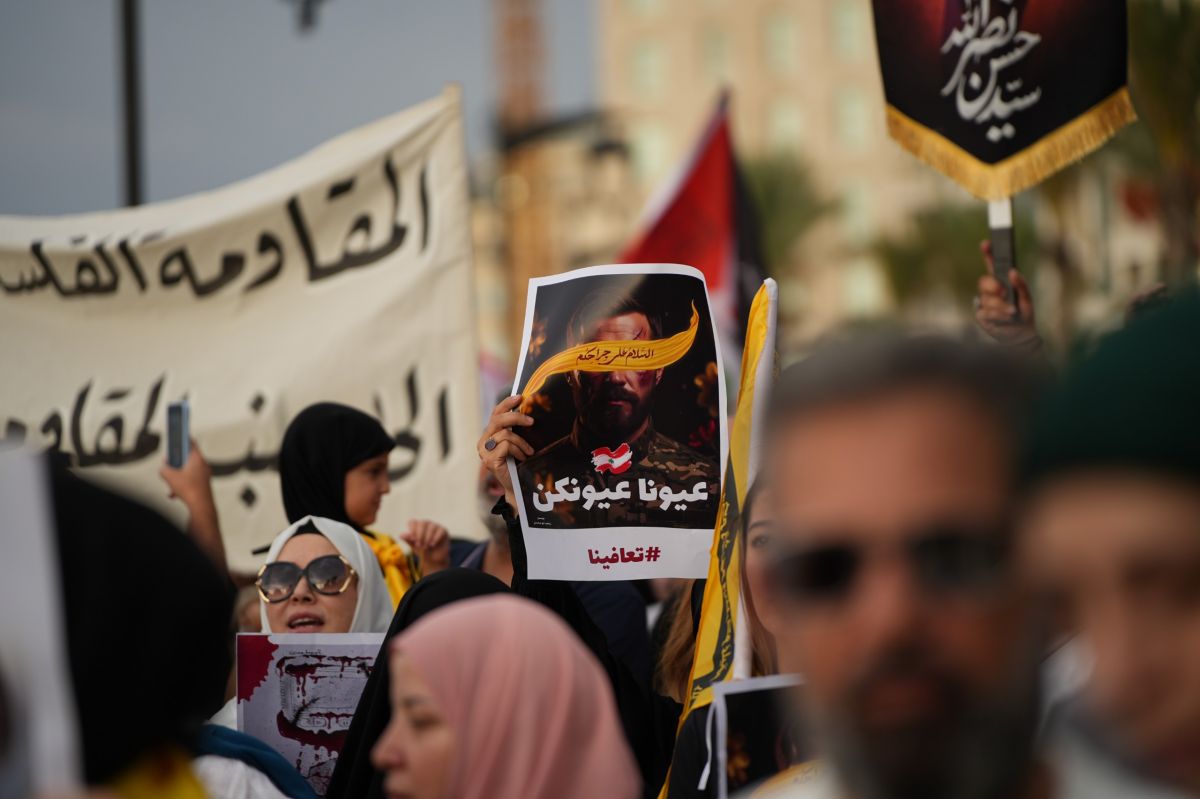
Two women holding signs during the commemoration of the beeper attack, on Sept. 17, 2025. (Credit: Mohammad Yassine/L’Orient Today.)






BEIRUT — "This wasn't an episode of 'Black Mirror.' It was our blood. Our red blood." A protester held up a sign among the crowd gathered for the march commemorating the Israeli beeper attack in Ain al-Mreisseh, Beirut, around 5 p.m.
On Sept.17, 2024, the simultaneous explosion of thousands of these rudimentary devices — used by Hezbollah and booby-trapped by the Israeli army—left 12 dead and at least 2,931 injured.
More than 300 people, according to a Lebanese police officer on site, responded to the call initiated, among others, by Khalil Harb, former journalist from the now-defunct newspaper as-Safir.
"We made this call along with other figures to say that our blood is not cheap and that we shouldn't accept such a crime being committed on our land," he told our on-site reporter. The choice of Ain al-Mreisseh, he said, was "so that no one could attribute a political affiliation to it."
A dozen Lebanese soldiers and police officers were deployed to ensure security. Posters depicting men wounded by the beepers were handed out to participants, bearing the phrase: "Our eyes are your eyes," a reference to the injuries caused by the blasts.
Others waved the Lebanese flag, as well as those of Hezbollah and the Syrian Social Nationalist Party (SSNP). "I came to show solidarity with the beeper victims who sacrificed so much for us," said Jana, in her twenties, who lives in Beirut's southern suburbs.
"Looking back a year, it was a terrifying day. It shows just how criminal this enemy is. No one expected such an attack. But we are strong and we know how to pick ourselves up every time," she said.
Elsewhere, a man had come with his young daughter in his arms. "The injured have shown honor and dignity. They sacrificed their eyes and hands so we could live. Without them, we wouldn't be here. This day will remain dark. It's the first time in history we've seen such violence, targeting women and children," he said.
"Some people in the country rejoiced at what happened, lacking honor and dignity. The country has always been divided," he criticized.
Near the march, a young woman asked a soldier what was happening. "I'm against this kind of march taking place here. Let them do it on their own turf," she said, speaking on condition of anonymity, near her friend — Ain al-Mreisseh being primarily a Sunni neighborhood.
"What message are they trying to send? What's done is done," said the woman, who is from Akkar (North).
At the scene, a statement was distributed to protesters, calling on the government to draw up "a comprehensive legal file, with the help of Lebanese experts and lawyers, to prosecute the Israeli entity for its crimes in international courts."
The text condemned a "war crime" and a "violation of human rights." It concluded that the initiative aims to "refuse to be forced by Israel to accept the idea of being killed as normal."
keeping their heads high
Before the march began, Ali Ibrahim—a survivor who "lost both his eyes" in the beeper attack—addressed the crowd, saying "the determination is even stronger," despite the "difficulties."
"The enemy wanted to break us, but that won't happen. We will keep our heads high. We will not be broken," said the thirty-something, whose remarks ended amid the cries of women: "Labbayka ya Nasrallah! [At your service, Nasrallah.]" Some joined in the slogan, others did not.
During the march, which was led by a youth marching band and accompanied by songs from Julia Boutros, the "voice of resistance," demonstrators carried a portrait of Hassan Nasrallah, who was killed by Israel in September 2024.
Along the seafront corniche, some shouted "Death to Israel," vowed never to abandon Palestine, and to "never lay down arms," in front of perplexed passersby out to enjoy the seaside promenade.
Perched on rocks by the water, men in swimsuits enjoying the last rays of sun watched the march, which ended a few minutes later near the American University of Beirut (AUB), concluding with the Lebanese national anthem.

