

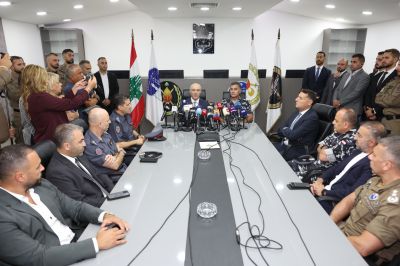
Interior Minister Ahmad Hajjar during a press briefing in May 2025. Illustrative photo.






Lebanese authorities dismantled an international drug trafficking network and seized a shipment of hashish and Captagon pills bound for Saudi Arabia, Interior Minister Ahmad Hajjar announced Monday at a press conference in Beirut following a meeting with the Internal Security Forces’ Information Division.
“We have dismantled an international Captagon and hashish trafficking network, with the arrest of its leader and other individuals. The group had been under surveillance for several months before being apprehended,” Hajjar said. He added that the network operated branches in Turkey and Australia and was preparing to expand into Jordan.
He said 6.5 million Captagon pills, destined for export to Saudi Arabia via the port of Beirut, were seized. The arrests were carried out simultaneously through local intelligence and the Information Division.
‘Comprehensive’ fight
Hajjar said fighting drug trafficking was a top priority for the Lebanese state. He noted that Lebanese forces were in contact with counterparts in Syria, Saudi Arabia, Turkey and Jordan and that the operation was conducted “professionally.”
“The fight against drugs knows no borders, identity, or confession; it is a comprehensive action covering all Lebanese territory, and the network we apprehended did indeed have international branches,” he said. “No one is above the law. The political authority fully supports the security forces so they may accomplish their work completely, and no one covers up any type of crime.”
Lebanon has been under pressure from Gulf states to curb the production and trafficking of narcotics, particularly Captagon, an illegal amphetamine that was Syria’s main export before the fall of President Bashar al-Assad.
Last week, Hajjar announced the seizure of about 8 million Captagon pills worth more than $90 million and the arrest of several suspects. Captagon became Syria’s primary export during the civil war that began in 2011, providing the Assad regime with a major illicit revenue stream.
The new Islamist-led authorities that toppled Assad have accused Hezbollah, a longtime ally of Assad, of smuggling drugs across the porous border between the two countries. The trade flooded the region, prompting neighboring states to demand stronger action from both Lebanon and Syria.
Hajjar said the Lebanese Army recently dismantled a drug laboratory inside the country and that “some quantities of drugs may originate from remnants of the former Syrian regime.” He stressed that security forces are committed to protecting society, adding, “No agent will be tolerated in Lebanon, and anybody violating the law will be prosecuted and brought before the competent courts.”
On Sept. 2, Hajjar announced the seizure at the port of Tripoli of “the largest quantity of cocaine ever smuggled” into Lebanon — 125 kilograms from Brazil valued at $15 million.
Asked Monday about the reported arrest of a Hezbollah cell in Syria, Hajjar said: “We have not been informed about this.”
Israeli media reported last week that in recent months the Israeli army had dismantled several military cells in southern Syria, some led by Lebanese nationals and operating on behalf of Unit 840, a clandestine branch of Iran’s Islamic Revolutionary Guard Corps’ Quds Force.
 7 p.m. recap: Sharaa in Riyadh; Qassem signals openness to cooperation; Ben-Gvir: ‘We demolish, again and again’