


It’s now time for the attendees to ask their questions...
“What do you like most and least about your job, and would you like to return after the next elections?” asked Samrani.
“What I like most is the feeling of being part of this change in Lebanon. I think we are on a new path,” Salam replied.
“What I like least is the slowness,” the prime minister continued. “It’s not just a waste of time; it’s genuinely frustrating. I can’t change things, I’m telling you honestly,” he added.
“Iranian influence is decreasing. From Gaza to Syria, a new Middle East is taking shape,” the prime minister continued.
“Do you think Lebanon has a particular role to play in the region?” asked Elie Fayad.
“Lebanon has its reason for existing, its reason for being. But it can go either way: the Lebanon of civil wars or the modern Lebanon of dialogue,” the prime minister said. He added, “It can play a significant role in the Arab world.”
“Do you think Lebanon has a particular role to play in the region?” asked Elie Fayad.
“Lebanon has its reason for existing, its reason for being. But it can go either way: the Lebanon of civil wars or the modern Lebanon of dialogue,” the prime minister said. He added, “It can play a significant role in the Arab world.”
“So the Cabinet meetings aren’t stormy?” asked Anthony Samrani.
“This is not the Soviet Union. There may be differing opinions, but so far, I see that it’s well managed,” Salam replied, drawing applause.
“How do you manage to lead a government with strong personalities and political parties in a Cold War-like standoff? What is the Salam method?” asked Samrani.
"For a long time, we haven't seen a team like this. Despite their differences, they [the ministers] have very good relations with each other," Salam replied.
“The Taif Accords are not our parents, they are not the Bible, they are not a holy book. Yet the Taif Accords remain the only pact among the Lebanese that made it possible to end the war. We must implement everything in Taif that has not yet been carried out,” Salam said.
"I saw the Americans more understanding during the last visit of Tom Barrack and Morgan Ortagus," Salam explained.
On the subject of the arms monopoly, Salam said: "We need the Americans or the international community to put pressure on Israel to withdraw from the five points that it continues to occupy in southern Lebanon and that have no military or strategic value. I explained this to [U.S. envoys] Morgan Ortagus, Tom Barrack, the American ambassador and other emissaries ... We are not in 1914. This is not the First World War … We are in the age of satellite images, drones that circulate all day long. Israel must take a real step on its side."
"It is said that the army's plan has no date. But that's not true. There are five stages, and the government has asked the army for a monthly report on the progress of the implementation of the plan," Salam continued.
“I think we’ve taken two big steps: the decision of Aug. 5. The army returned to us with a plan [to disarm Hezbollah]. The headline in L’Orient-Le Jour wasn’t accurate: ‘The Cabinet welcomes the plan.’ It should have read: The Cabinet ‘welcomes’ the army’s plan, but we won’t dwell on that kind of mistake,” Salam said, drawing laughter from the audience.
“We offer our deepest apologies,” replied Samrani.
Elie Fayad raised the topic of financial reforms in Lebanon, judicial independence and the training of regulatory authorities, noting that for public opinion, only Hezbollah’s disarmament seems to matter.
“There are those who speak of disarmament and the withdrawal of weapons, but I prefer to stick to the formula of the Taif Accords. Long before 1701 and 1559, we must focus on the extent of the state’s authority over the entire territory,” the prime minister replied.
“Without the armed struggle in the south — by the communists ... and later Hezbollah, a major player in armed resistance. Without Hezbollah, the south would not have been liberated. But since 2000, have these weapons been used, as Hezbollah tries to make us believe, to deter the enemy from attacking us? Unfortunately, no. These weapons have not supported Gaza,” Salam said, drawing applause from the audience.
“Today, the strength of the Palestinian cause isn’t in the Kalashnikovs, but in the number of states recognizing the State of Palestine and the hundreds of thousands of people taking to the streets in support of Gaza. Its strength lies in these changes, not in the few weapons scattered in Palestinian camps, which pose a danger to the Palestinians themselves,” Salam said.
On the topic of disarming Hezbollah and Palestinian factions, Salam responded to Elie Fayad: “Maybe it’s time. We have to start.”
Our editor-in-chief, Anthony Samrani, raised the Palestinian issue: “How does it feel to be accused of being a Zionist agent? Is that a label that particularly hurts you?”
“It didn’t affect me much; it’s just blatant lies,” Salam replied.
“Were there things that surprised you when you came to power?” asked Anthony Samrani.
“It wasn’t worse, but it was more difficult than I imagined, especially given the state of the administration and the challenges of the bureaucracy,” Salam replied.
“Do you ever go home and think you were right to leave for The Hague?” asked Anthony Samrani.
“It’s not exactly posed in those terms,” Nawaf Salam replied, adding that he misses the “questions asked before The Hague.”
“Unfortunately, the last 30 years have seen us fail to implement several key measures. The Taif Agreement, the Israeli withdrawal that could have allowed a recovery, and the Syrian withdrawal were all mismanaged. These were opportunities for the country, and we missed them. Today, however, there is a promising moment, and I want to be part of this period of change,” the prime minister said, noting that the election of President Joseph Aoun and his inaugural speech offered a new chance for Lebanon.
“We must begin by carrying out the reforms that have yet to be implemented,” Salam added.
“I like the formula ‘more reformer, less revolutionary — even if the reformer carries a revolutionary side,’” Salam said, stressing that change must come through democratic means.
“In Lebanon, we need many reforms — financial, economic, banking — to bring some order to the country,” the prime minister added, also pointing to the need for administrative and political reforms.
Asked about his position on the March 14 movement and the Oct. 17 revolution, Salam said: “March 14 and Oct. 17 were two turning points in the country’s history. I have never defined myself as a synthesis of the two, but I have strong affinities with the 2019 thawra [revolution] and the principles of March 14.”
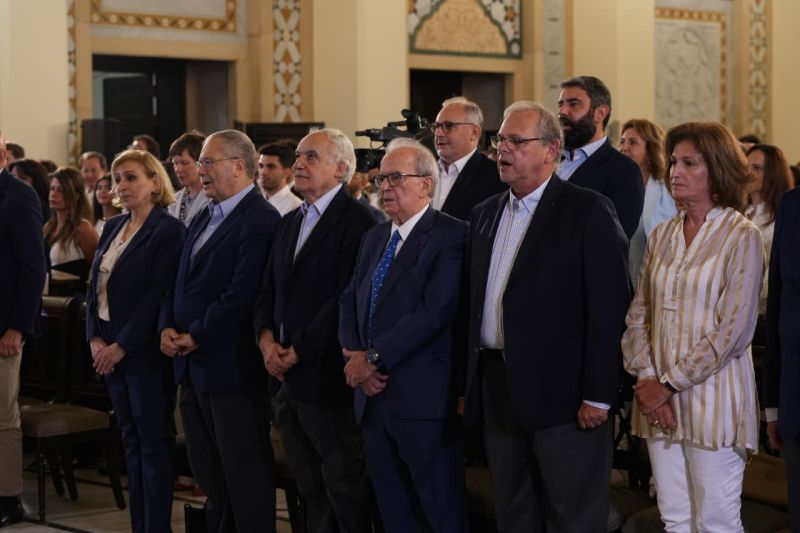
(Credit: Mohammad Yassin/L'Orient Today)
The audience, singing the national anthem before the opening of the debate.
The debate with Prime Minister Nawaf Salam has begun. You can follow it live, here.👈
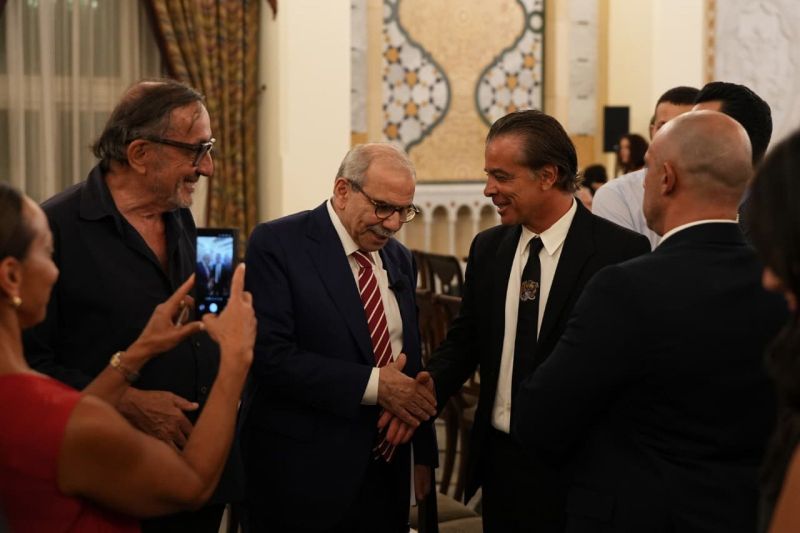
(Credit: Mohammad Yassin/L'Orient Today)
While waiting for the start of the live broadcast, the prime minister spoke with the attendees.
Prime Minister Nawaf Salam will sit down with our editors-in-chief, Anthony Samrani and Elie Fayad, at 8:45 p.m. Stay tuned for this final highlight of L'Orient-Le Jour's festival
💬 Program Highlight: All those registered for the debate with Prime Minister Nawaf Salam are asked to gather at the children’s area at 6:45 PM.
From there, participants will be escorted to the bus that will take them to the Grand Serail, where the interview — conducted by our editors-in-chief Elie Fayad and Anthony Samrani — will take place. At the end of the debate, participants will be brought back by bus to the Hippodrome.
The debate will be held in French, with simultaneous translation into English. Registration is closed.
“Yes, jobs will be lost — but that’s why we need to prepare our youth to make better use of AI. If we give them the right skills and mindset, they won’t just adapt, they’ll thrive in this new era,” added Fatima.
Kristen struck a more optimistic note on AI: “AI can help companies predict customer behavior 15 years ahead by creating digital twins and running simulations. While leadership in this area remains fragmented, I see AI being used in smart and promising ways — ways that could help shape a brighter future for our society,” she said, speaking about the future of AI and its impact on jobs.
On AI in the MENA region — and Lebanon in particular — Fatima Abu Salem said what worries her is “the adoption of a Western, privileged perspective on AI, without asking whether this is really what we need.”
“I don’t believe we should invest heavily in generative AI right now. Yes, it could be used positively, but it’s a dangerous time,” said the AUB professor. “We’re not using AI to elevate our collective intelligence or to solve our local problems,” she added.
Ludovic asked the guests to compare NFTs with the adoption of AI in daily life.
Kristen responded: “If you look at adoption rates, AI is evolving on a completely different scale than NFTs. With generative AI, people use it — often without even realizing it. It’s seamlessly integrated into everyday tools and workflows. That’s the key difference: AI adoption is broad, subtle, and deep-rooted.”
Answering a question about the differences between Europe and Silicon Valley on AI, tech and media entrepreneur Craig Forman noted: “In some parts of the world, like Europe, you wonder what’s going to happen. In Silicon Valley, you ask: what can we do for them?”
He added: “This is where the danger lies … it’s up to consumers to question what is represented,” stressing that the companies producing AI are also the ones handling the control mechanisms.
Fatima:
“AI has been around for decades. It started as an early framework developed by mathematicians to emulate human behavior. Then came machine learning, which became a powerful tool — and eventually evolved into deep learning, a system that improves by learning from its own mistakes. After that, we entered the era of generative AI, which can create almost anything. But the fact that it can now talk to you — that, to me, is the scariest part of AI.”
Ludovic asked, "What was your ‘wow’ moment with AI?" Fatima said:
“I was horrified,” she replied. “When I discovered ChatGPT, I felt it was going in the wrong direction — it shouldn’t have happened through ChatGPT.”
“The question is obviously provocative, but it’s true we tend to think artificial intelligence has all the answers,” says Ludovic Blecher, consultant and board member, as he opens the debate.
Next up:
🎤The roundtable space, for a debate on the theme: Artificial Intelligence, a New Religion?
Fatima Abu Salem (Professor at AUB, AI consultant), Kristen Davis (innovation expert), and Craig Forman (tech & media entrepreneur) will explore one central question: Will AI be the next religion?
The debate will be held in English, with simultaneous translation into French. Admission is free.
The talk with Kim Ghattas concluded with a big round of applause, and Ghattas thanked the audience.
During the Q&A, Kim was asked about world leaders:
"I can’t think of a single leader today who is genuinely doing a good job," Kim said. Then she paused and added, "Actually, our Prime Minister [Nawaf] Salam is doing a good job," followed by, "and our president, [Joseph Aoun]," — which made the crowd laugh and cheer.
What would you say to another 13-year-old who dreams of becoming a journalist?
“Imparting knowledge is a gift, and journalism is a great career. Don’t give up — keep at it, and find new ways to tell stories.”
Kim also draws a comparison between Ireland and Lebanon. She recalls being thanked by an Irish family from Dublin who had watched her report on the 2006 war in Lebanon and related to the Lebanese struggle.
“That made my 13-year-old self proud of the choices I made.”
She concludes with a powerful statement before moving to the Q&A:
“Knowledge is power.”
Where does Turkey stand?
Kim Ghattas responds: "Turkey sees the Israeli threat approaching its doorstep, especially given its own ambitions in Syria. This makes Syria the next critical issue in the region."
Kim Ghattas: "Israel is taking a page out of Iran’s playbook. The Iran-Iraq War in the 1980s was devastating for Iran. The U.S. was backing Saddam Hussein, and in response, Iran made a strategic decision: they would never again be under the boot of a Sunni dictator. So they pushed the conflict outward — starting with the creation and support of Hezbollah. Then, in 2003, thanks to the U.S. invasion of Iraq, Iran was able to rebuild and expand its regional influence."
"Today, Israel is following a similar mindset: 'We will never be invaded again.' After October 7, they're striking in every direction — just as Iran once did. And now, it’s difficult to imagine how we climb out of this spiral of escalation."
"Meanwhile, the U.S. seems to lack a clear policy. Trump may want his Nobel Peace Prize, but if Israel strikes Doha, that prize won’t come. There are no serious de-escalation teams in place — just envoys who might be good at negotiating business deals but are out of their depth here. It's a spaghetti strategy: throw everything at the wall and see what sticks."
Speaking about her upcoming book on the Iranian Revolution and the birth of Hezbollah (to be released in October) Kim Ghattas said:
"I begin the book with a quote from Michael Puur, who was born in Lebanon, speaks Arabic, and is one of my favorite scholars on the region. It’s a sentence I believe we’ve forgotten — yet it feels more true now than ever: 'The mark of a truly civilized man is empathy.'”
“I try not to think in grand terms — like whether my book will save the world or if an article I write will end a war. But if even one person can read my work, understand it, and maybe change their perspective — if they can see how everything is connected, how we’ve all been shaped by events that happened forty years ago — then I feel just a little bit less powerless.”
"I'm trying to tell the story beginning in the 1980s, using Lebanon as the stage — particularly around the Israeli invasion of Lebanon in 1982, which was the first time Israel had invaded an Arab state. That moment set off a chain of events that still echoes today," she added.
Asked: How does being a Lebanese citizen reporting on U.S. foreign policy shape your perspective?
Ghattas answered: “I want to be read both in the region and in the U.S. When I was at the BBC, part of my job was to translate America to the world — to explain how the machinery works. It’s not just about the headlines, because headlines can be misleading. There’s a reason why people in Pakistan or Argentina are asking, ‘What is America going to do next?’ Whether we agree with it or not, U.S. foreign policy has a significant global impact.
That’s why I aim to write in a people-centered way — to help readers truly understand. I want them to have that ‘Ah, now I get it’ moment.”
"One of the most memorable readers I ever met was a policeman from Belfast who had lived through the Troubles. He attended one of my talks in London and told me that the figures I described in my book Black Wave — people from Damascus and Baghdad — reminded him of the same types of individuals he had known back in Ireland during that time. It was a powerful reminder of how human experiences can echo across different conflicts and regions," she added.
When asked why she shifted from fast-paced journalism to writing long-form books, Ghattas responded:
“I started to realize that news doesn't have the same impact it once did. I needed to think about how to make a long-term impact. I still rely on newspapers and journalism as sources for my books, but I wanted to go deeper — to say more. That’s why I started writing books: to create something with more weight and lasting influence.”
Kim Ghattas explained that she decided to become a journalist at the age of 13 and pursued that goal with determination.
“It’s what I had to do. Growing up in Lebanon during the Civil War as a young child, I was appalled by the injustice. I thought that if I told Lebanon’s story, I could help stop the war. I realize now it’s not that simple — but telling stories and giving voice to the truth remains deeply important, both for us and for the world.”
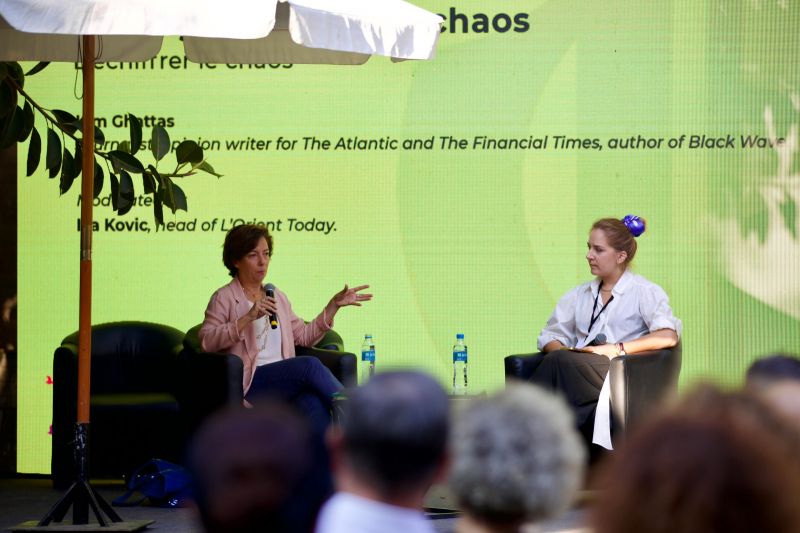
(Credit: Matthieu Karam/L'Orient-Le Jour)
A large audience turned out to attend the discussion between Kim Ghattas and our very own Iva Kovic, marking Kim’s first public appearance in Lebanon.
We continue with a conversation with journalist Kim Ghattas, columnist for The Atlantic and The Financial Times and author of Black Wave led by L'Orient Today's Iva Kovic-Chahine
📰 Program Highlight: We look forward to seeing you at 5:00 p.m., at the roundtable space, for a discussion with Kim Ghattas, who builds bridges between writing, journalism, and regional issues.
A journalist, Kim Ghattas is also the author of “The Secretary”, an account of her travels alongside former U.S. Secretary of State Hillary Clinton, and “Black Wave”, which analyzes how the year 1979 — with the Iranian revolution and Saudi Arabia’s conservative shift — redefined the Middle East.
The conversation will be held in English. Admission is free.
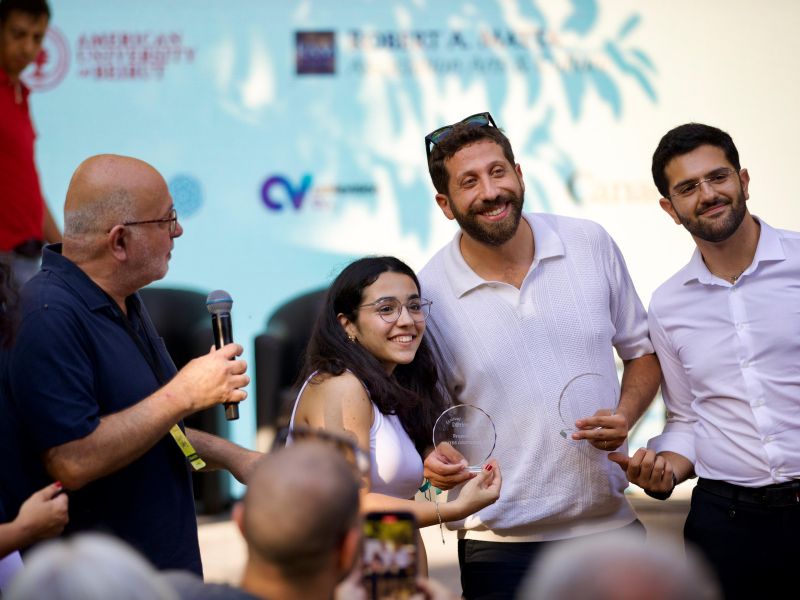
(Credit: Matthieu Karam/L'Orient-Le Jour)
Drum roll..... 🥁🥁🥁🥁🥁🥁
Anthony Bou Habib and Sarah Chehade, who defended yes, are the winners of the debate competition! They each win a one-month internship at L’Orient-Le-Jour, and all participants will receive a one-year subscription to our daily newspaper — making the information free for them 😉.
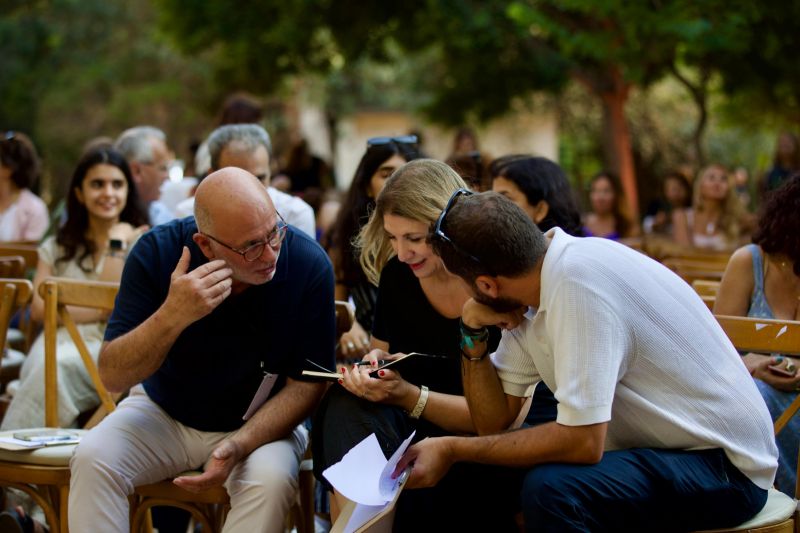
(Credit: Matthieu Karam/L'Orient-Le Jour)
Final whistle! The third and final debate is over, and our jurors are deliberating once last time to decide which team will win👀🤫.
Team B protests: “But what is the value of a life, in your view? There are journalists in Gaza risking their lives to bring us information. You’re saying all they deserve are a few state subsidies?”
Team A responds: “Information must, of course, be of high quality. Saying it should be free doesn’t mean those who produce it shouldn’t be paid. If journalists aren’t compensated, the quality of information suffers. But information shouldn’t be a luxury only for those who can afford it. How can society progress if everyone doesn’t have access to the same information?
Take a concrete example: if an article shows that one plastic bottle pollutes seven times more than another, but it’s behind a paywall, much of the population won’t see it. As a result, we continue harming the planet simply because information isn’t accessible.
That’s why we believe essential information should be financed by the state, through taxes, not privatized. Access to information — especially on the environment, health or fundamental rights — is a public good.”
Team B, defending no, argues: “Quality information comes at a price. We must not break the link between effort and recognition. The hours of work, reflection and writing have value. By paying those who produce information, we ensure its quality. When it’s offered for free, it loses value.”
Team A defends yes: “Information is a vector of knowledge, and knowledge relies on justified beliefs. That’s why we argue that information, as the foundation of knowledge, should be accessible to all — and therefore free. However, it’s essential to distinguish between different sources, including scientific, academic or factual ones, to ensure the reliability of what is shared.”
Next up, the finalist will debate: “Should information be free?”
Share your thoughts with us in the comments!
The verdict is in! 🔔
First round: On “Do social networks offer more freedom than traditional newspapers?” — Team A, defending yes 👑, takes the win.
Second round: On “Can we laugh at everything?” — Team A, defending no 👑, comes out on top.
😮💨 The competition is tight! The winners of the first two rounds will now face off in the third and final debate. Stay tuned 📣
🤔 “Do you think our problems persist because we laugh?” asks Team B. “Aren’t we in the process of healing, laughing at our challenges? Our society proves it: we try to suppress it, but it endures, thanks to its laughter!”
Team A retorts: “Laughter is just a façade to hide real emotions. It’s not a permanent solution, only a temporary band-aid. Sure, laughter can be a defense against the truth, a way to protect oneself, but it can also become a barrier. By constantly making fun of everything, we lose touch with our deeper emotions. And if this goes on too long… we eventually crack.”
“Laughing isn’t always a path to emancipation. Sometimes, it’s by stopping laughter that we finally take the time to come together, reflect, and have serious discussions to find real solutions.”
Team B responded: "I would like to present laughter to you as a symbol of freedom, because it is when you ban laughter that you start to suffer ... When we laugh at everything, no fear in the world will be able to subdue us." Thy also cite as an example the comedian John Achkar who laughs to denounce corruption, misery, "to transform, in short, our sorrows into freedom."
Team A: “No, we can’t laugh at everything. We have to be realistic. If we laugh at everything, we risk forgetting the seriousness of certain issues. The Lebanese, for example, often make light of their situation. But by constantly joking about tragedies, we gradually lose the ability to confront reality seriously. Laughter then becomes an escape, not a solution.”
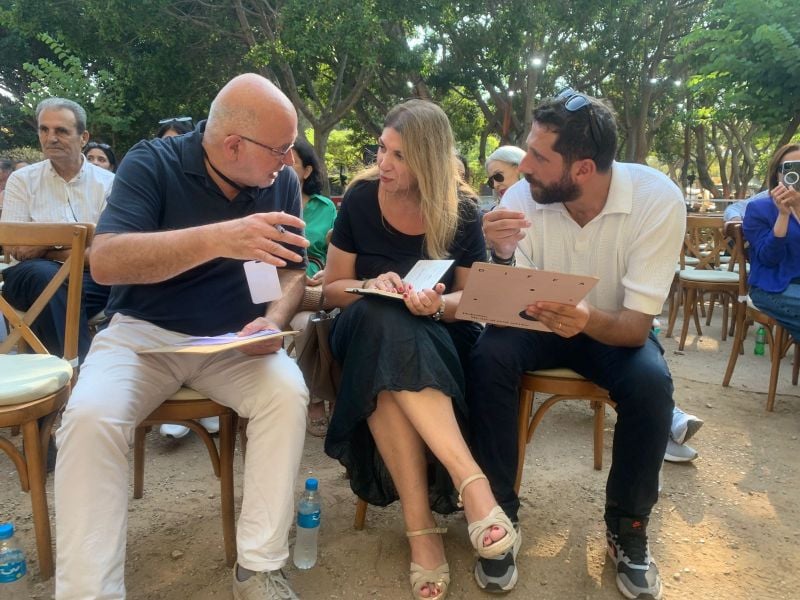
(Credit: L'Orient-Le Jour)
While the jury deliberates, the second topic is introduced: “Can we laugh at everything?”
Team B: “The orthodox definition of freedom in the Catholic Church is arriving at the truth. We can’t put truth and falsehood on the same footing. If we let everything circulate unfiltered on social networks, anyone can claim to be a journalist, and the truth disappears. This can mislead society, because misinformation is everywhere. Traditional media provides a level of oversight — it’s not censorship — and can be held accountable and corrected when mistakes are made,” says Georges.
Team A countered that the truth “can also be camouflaged by traditional media.”
Team B: “What about the algorithms? If I like a cat video, my feed automatically fills with cats. Where is the freedom then, if someone else is choosing for me?” asks Sarah S. “With traditional media, I decide for myself what I want to learn about.”
Team A: “If freedom is the ability to act according to your will effectively, the point is clear: with traditional media, you have to go through an editor-in-chief, respect an editorial line, and navigate the private interests of a few billionaires” — which, of course, doesn’t apply to L’Orient-Le-Jour, an independent 😉 daily. “On social networks, it only takes one click to express yourself and share your ideas.”
🗣 The debate is beginning!
For the first round, students drew this topic: “Does social media offer more freedom than traditional newspapers?”
But first, John Achkar takes the stage to lighten the mood.
And yes, the students are a bit nervous, and that’s perfectly normal!
🎤 Join us at 3 p.m. in the round table area for a Flash Talk with John Achkar, followed by a series of engaging student debates.
Four student teams from USJ’s faculties of law, political science, literature, philosophy and technology will face off. The themes, kept secret until the last minute, will be revealed on the spot.
After two elimination rounds, a final will decide the winning duo, chosen by a jury featuring Marie-Claude Najm Kobeh, dean of USJ’s Faculty of Law and Political Science, comedian John Achkar, and L’Orient-Le-Jour co-editor-in-chief Elie Fayad.
The debate will be conducted in French. Admission is free.
The program for this new day is once again packed:
⏰ 3:00 PM – Opening
🌳 Come enjoy the Hippodrome, discover our exhibition “L’Orient-Le Siècle, 100 Years of Front Pages”, relax in the food court, and let your children take part in activities organized in partnership with Cirquenciel.
Admission is free.
🚌 3:00 PM – Guided tour “In the Footsteps of L’Orient-Le Jour”
This bus tour through Beirut with L'Orient-Le Jour's Caroline Hayek, senior reporter (Albert Londres Prize 2021), is reserved for our subscribers who registered in advance.
🎤 3:00 PM – “Flash Talk” with John Achkar + Debate competition
Four groups of students from the faculties of law, political science, literature, philosophy, and technology at USJ will face off. The topics will be revealed on-site. Two elimination rounds followed by a final: at the end, a winning team of two will be chosen by a jury made up of Marie-Claude Najm Kobeh (Dean of the Faculty of Law and Political Science at USJ), actor John Achkar, and Elie Fayad, co-editor-in-chief of L’Orient-Le Jour.
The debates, moderated by our journalist Nemtala Edde, will be held in French. Free entry.
📰 5:00 PM – L’Orient Today x Kim Ghattas
A conversation with Kim Ghattas, weaving together writing, journalism and regional issues. A journalist, Kim Ghattas is also the author of The Secretary, a travel account alongside former U.S. Secretary of State Hillary Clinton, and Black Wave, which examines how the year 1979 — with the Iranian revolution and Saudi Arabia’s conservative turn— redefined the Middle East.
The conversation, led by L’Orient Today’s editor-in-chief Iva Kovic, will be in English. Free entry.
🤖 6:00 PM – Artificial Intelligence: The Next Religion?
Fatima Abu Salem (Professor at AUB, AI consultant), Kristen Davis (innovation expert), and Craig Forman (tech & media entrepreneur) will explore one central question: Will AI be the next religion?
The debate, moderated by Ludovic Blecher (advisor and board member), will be held in English with simultaneous French translation. Free entry.
💬 6:45 PM – Debate with Nawaf Salam
An open conversation with a sitting Prime Minister: Lebanon has rarely experienced such a democratic exercise.
On the occasion of our festival, an exclusive interview will take place with the former president of the International Court of Justice. This interview, conducted by our editors-in-chief Élie Fayad and Anthony Samrani, will be held at the Grand Serail. Departure for registered participants will be from the Beirut Hippodrome. We invite registered attendees to gather at 6:45 PM at the Hippodrome (children’s area). Participants will be transported by bus to the Grand Serail and brought back to the Hippodrome after the discussion.
The debate will be conducted in French, with simultaneous English translation. Registration is closed.
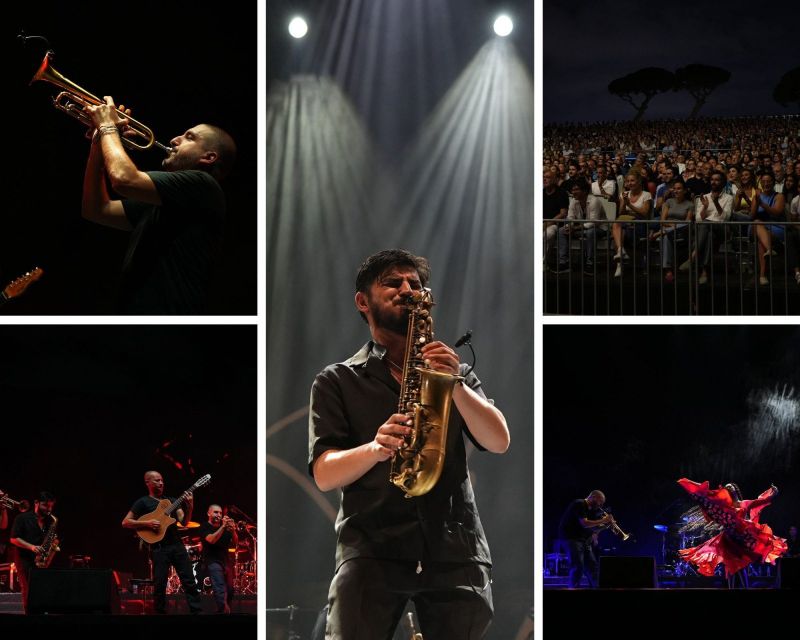
(Credit: Collage of Mohammad Yassin's photos/L'Orient Today)
The stands were packed, and Maalouf and his team kept the crowd on edge until the very last note 🎼😮💨
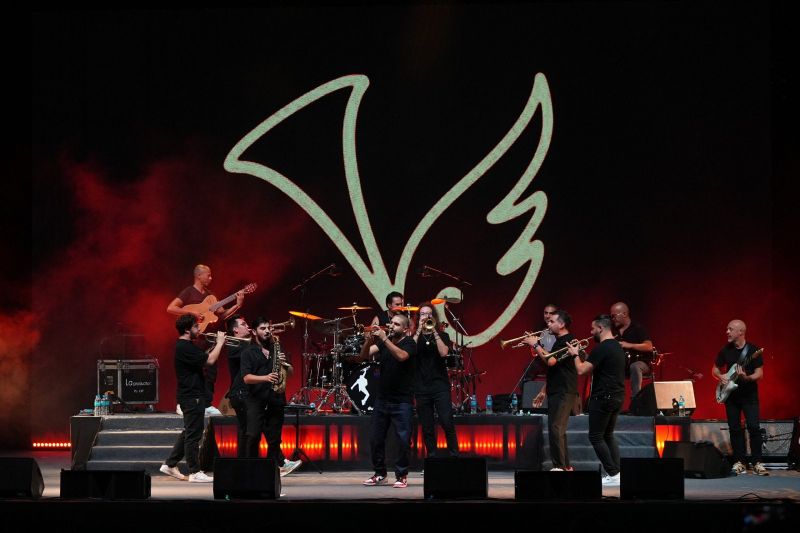
(Credit: Mohammad Yassin/L'Orient Today)
The harmony among the musicians on stage is truly impressive 🥁
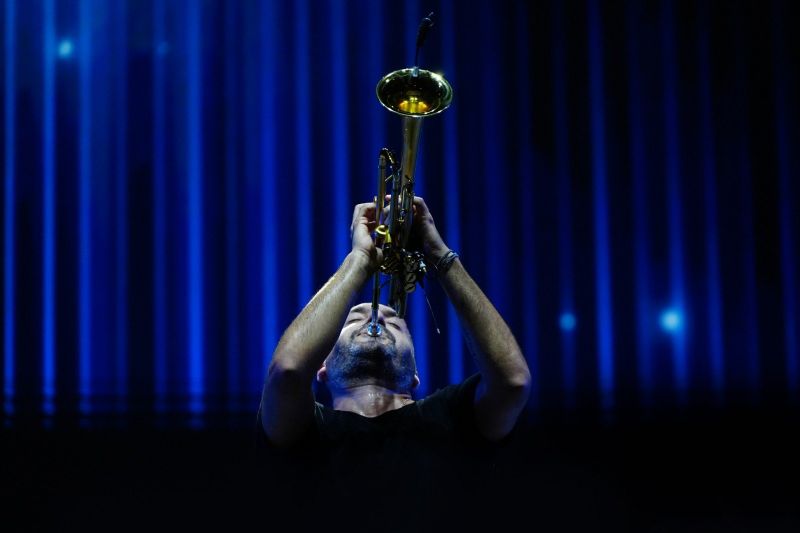
(Credit: Mohammad Yassin/L'Orient Today)
This one might be our favorite — Ibrahim Maalouf’s passion shines through!
😍 What a magical evening! Since this morning, we’ve been replaying the concert through photos again and again. Here they are for you 📸
We’re off to another day full of events, after a Saturday marked by intense roundtable discussions on commitment, art and censorship — and above all, an evening of celebration with the exceptional concert of Ibrahim Maalouf “and the Trumpets of Michel-Ange” 🎺
👋 Welcome to our live coverage of the third and final day of the L’Orient-Le Jour festival!
Already have an account? Login here
You have reached your article limit
Add L'Orient Today to your syllabus.
Subscribe for $0.5/month for 3 months.
This article is only available to L’Orient Today subscribers.
Already have an account? Login here