


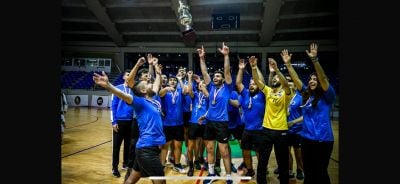
The men’s handball team of USJ (seasons 2023/2024 and 2024/2025). (Credit: USJ)






About 20 years ago, Saint Joseph University of Beirut (USJ) had no sports facilities of its own. It relied on renting fields from schools to train students and host competitions. Today, the university boasts a wide range of infrastructure, including indoor fields on the Mansourieh campus, squash, basketball and volleyball courts, a dance studio, martial arts facilities, and even a swimming pool at the Innovation and Sports Campus (CIS), which opened in 2012.
In 2020, eager to encourage students to reconnect with athletics, USJ revived the interscholastic games suspended during the Covid-19 period. “More than 57 Lebanese schools responded to the call, a level of participation unseen in 11 years,” said Maroun Khoury, director of the university’s sports department. “At the same time, we offered all Lebanese universities the opportunity to come play once a week for free on campus, which not only restarted inter-university sports, but also allowed young people to let off steam and alleviate their stress through sports activities.” Since then, he added, serious competitions and rankings have emerged, pushing universities to train harder and improve their athletic performance.
USJ has also introduced new sports, such as padel, which is gaining popularity in Lebanon, and launched a cheerleading team — the first university in the country to do so. “This allows young women who love to dance but aren’t necessarily involved in sports to take part in a physical activity,” Khoury said.

“At USJ, we give importance to all sports without favoring one over another, and we consider sports to be as important for young women as for young men, organizing competitions for both,” he added. Khoury credited the surge of activity to students’ eagerness to blow off steam after long lockdowns and to the economic crisis, which has made affordable sports more attractive.
“With all the trauma Lebanese people experience on a daily basis, we’ve noticed our students who train or come to exercise are able to vent and release their stress and anxiety through physical activity, which is an excellent form of therapy for them,” Khoury said. To respond to this need, the university restarted morning training at 7 a.m. before classes. During the war in October, it also offered training on the Mansourieh campus and organized tournaments with universities from Kesrouan, with USJ being the only Beirut-based institution to participate.
From local competitions to international achievements
The enthusiasm of students has pushed USJ into even more competitions, nationally and abroad. “Whereas at first we only traveled once a year to take part in international competitions, this year we participated in more than four overseas events, and our athletes stood out in most disciplines, whether team or individual, in both men’s and women’s sports,” Khoury said. Even at the height of the October 2024 war, when flights were canceled, the women’s futsal team traveled to Rome and secured third place, while in Lausanne, USJ students finished second in beach volleyball.
USJ has also extended its athletic reach to its regional campuses in Saida, Zahle and Tripoli, as well as in Dubai and Ivory Coast. “The university’s ultimate goal is to develop sports in its five regional centers, so that all students have the same opportunities to succeed and develop their athletic talents as those in Beirut,” Khoury said. He noted that the university organized competitions throughout the year bringing together athletes from all campuses.
In 2015, USJ created “Club 1875” — named after the university’s founding year — to support high-level athletes and allow them to continue competing after graduation. “We ensure they maintain their fitness, oversee their training, and cover all costs related to their preparation. We even offer athletes representing the university a 40 percent reduction in tuition fees,” Khoury said. “Let’s not forget that being part of the sports team defending the university’s name instills pride and belonging, while providing strong motivation to succeed both athletically and academically.”
Beyond competitive sports — where top athletes represent USJ at international or inter-university events — the university promotes the idea that “sports should be accessible to all.” It has developed three sections: one for mass participation, which organizes tournaments between different faculties; one for recreational sports at the CIS; and one for academic sports. This year, the Faculty of Management launched a university diploma in sports management in collaboration with the sports department. Taught online in English by foreign professors, the program lasts nine months and will eventually lead to a master’s degree. USJ also introduced sports electives such as dance, swimming, volleyball and boxing to encourage students to stay active.
While Khoury said students’ enthusiasm has been the driving force, he stressed that support from the university’s leadership was key. “Support from the dean, who is strongly in favor of all sports, has enabled USJ to become the undisputed leader of university sports in Lebanon,” he said.

 Israeli army carries out demolition at Jabal Amel School in Houla as strikes continue