


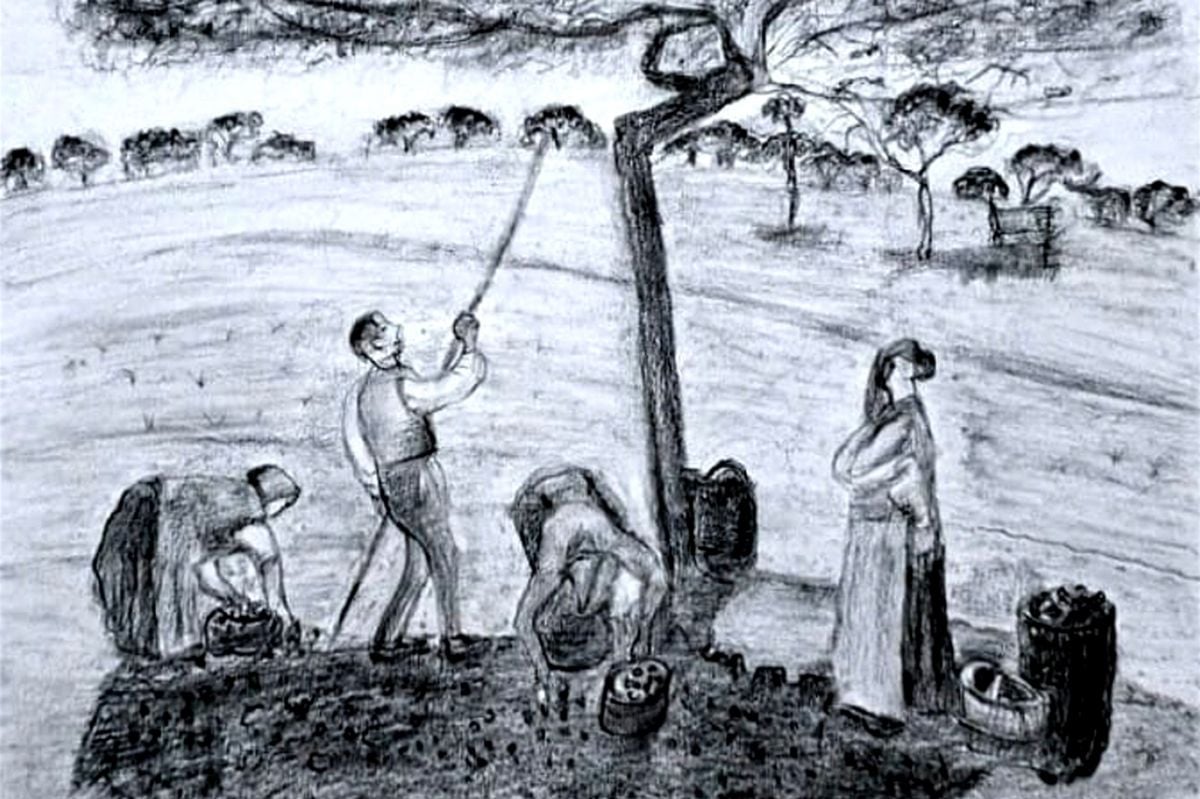
A painting by Wafaa Nazer. (Photo sent to L'Orient Today)






My mother Wafaa grew up in Qoubbeh, a warm, close-knit corner of Tripoli, where her father, his sister and four brothers lived in three neighboring buildings.
At 13, while heading to school one morning, her cousin Samir, 16 years older, told his father that he wanted to marry Wafaa. Later that year, they were married and moved into an apartment just upstairs from her childhood home.
Still, the schoolgirl in her hadn't vanished. The morning after her wedding, she got dressed in her sky-blue school uniform and walked to class before being turned away.
“You’re married now. You can’t attend school,” the principal told her with quiet finality. Just like that, that door was closed.
Ten years later, my family and I moved into a new apartment on Moutran Street, while my grandfather settled one street over. Between those two homes, life unfolded, familiar, contained, ordinary. But inside that ordinariness, something persistent stirred.
Wafaa raised my siblings and me with tenderness, her hands always warm from kneading dough or smoothing a fevered brow, her voice steady even when the weight of responsibility pressed heavily. But late at night, the only light was the flicker of the lamp on her side as she opened her schoolbooks.
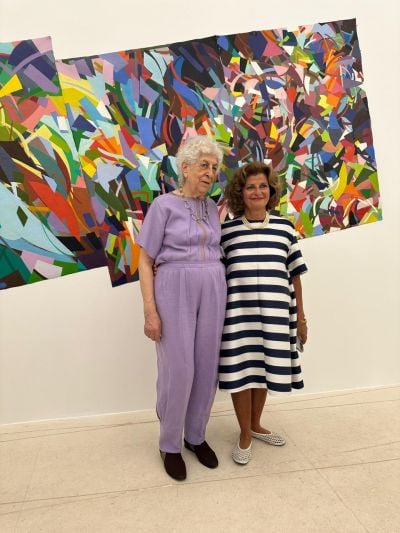
She was studying for the Lebanese baccalaureate while raising four young children. She didn’t dare tell my father. He wouldn’t have approved, not of cruelty, but of a world that had taught him a different kind of contentment. To him, she had what one needed: a home, children, security.
The faint smell of ink, the scratch of a pen, the texture of paper under her fingertips, these became her secret companions. She learned by whispering lessons into the silence, by memorizing in the dim glow of a single bulb, by tracing the outlines of a future she could not yet claim.
That first year, she failed. The second year, she tried again. On the day of the results, she finally told my father. We sat by the radio as candidate numbers were read aloud. Hers came up. She passed. Abdel Halim Hafez’s joyful song “Wa Hayat Albi W Afraho” filled the house, and we all sang along, proud. My father celebrated too, believing this was the summit of her ambitions.
But for Wafaa, getting her high school degree was only a door reopening.
She enrolled at the Lebanese University to study Fine Arts, leaving us at our grandmother’s house while she attended classes. It was not easy, between motherhood and academic demands, she struggled with attendance and failed her first year.
Still, she tried again, quietly, determinedly. One day, a university professor congratulated my father in a café on her success. He was stunned. At home, he asked my mother, “Why do you need a degree? You’re not looking for a job. I’m providing everything.” He could not understand the hunger that kept her going. She paused her studies once more.
Years later, she quietly completed her BA and then a Master’s in Sociology, still, without his knowledge. She fought to work, eventually earning his reluctant blessing to become an Arabic teacher.
Standing in front of classrooms with chalk-dusted fingers and eyes that carried both fatigue and an unspoken triumph, she shared her knowledge generously for 23 years, her voice often rising above the hum of restless students, her patience tested but rarely broken. Teaching, for her, was never just a job; it was a way of planting seeds, even when the soil seemed barren.
When she retired at 64, she began to study Arabic calligraphy, another dream pursued with patience and a kind of tender stubbornness. For nearly a decade, she traced letters with slow, precise hands.
For nine long years, she studied calligraphy, not casually, not as a hobby, but with the same fierce dedication that had carried her through her youth. The ink smelled earthy, the strokes were deliberate, meditative; the script flowed like breath across the page.
Then 2019 came. Lebanon’s economy collapsed. Banks froze our accounts. She lost her life savings.
But she did not retreat. At 70, she decided to return to her first love, art. She enrolled at the Lebanese University in Tripoli to study Fine Arts, again.
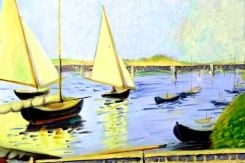
She walked into classrooms filled with students five decades younger. Her hair neatly tucked under her hijab, her steps steady, her presence quiet but undeniable. She did not try to blend in; she simply took her place.
Her daily life during those years became a rhythm of discipline and delight. She would spend hours sketching, our living room often smelled faintly of drying paint and paper curling gently as it absorbed color. Her fingers would be stained with graphite, a smudge on her cheek betraying her devotion.
Meals were often simple: warm lentil soup, olives glistening with oil, fresh oat bread, because her appetite was never for luxury, only for the hours she could pour into her craft, unless I prepared lunch.
And then there were her evenings: a cup of chamomile tea, a low hum of Fairuz playing in the background, the soft clatter of her brushes being cleaned one by one, each rinsed like a ritual. She would often pause, looking out the window at the lights of Tripoli scattered like stars, her expression both serene and fiercely alive.
What does it mean to begin again at 70? To reimagine yourself not as someone nearing the end of a chapter, but as an artist standing at the edge of her first great canvas?

For my mother, it meant defying a world that told her her time had passed. It meant showing up to class in the rain, her scarf damp, her sketchbook dry beneath her coat. It meant accepting the slow ache of her joints as the price of leaning over canvases for hours. It meant laughter with classmates young enough to be her grandchildren, and sometimes, quiet solitude when the gap between their worlds felt too wide.
Then the pandemic came. Overnight, everything turned digital. Online platforms, uploaded assignments, logins and passwords. This was a new language, and not one she had ever learned. Each unfamiliar word was a hill to climb, each login a small victory. With a dictionary in one hand for her English course, and me, her daughter, on the other, she climbed anyway.
Her classmates did not always understand her. To them, she may have seemed an outlier, a figure misplaced in their timeline. And while a few professors supported her, others held back, saying simply that “the system was not built for seniors.”
We speak so loudly about inclusivity, but where does age fall on that promise? When it comes to education, do we truly mean everyone, or only those who move at the expected pace?
Aging is not a decline; it is a continuation. And for people like Wafaa, growth is not about career advancement or recognition; it is about becoming. Her art is not filtered for trends or algorithms. It is shaped by memory: the plumeria, pomegranate and blackberry trees of Qoubbeh, the echo of Abdel Halim on a summer night, the long ache of postponed dreams. Each brushstroke whispers a moment lived. Each sketch carries a quiet defiance.
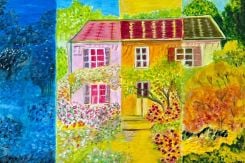
Living with her these past nine years, I have seen the cost of chasing your dreams. The fatigue that settles on her shoulders, the hesitation before submitting a project, the flicker of doubt that sometimes crosses her face. And then, the light, those rare, radiant moments when something works, when the effort feels seen, when she presses “submit” and breathes out a soft sigh of victory.
She rarely asks for praise. What she needed was a little more time, patience, and presence from those meant to guide her. Often, that is all it takes for someone to keep going.
And she did keep going.
This is not just the story of a mother who went back to school. It is the story of a woman who refused to let a marriage at an early age, a conservative city, a collapsing economy, or the invisible lines of age decide where her life would stop expanding. That grit is not loud or fast, but steady and luminous. That beauty is often painted slowly, in colors long kept waiting.
Her courage does not shout. It moves softly. It puts on a school uniform the day after marriage. It traces calligraphy at 64. It logs into a digital classroom at 70. And it holds a paintbrush still, drawing new chapters in a life that never stopped unfolding.
Rima Nazer is a communications specialist & co-founder of Jardins D’EDEN, a brand of artisanal natural products that empower women and preserve cultural craftsmanship, blending entrepreneurship with social impact and storytelling.
 Israeli army carries out demolition at Jabal Amel School in Houla as strikes continue