


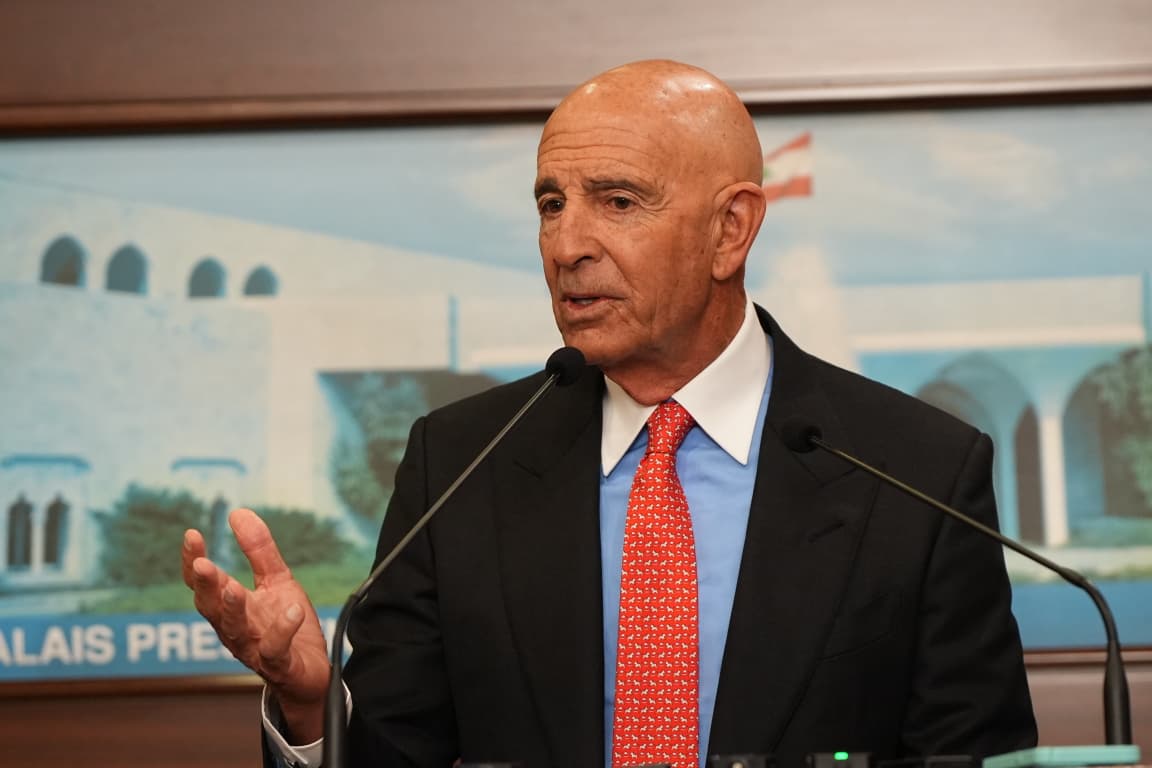
The American envoy Tom Barrack, at the Baabda Presidential Palace, on Aug. 26, 2025. (Credit: Mohammad Yassin/L'Orient Today)






BEIRUT — Lebanon's president's office had to step in as peacemaker after an incident sparked controversy in the press room of the Baabda Presidential Palace: blunt remarks from American envoy Tom Barrack aimed at journalists.
During his press conference, Barrack admonished reporters who were pressing him with questions. He warned that if the situation turned disorderly, "animalistic," the delegation would leave, and urged the press to "act civilized."
"Do you think this is fun for us ... putting up with this insanity," he added, before starting to brief the press.
In a statement, the president's office expressed "regrets over remarks made unintentionally from its podium by one of its guests." The presidency reaffirmed its "absolute respect for human dignity" and extended "full consideration for journalists and press correspondents accredited to it," praising them for "their efforts and dedication in carrying out their professional and national duty."
The Editors' Syndicate responded sharply. It denounced what it described as "yet another instance of Lebanese media being treated in a manner contrary to decency and diplomatic norms," adding that Barrack’s characterization of journalists as "animalistic" was "entirely unacceptable and highly condemnable."
The syndicate called on the envoy "to publicly apologize to the media corps," warning that failure to do so could trigger a boycott of his visits and meetings in Lebanon to defend the principle that "the dignity of the press and journalists is not to be bartered, and no envoy, regardless of rank, can trample on it."
The Union of Journalists of Lebanon said the statements "reflect unacceptable arrogance and implicit contempt for the journalistic mission."
The press photographers' union denounced a "direct insult" to the journalists and photographers present and a "dangerous and totally unacceptable precedent", demanding an "immediate and public apology."
The chairman of the parliamentary Telecommunications Committee and Hezbollah MP, Ibrahim Moussawi, also released a scathing statement. He described Barrack as reflecting "the reality of the United States and the aggressive, savage philosophy on which it was founded — a philosophy of genocide and denial of moral values."
Moussawi condemned the incident as "a flagrant insult" to journalists and criticized the palace’s information officials for not expelling Barrack to "preserve the dignity of the institution and media professionals."
He urged Lebanese authorities, particularly the ministries of Information and Foreign Affairs, to summon the U.S. ambassador to lodge an official protest.
Information Minister Paul Morcos, who is currently abroad, also "regretted" these remarks and stressed his "attachment to the dignity" of journalists. He also said he contacted the relevant departments at the president's office.
"Lebanese journalists exercise their profession in a noble manner to convey the truth despite all the difficulties and challenges they face in their profession," he added.
'Insolent, insulting and unacceptable attitude'
Journalist Diana Moukalled, co-founder of the media outlet Daraj, criticized the U.S. envoy’s reaction to journalists as “an insolent, insulting and unacceptable attitude, which goes against the most basic rules of diplomacy and respect for press freedom.”
"Lebanon is under immense pressure, in an extremely sensitive context regarding Hezbollah's weapons," she wrote in a Facebook post. "Turning the debate from political and legal matters to contempt for journalists and the region does not solve anything. It exposes an empty, paternalistic mindset that sees the Lebanese not as partners, but as 'thugs' who must be disciplined. We are not a backdrop for a diplomatic stage, and those who call on Lebanon to be a strong state must tolerate questions from its journalists, regardless of their opinions."
Riad Kobeisi, an investigative journalist with al-Jadeed local channel, echoed the sentiment: "Those who ask Lebanon to be a strong state must tolerate the questions of its journalists, not treat their attitude as animalistic."
Journalist May Abi Akl described Barrack’s remarks as “a serious insult uttered on an official platform in Lebanon, and therefore cannot be ignored.” She questioned why the journalists present at Baabda Presidential Palace did not immediately leave to preserve their own dignity and that of Lebanon, and criticized the characterization of their conduct as "animalistic." Abi Akl said it was essential to demand a personal apology from the American envoy, as well as from the U.S. embassy.
Ghayath Yazbeck, a Lebanese Forces MP and a former journalist, wrote on X: "What Thomas Barrack said to journalists at Baabda Palace is unacceptable, and must be followed by an apology."
Barrack’s visit comes amid domestic tensions. At Baabda, he emphasized that "Israel is ready to withdraw from south Lebanon but wants to see concrete measures," pressing Lebanese authorities to implement the disarmament of Hezbollah. Prime Minister Nawaf Salam’s government adopted the U.S. roadmap on Aug. 7, a plan designed to gradually uphold the Lebanon-Israel truce and disarm militias, chief among them Hezbollah. The party, however, has shown no willingness to comply.
On Monday, Hezbollah leader Naim Qassem reiterated the party’s refusal to surrender its weapons. That same day, Israeli Prime Minister Benjamin Netanyahu praised "Lebanon's efforts to disarm Hezbollah" by year’s end, offering to "reduce" Israel’s presence in south Lebanon if disarmament proceeded, though he stopped short of committing to a full troop withdrawal.
 2 Israeli soldiers injured in 'operational accident,' as army continues attacks in the South