






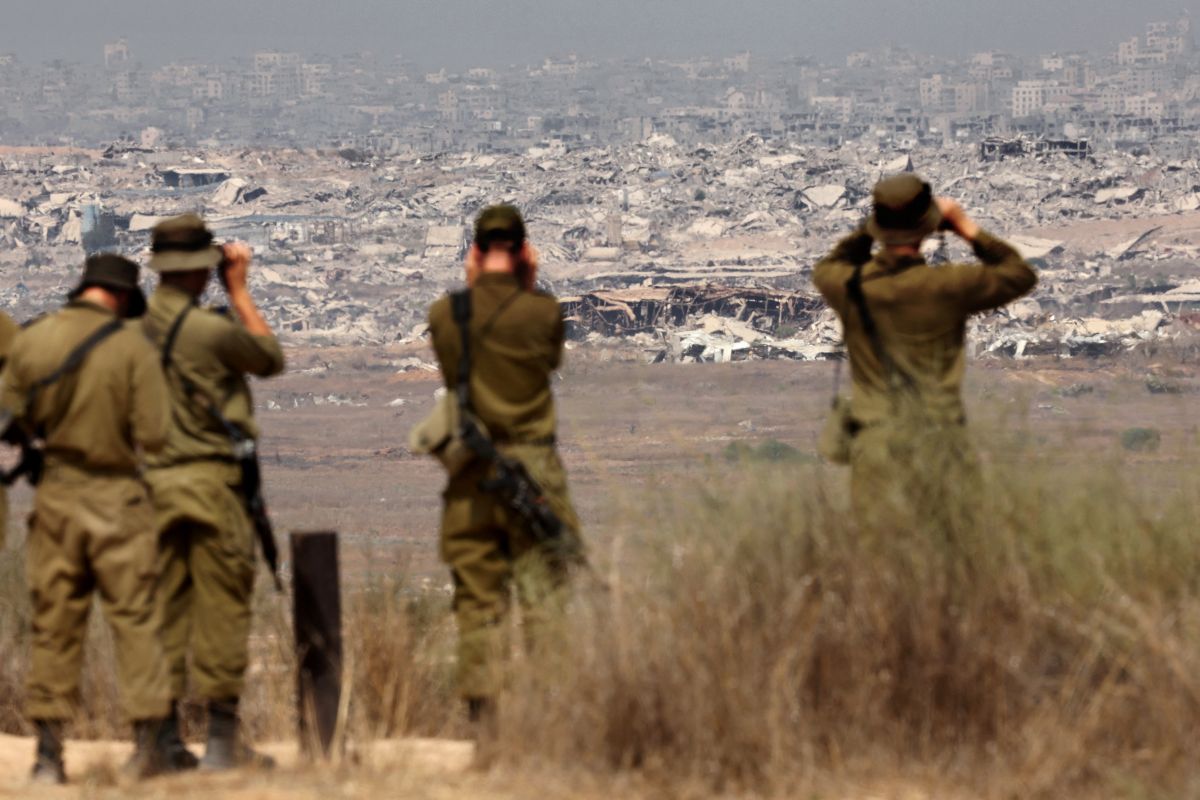
Israeli army soldiers observe destroyed buildings in the Gaza Strip from the border with the Palestinian territory, on Aug. 13, 2025. (Credit: Jack Guez/AFP)






The Israeli military has warned that carrying out the orders from Benjamin Netanyahu's government to raze the entirety of Gaza City — both above ground and in its underground infrastructure — similar to operations carried out in Beit Hanoun and Rafah, could take many months, if not more than a year, Israel's Haaretz daily reported Sunday.
This follows a threat made Friday by Defense Minister Israel Katz, who said that if Hamas refuses to accept Israel's conditions to end the war, Gaza City, seen as the stronghold of the Islamist movement, will meet the same fate as Rafah and Beit Hanoun, referring to two cities in the Gaza Strip largely destroyed by Israel in its nearly two-year-long war against the Islamist movement.
In such a scenario, the Israeli military would face an even more severe crisis in the availability of its reserve units, which are already dealing with falling mobilization rates and low morale, Haaretz reports, citing military sources.
The "Gideon's Chariots II" operation, approved Wednesday by the Defense Minister, is a plan to conquer Gaza City and neighboring refugee camps with the stated goal of defeating Hamas and freeing the hostages taken during the Oct. 7, 2023, attack that triggered the war. The announcement comes as Israel, under heavy criticism for this operation, must decide before the end of the week on a 60-day cease-fire proposal that Hamas has accepted.
Negotiate to the end
The army's chief of staff, Eyal Zamir, told political leaders that "the [Israeli military] will not launch a major assault on Gaza City as long as a humanitarian zone has not been set up to accommodate its residents." He stated that military operations would not start until "all operational and legal preparations are complete," despite pressure from the prime minister, who is calling for the offensive to speed up.
At present, no area has been established for displaced Palestinians, which will require major infrastructure work. Military sources note that evacuating Rafah took two weeks and estimate that the evacuation of Gaza City, home to about 1.2 million Palestinians, should take even longer. Still, the army chief's plan allows for operations to be halted quickly if an agreement is reached between Israel and Hamas on hostage release and a cease-fire.
The general staff insists on its willingness to negotiate as much as possible to secure the release of as many hostages as possible before starting any offensive against Gaza City, owing to the high risks to their safety during heavy fighting.
Tensions are particularly high between the government and the military leadership on this point. Israeli military officials told the Israeli daily over the weekend that the chief of staff "will not make any illegal decisions" and "remains under the direction of the army's legal adviser, Yifat Tomer-Yerushalmi."
Currently, three army divisions are engaged in the Gaza Strip: the 99th Division is fighting in the Zeitoun neighborhood on the outskirts of Gaza City; the 162nd Division is operating in Jabaliya and near the Sabra neighborhood; while the 36th Division is deployed along the Morag corridor and in the Khan Younis region. Meanwhile, the Gaza Division is responsible for securing the Philadelphi Corridor, along the Gaza-Egypt border, and for overseeing food distribution points in the area.
At the same time, the Defense Ministry has ordered the call-up of 60,000 army reservists, due on Sept. 2, approving "the issuing of the call-up orders for the necessary reservists to carry out the mission." Most of them will replace regular troops stationed in the West Bank and on the northern border, so those regular forces can take part in the offensive on Gaza City.
