


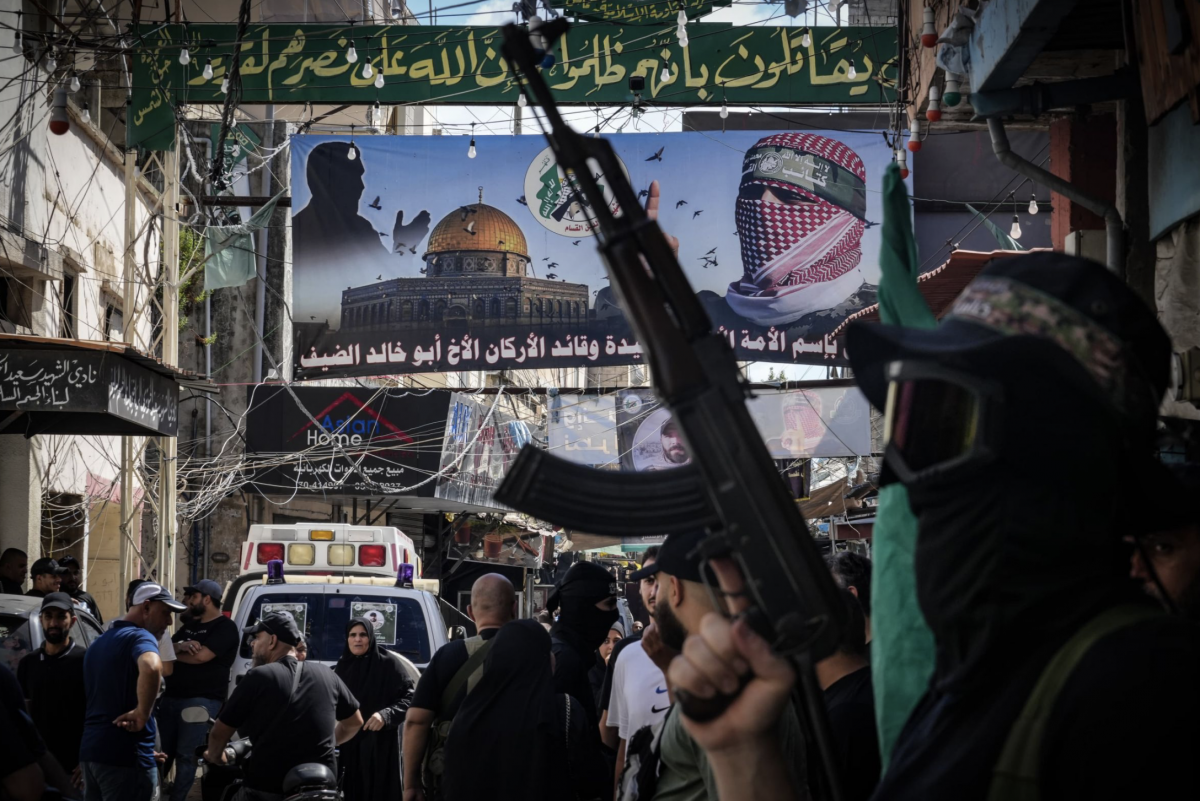
A crowd in the Ain al-Hilweh Palestinian refugee camp during the funeral of Samer al-Hajj, the Hamas security chief in the camp, on Aug. 10, 2024. (Credit: Mohammad Yassine/L’Orient-Le Jour)






The disarmament of Palestinian camps is underway, two months after its initial deadline. On Thursday evening, the Lebanese Army entered the Burj al-Barajneh camp, in Beirut’s southern suburbs, to launch its mission, a source at the Lebanese Army confirmed to L’Orient-Le Jour.
Following Palestinian President Mahmoud Abbas’s visit to Lebanon in May, Cabinet announced that the operation would begin in mid-June. But implementation was delayed due to a lack of cooperation from certain Palestinian factions, most notably Hamas.
An agreement between Ramallah and Beirut, however, now appears to have cornered this movement — along with its Lebanese ally, Hezbollah.
The disarmament of Palestinian camps was set in motion following a three-day visit by Abbas’s son, Yasser. The visit paved the way for an agreement with the Lebanese authorities on the issue. Abbas, who left Beirut on Thursday, held talks with several Lebanese officials, including Parliament Speaker Nabih Berri.
“The meetings led to an understanding on the plan to be carried out,” said a source close to the Palestine Liberation Organization (PLO), without giving further details.
On X, Prime Minister Nawaf Salam welcomed the start of the process to hand over Palestinian weapons. “An initial shipment of arms was handed and placed under the custody of the Lebanese Army,” he noted. “This operation will continue in the coming weeks with additional shipments from Burj al-Barajneh and other camps.”
The army’s mission is expected to last two to three weeks and will be facilitated by the presence of mainly PLO factions (including Abbas’s Fatah) in Burj al-Barajneh, which have been endorsing the principle for several months.
According to Ambassador Ramez Dimashkieh, chairman of the Lebanese-Palestinian Dialogue Committee, the operation will serve as a precedent for the army to access other camps with a stronger Hamas influence.
L’Orient-Le Jour learned that neither Hamas nor Hezbollah was consulted. The latter already opposes the government’s plan to disarm it by the end of the year.
A first camp
From there, the mission in camps where Hamas and the Palestinian Islamic Jihad (PIJ) — allies of Hezbollah — hold sway will be anything but easy. Although both Islamist groups have repeatedly expressed their intention to respect Lebanese sovereignty, they are likely to throw obstacles in the government’s path.
This could be the case in the Ain al-Hilweh camp near Saida, where the situation promises to be far more complicated. The largest camp in Lebanon exists with fragile balances, where rival factions coexist alongside small Islamist groups on its fringes, groups that only Hamas can approach.
“We do not expect clashes,” a well-informed source said. “The most difficult camps will be Ain al-Hilweh, Rashidieh and Mieh Mieh, because of the presence of radicals.”
Speaking to L’Orient-Le Jour, Sheikh Maher Hammoud, known for being close to Hezbollah and familiar with Ain al-Hilweh, said that “the government’s decision to proceed with disarmament is purely symbolic. It is impossible for the army to access Ain al-Hilweh — or at least not before a political dialogue and guarantees are secured in advance.”
In the same vein, the Palestinian Factions’ Gathering issued a statement Thursday evening, saying that “what is happening in the Burj al-Barajneh camp is an internal organizational matter specific to Fatah and has nothing, directly or indirectly, to do with the issue of Palestinian weapons in the camps.”
Denying any intention to disarm, these militias stated that their arsenals “will remain as long as the occupation of Palestine continues.” While it is unclear which factions are grouped under this gathering, the group in question appears to be within Hamas’s orbit.
Contradictory statements
General Sobhi Abou Arab, commander of the Palestinian National Security Forces, told Al-Jadeed that the weapons in question were owned “illegally” and belonged to Chadi al-Far, a Fatah dissident who was arrested by the Lebanese Army the previous day at the Phoenicia Hotel in Beirut.
Meanwhile, Palestinian presidency spokesperson Nabil Abou Roudeina said that the State of Palestine will “begin handing over the weapons present in the Palestinian camps to the Lebanese Army.”
In a statement, he specified that the relevant Palestinian authorities have handed over the first shipment of weapons from the Burj al-Barajneh camp. He added that more arms will be handed over to the authorities in the coming days.
Despite these conflicting statements, at a time when Lebanon is trying to secure concessions from Israel — notably the withdrawal from southern Lebanon and a halt to airstrikes — by demonstrating to the international community its willingness to move forward on the weapons monopoly issue, Thursday’s operation could be seen as another step forward.
Commenting on the matter, U.S. envoy Tom Barrack congratulated Beirut and Fatah for the agreement. “A historic step toward unity and stability, showing true commitment to peace and cooperation,” he wrote on X.
Multiple sources consistently said the next steps will, in principle, concern the camps south of the Litani — al-Bass and Rashidieh — which are to be disarmed under Resolution 1701. The Rashidieh camp, home to several factions including Hamas, is particularly likely to pose problems. It has repeatedly been the launch site for rockets fired toward Israel.
Reactions from residents
The start of the disarmament process has prompted mixed reactions. Some residents condemned the operation, according to L’Orient-Le Jour’s reporter on the ground.
“Weapons should not be handed over to the state,” one resident said.
Hiba, 24, a Palestinian nurse, believes that Fatah should surrender its weapons, which “serve no purpose” and are “used against its own people.”
“But I don’t want Hamas to give up theirs,” she added.
Ihab, another resident, also opposes the handover: “It’s a mistake; the army would enter the camp whenever it pleases.”
In a café whose walls are decorated with a portrait of former Hezbollah leader Hassan Nasrallah, killed by Israel in September 2024, a 27-year-old Palestinian man said, “Our weapons are our honor. We are handing over our honor.”
Sami Diab, 25, living near the airport road in Beirut’s southern suburbs, was more optimistic: “It was about time. These weapons have only been used against the Palestinians themselves.”
This article was originally published in French in L'Orient-Le Jour and translated by Joelle El-Khoury.
 The 7 p.m. recap: Houthis advance, government announces counteroffensive; Iran raises stakes; Israeli shells hit close to journalists in south Lebanon
 2 Israeli soldiers injured in 'operational accident,' as army continues attacks in the South