

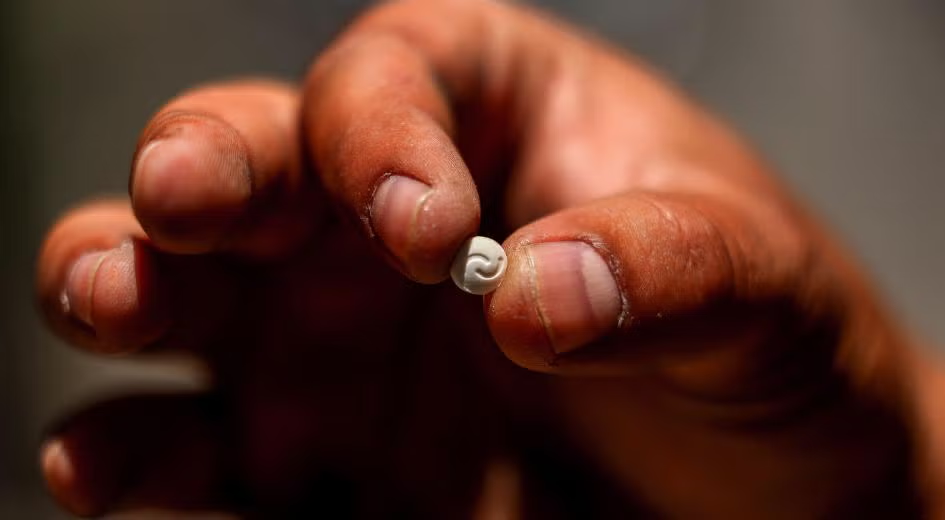
A Captagon pill, recognizable by its two crescents. Archive photo Joseph Eid/AFP






BEIRUT — The Iraqi Interior Ministry said it helped dismantle one of the Middle East’s largest Captagon factories in Lebanon, in a move authorities described as a major blow to regional drug networks.
"Close security and intelligence cooperation between the Iraqi Interior Ministry and the Lebanese State Security Directorate General has led to a major breakthrough, namely the discovery and dismantling of one of the largest Captagon manufacturing factories in Lebanon’s Bekaa Valley," the ministry said in a statement issued in Baghdad.
The ministry said the seizure was made possible by "precise information provided by Iraqi services to their Lebanese counterparts," which enabled the Lebanese Army to launch a large-scale operation in mid-July. The raid not only shut down the factory but also destroyed "huge quantities of drugs meant for the manufacturing and distribution" of the synthetic amphetamine.

The Iraqi Interior Ministry called the operation "the hardest blow dealt to Captagon networks in the Middle East," highlighting the intelligence cooperation as evidence of "the strength of relations between the two countries."
On July 14, the Lebanese Army had announced the dismantling of a major Captagon pill manufacturing plant in Yammouneh, in the Baalbeck district, describing it as "one of the largest factories seized to date."

Since the fall of the Assad regime in Syria on Dec. 8 — accused of running a narco-state at the center of global Captagon production — Syrian authorities have reportedly destroyed nearly 200 million pills, while seizures rose to about 300 million tablets in 2023, according to a World Bank report. Although studies have yet to determine definitively who now supplies the drugs, primarily consumed in Gulf countries, reports suggest production centers have emerged in Sudan.
 Israeli army carries out demolition at Jabal Amel School in Houla as strikes continue