





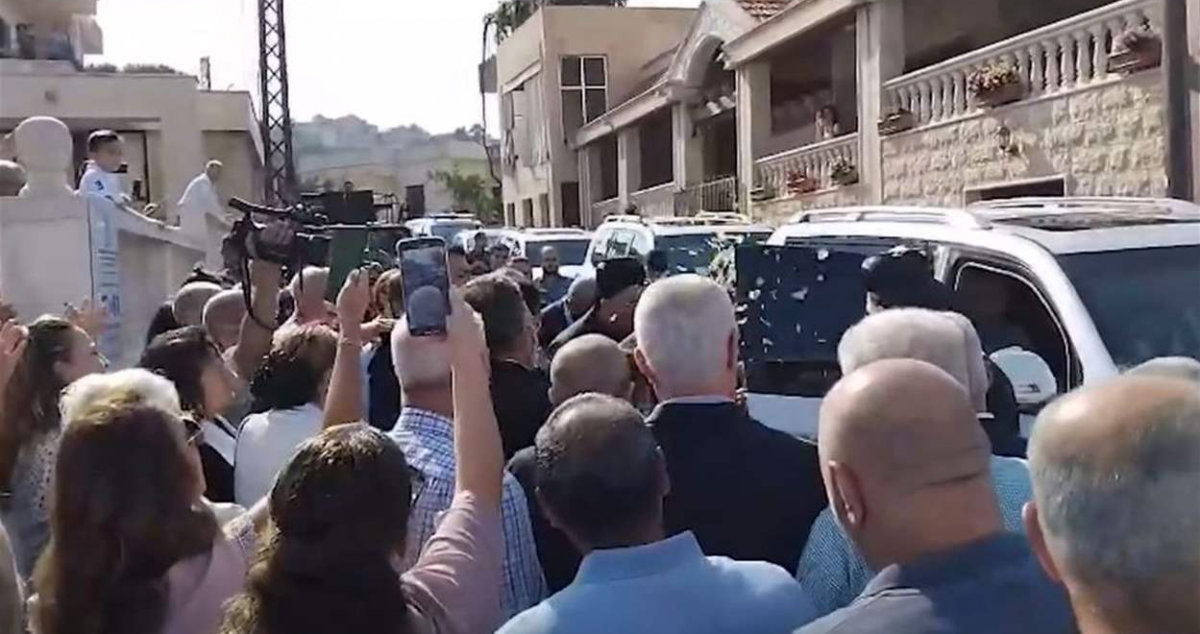
Maronite Patriarch Bechara al-Rai in southern Lebanon on 10 Aug. 2025. (Credit: NNA)






BEIRUT — Maronite Patriarch Bechara al-Rai, accompanied by Apostolic Nuncio Monsignor Paolo Borgia, called for peace and denounced the devastation of war during a pastoral visit to towns along Lebanon’s southern border, where he was warmly received by local residents, the state-run National News Agency reported Sunday.
The first stop was in the town of Debel (Bint Jbeil), where he received a warm welcome with applause, ululations, and the scattering of flowers by the town’s residents.
Rai also visited the Maronite Diocese of Sour in the town, affirming "No to war, yes to peace," and stressing that "the responsibility for achieving peace lies with both citizens and officials."
In the town of al-Qouzah (Bint Jbeil), he pointed out that "only 72 people remain living there," expressing his hope "for the town’s return to its former state, as it must live and resist in order to preserve its heritage, land, and existence."
Rai emphasized that "war is against all humanity, and brings nothing but destruction, ruin, and displacement," calling for prayers for "a just and lasting peace for Lebanon."
Rai regularly criticizes Hezbollah, calls on it to hand its weapons to the state, and frequently opposed in his Sunday sermons the party's opening of a "Gaza support front" from southern Lebanon on Oct.8 2023.
After almost one year of crossborder fire between Hezbollah and Israel, the conflict escalated into a full scale war on Sep.23 before a cease-fire was called for on Nov.27.
However, Israel attacks southern Lebanon almost daily, frequently attacks the Bekaa, and has also targeted the southern suburbs of Beirut.
'The war has never been a solution'
In Ain Ebel, in the same district, Cardinal Rai declared: “We mourn the victims, our brothers in humanity, but we hold on to the belief that war has never been a solution, and we hope it is gone for good.”
The religious leader then visited Rmeish, a Christian village generally supportive of the Lebanese Forces (LF) and hostile to Hezbollah. He was warmly welcomed by locals in the presence of MP Michel Moussa, representing President Joseph Aoun; a representative of LF leader Samir Geagea; the mayor of Rmeish; members of the municipal council; and local dignitaries, according to the state-run National News Agency.
The patriarch continued his visit at the Church of the Transfiguration, where he led the Sunday prayer alongside a group of priests and many faithful. A large banner was displayed at the entrance, bearing his photo and the inscription: “Rmeich opens its doors and hearts to the visit of its supreme pastor, bearer of God’s word and architect of unity and peace.” Portraits of Cardinal Rai were also hung throughout the village streets.
Father Najib al-Amil, parish priest of Rmeish, welcomed the patriarch and praised “the resilience of the residents of the southern border villages — especially Debel, Ain Ebel, Qouzah, and Rmeish — during the recent war, despite the difficult circumstances they faced, particularly as the war’s destruction damaged and burned their agricultural lands.”
He added, “Today, we are under occupation because we are behind on the five points,” reaffirming the determination of Rmeish’s residents to remain on their land. Israel currently occupies five strategically important hills along the southern border.
Father Amil also expressed gratitude toward several Lebanese officials who “maintained constant contact with the residents and community representatives during the war, to respond to their humanitarian needs and demands.”

 Evening recap: Netanyahu announces West Bank offensive; 7 killed in Jordan church shooting; tents burned in south Lebanon
 US strike on Iran this weekend? ‘Absolutely,’ says Barrack; ‘I have no idea,’ says Trump