






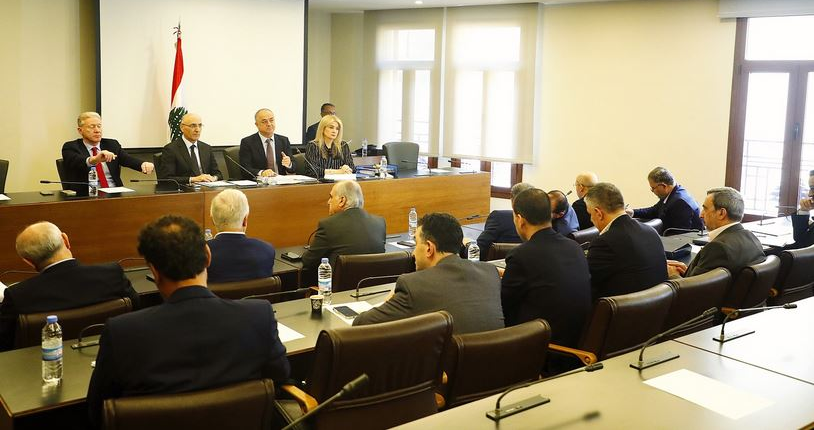
The parliamentary subcommittee, during its meeting on Wednesday at Parliament. (Credit: NNA.)






BEIRUT — A subcommittee of Lebanon’s joint parliamentary committees met Wednesday under the chairmanship of Parliament Vice President Elias Bou Saab to review seven proposed electoral laws, just months ahead of the 2026 legislative deadline.
The debates, attended by Interior Minister Ahmad Hajjar, Foreign Affairs Minister Joe Rajji, as well as member MPs, did not result in a vote due to "divergences within the committee," MP Saab explained after the meeting.
"We have differences of opinion and I was keen that we should not proceed to a vote (...) These differences relate to whether we should limit the debate to amendments to the current law or examine all the laws proposed by MPs," he added, as quoted by the state-run National News Agency (NNA.)
The 2017 electoral law, which has never been fully implemented, restricts the diaspora vote in the 2026 legislative elections to just six seats, as opposed to the 128 seats for which resident Lebanese vote. This is causing controversy.
The diaspora vote in fact splits the political class into two camps: on one hand, those who want to confine its voters to the six seats, as specified by the 2017 law. The Aounist Free Patriotic Movement (FPM) and the allied Hezbollah and Amal parties.
Meanwhile, around 68 MPs from the Lebanese Forces (LF,) Kataeb, PSP, the Change Bloc, independents, and others want to amend the law. They aim to make permanent a special change used in the 2018 and 2022 elections, which was based on constituencies of origin.
Their proposal, submitted on May 9, calls for the pure and simple elimination of the six-seat clause, to allow the diaspora to vote for all 128 MPs according to their constituency of origin.
"There are different points of view, and none of the MPs who submitted proposals is ready to withdraw theirs, with everyone insisting that the proposals be discussed," Saab added.
"At the same time, it was suggested that priorities be set and submitted to Parliament so that it can decide on the merits of this proposal, or that all the proposals be brought before the General Assembly if disagreement persists, as long as the discussion proceeds calmly and without tensions," continued the subcommittee chair.
This meeting was held as the government, at the subcommittee's request, set up a ministerial committee to study any bill the government would send for presentation to the committee.
According to Saab, the 2017 electoral law poses "several problems." "The interior and foreign affairs ministers made observations about the current law, particularly concerning the implementation of provisions related to the election of six diaspora MPs, the magnetic card, and the modalities of expenses," he said.
On the issue of the magnetic card, the interior minister indicated it would not be possible to put the smart card system in place by the election date. Together with his foreign affairs counterpart, he also decided to consider, within a technical committee, the issue of the six diaspora MPs.
"The committee submitted these observations to the prime minister, who will present them to the Council of Ministers. Once the government has adopted an official position on the matter, it will inform us and we will follow up accordingly," emphasized the subcommittee chair.
Commenting on the meeting, LF MP Georges Adwan considered that, given the current disputes, it is no longer possible, just a few months ahead of the vote, to study new proposed laws: "We no longer have the luxury of being able to study new laws given the current differences. A roadmap needs to be established to resolve the six seats issue, while stressing the necessity of a vote by non-residents for all 128 MPs," he noted.
"Lebanon needs to thoroughly study every aspect of the system after the weapons issue is resolved, in order to reach a new electoral law different from the previous one," he continued, urging people to "move away from politics of axes and aim for citizenship."

