








It was Beirut in 1983.
On the steps of a private university, students linger between classes, unsure whether the professor will show up, while in the distance, the rumble of a new round of fighting begins to rise.
The tension in the air feels like the buildup before a storm. After so long living with the constant threat, drawing close and retreating again, they barely notice it anymore.
There is always a backup plan if going home becomes impossible: an underground parking lot, a friend who lives nearby.
Then there is Sarufim, who doesn’t care. He’s from the North. If there’s shelling, it isn’t meant for him. He urges the others not to take it personally.
Suddenly, the shells start to fall. Some land on campus. You come to recognize them by their sound. They are all leftovers from foreign wars or surplus still in use: Russian GRAD Katyushas, Russian RPG-7 anti-tank weapons, American LAW rockets. The walls shake, legs give out, and everyone takes cover wherever they can.
The professor won’t be coming. No one will go home until things calm down, which might take until dawn. Fear gives way to euphoria. To keep the adrenaline rush from crashing, someone suggests heading to the demarcation line — the “Green Line” — just a stone’s throw away, to buy falafel sandwiches.
Someone cracks, “El-falefel taybeh, bas mish kel yom!” (“Falafel is good, but not every day.”) It's a line from a Ziad Rahbani play, instantly recognizable to everyone there. They’re broke students, often underfed at the handful of shabby cafés nearby, numbing their despair with hash, or worse: A truly lost generation, with no plans and no prospects, boxed into a narrow world and dreaming of impossible ‘elsewheres.’
But the word “falefel,” delivered deadpan in imitation of Ziad, sets them off. Fifty students, who just moments ago stared down death, double over laughing.
Someone picks up the mood by singing “Ismaa ya Rida” (“Rida, Listen”), soon joined by the others who had been frozen in fear just moments earlier and are now beginning to relax. The original “Ismaa ya Rida,” a book by Anis Freiha assigned in sixth grade, is addressed to the author’s son. It recounts short tales about the innocence of village life in Lebanon before modernity and the pull of the city began to change everything.
Read more
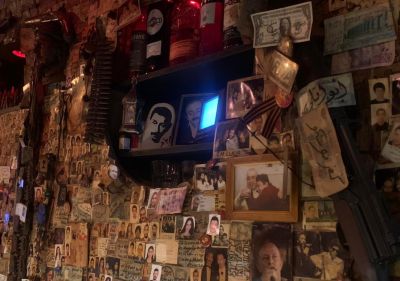
In a Beirut bar, Ziad lives on: 'He will be reborn every time someone discovers his songs'
But when Ziad Rahbani reuses the title, it is to unravel the bitterness of a time when the price of lettuce is soaring, when the lettuce you plant no longer belongs to you, when you spend everything you have on a meal only to wake up hungry the next day and must struggle again to eat. “Listen, Rida, Arabic is no longer a useful language. Tune in to Radio London in the evening and learn English with Mary, who spells and explains.”
Their eyes drift off. London… if only. Or really, anywhere but here. And again, it is Ziad who carries them out of this world with “Al Bostah” (“The Bus,” song written by Rahbani). In the heat of a wheezing bus, a man dreams of Aliya’s black eyes [another song by Rahbani], which could belong to any classmate at this university. The bus is a miniature version of their daily lives.
Few words are spoken, but the weight of a narrowing existence creeps in, where ugliness and obsolescence are beginning to take over everyday life.
“One’s eating figs, another a head of lettuce, and that one over there, with his wife — God, what an ugly wife he has!”
Hands and feet tap in rhythm, and impromptu dances break out. All anyone can think about are Aliya’s beautiful eyes, repeating through the chorus of a song that is, in truth, oppressive. Everyone knows that without Aliya’s eyes, life would not be worth living.
Until dawn, on the steps of this university — behind which a future might still take shape, if only it functions and peace returns — Ziad Rahbani’s cathartic lines ring out. His last two plays sweep away the sweet illusions of “Dad’s Lebanon.”
In “Film Ameriki Tawil” (“An American Feature Film”), he gathers eight characters in a psychiatric hospital, each with his own phobias. There is the Armenian, whom Ziad calls "stereo" because his neutrality allows him to move freely between East and West Beirut. Yet both his shops — one in the East and one in the West — have been destroyed simultaneously.
Two addicts believe their weed dissolves sectarian tensions. There is a Christian obsessed with the idea that Muslims are out to get him. And a traumatized man who shows his ID to everyone he meets, explaining that he turned on his high beams only because the others had burned out.
They act it out, laugh at themselves and recognize themselves in this social satire that is not even a caricature.
In “Shi Fashel” (“A Flop”), Ziad delivers the final blow to the Rahbani tradition by showing the impossibility of returning to the cheerful folklore of village life. Nothing works. Everyone is at odds. Rehearsals are impossible, paralyzed by pockets of fighting that prevent the sets from arriving, by misunderstandings among the cast, by interfaith tensions and by the constant phone calls from Mrs. Jureidini, the worried mother of one of the actresses, glued to her transistor radio and calling to share updates.
Journalists come and go with absurd questions, including the sublime “Maro of L’Orient-Le Jour,” a caricature entirely foreign to Arab culture. She cheerfully assumes the play is about the departure of “the Gharib,” the foreigner — clearly meant to refer to the Palestinians — and ends up chatting about clothes and diets with the lead actress. In a fluted voice, she asks what the circle means in all the paintings. She is told it is the mark left by the bottom of a jar, randomly placed by the props handler.
So much for “The Village of Glory,” the title of a play that upends the myth created by the brilliant trio formed by Ziad’s father, uncle and iconic mother. The break between the pre-war generation — drunk on imagined glory and patriotic virtue — and a youth trapped by war, scraping by between lulls in the fighting, was complete.
By turning his back on his family’s tradition and by weaving quarter-tone jazz into his parents’ folkloric rhapsodies, Ziad opened the eyes of the blind. Ziad brought the two ‘Beiruts’ together in the same joyful bitterness, the same elegant despair.
This article was translated from L'Orient-Le Jour by Sahar Ghoussoub.