






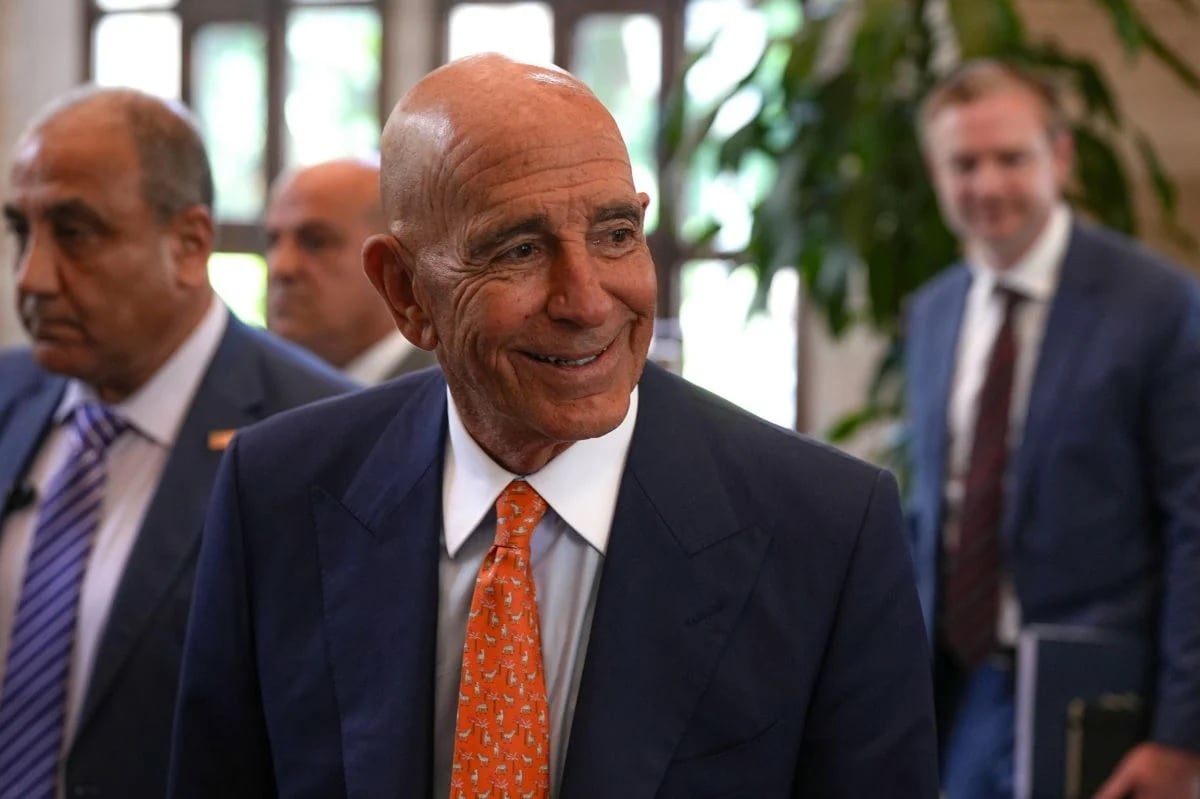
The American envoy Thomas Barrack. (Credit: Mohammad Yassine/L'Orient Today.)






BEIRUT — In an interview with al-Jadeed Tuesday, U.S. envoy Tom Barrack reported "progress" in Lebanon talks but warned that "the timeline is short" for achieving stability amid the conflict with Israel.
Barrack had been in Lebanon since Sunday, where he met with Lebanese officials to collect their response to the U.S. roadmap aimed at de-escalation with Israel and the disarmament of militias. On Tuesday, he had a lengthy meeting with Parliament Speaker Nabih Berri, Hezbollah’s main ally.
In response to a question, the U.S. envoy described his talk with Mr. Berry as "excellent," praising Berry’s extensive political experience and deep understanding of Lebanon and the region.
"He asked me what could be done to reduce tensions," he said. When asked whether it was true that Berri proposed 15 days of cessation of hostilities on the Israeli side as a condition for progress on the weapons issue (with Israeli violations remaining daily in South Lebanon and beyond), Barrack replied it was "much more than that."
He recalled that there has been a cease-fire since November and that this text includes the steps to be taken to achieve lasting stability for all parties. He emphasized that efforts are focused on revitalizing this agreement to resolve all resulting disputes and to see how it can be fully implemented. "We are making progress, I am hopeful," he said.
When pressed to elaborate on the progress of the talks, he assured that everyone is working toward a peaceful solution, including the government. "But the timeline cannot be long, we do not have much time given the developments in the region," he said.
And if Hezbollah refused to hand over its weapons? "There is a law that mandates a monopoly on weapons, and it is for the government to decide if and how it wants to enforce it. Everyone in Lebanon has weapons, light or heavy, and this is not the Americans’ business," he replied.
He added, "Where we can intervene is on the tensions at the border with Israel, using our influence to convince the Jewish state to implement the cease-fire. Everyone in the region is cooperating for this stability and the timeline is short," he said.
Asked about the possibility of a new Israeli war if Hezbollah does not disarm, Barrack said, "There will certainly not be another Israeli war, no one wants war." He pointed out that he does not dialogue with Hezbollah but with Lebanese officials, arguing that there needs to be an understanding among Lebanese factions.
Regarding Syria, Barrack emphasized that stability in that country contributes to stability in Lebanon and vice versa, and that both countries have an interest in cooperating. "There are a few disputes to be resolved along the borders and they can be settled," he said.
As for reforms, he finally stated that one of the priorities is banking reform in Lebanon, highlighting government efforts in this regard, and stressing that security and stability are necessary conditions for these reforms to be carried out.
