






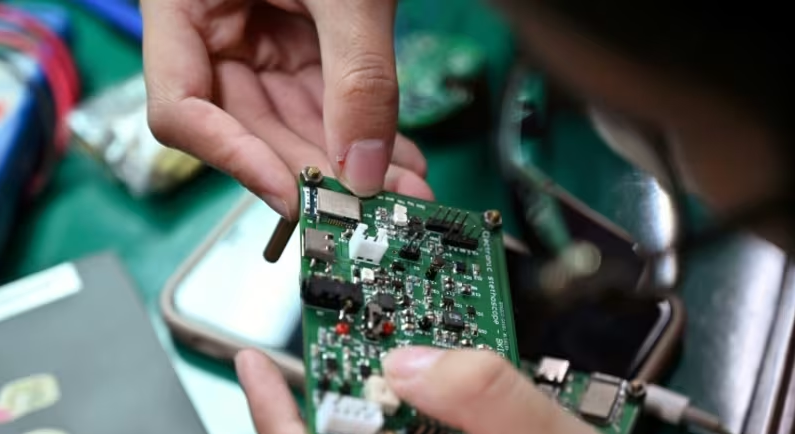
A worker handling a printed circuit board with electronic components. (Illustrative photo Nhac Nguyen/AFP)






The European Commission on Tuesday authorized German state aid worth 659 million euros for four new “pioneering installations in the semiconductor value chain,” according to a statement published on the institution’s website.
This green light, granted despite strict rules governing state aid in the European Union to prevent distortions of competition, aims to “strengthen the position and autonomy of countries in the European area within the semiconductor value chain, by supporting the construction of pioneering installations.” This decision is part of the strategy launched in 2022 with the European Chips Act, as well as the Commission’s policy guidelines for 2024-2029, against a backdrop of rising prices for certain electronic components, especially memory chips, as global manufacturers reorient their capacities toward the needs of artificial intelligence players. This increase has already begun to affect certain consumer products, including Apple computers and Microsoft and Sony video game consoles, pushing some companies to adjust their prices or marketing schedules.
To justify its decision, the Commission considered that the plants in question were “pioneers in Europe” and that the aid provided had an incentive effect, since, without public support, Element 3-5, Vishay, and KLA would not invest in the EU, and Ketek would not invest at all, among other arguments.
The German aid package will be paid directly to the companies concerned and “will be jointly financed by the federal budget and the authorities of the relevant Lander.” Of the total amount:
- 353 million euros will be granted to the SME Element 3-5, co-founded by researcher Yilmaz Dikme, to fund a facility for the production of silicon carbide (SiC) epitaxial wafers in Baesweiler, North Rhine-Westphalia. According to the European Commission, this new wafer production technology will improve energy efficiency, yield, and manufacturing performance compared to conventional hot-wall chemical vapor deposition processes;
- 214 million euros will go to Vishay Siliconix Itzehoe, a subsidiary of the American group Vishay Intertechnology Inc., for a facility dedicated to the production of silicon N-type and P-type power MOSFETs in Itzehoe, Schleswig-Holstein. These "metal-oxide semiconductor field-effect transistors are used to efficiently switch and regulate high voltages and currents in power electronic circuits";
- 74.4 million euros will be paid to KLA-Tencor MIE, a subsidiary of the California-based American group KLA Corporation, for a facility producing advanced equipment for overlay optical metrology and layer measurement in Weilburg, Hesse. This equipment "improves yield and productivity in chip manufacturing plants," for both the front-end phases and back-end assembly and testing stages;
- 17.9 million euros will go to the German group Ketek for a facility in Munich, Bavaria, dedicated to producing two highly specialized components: silicon drift detectors (SDD) and graphene radiation entry windows (GREW). The goal is to produce a new generation of detectors by integrating these two lines in a cleanroom (a controlled manufacturing environment free from contaminating particles), to “improve component integration and manufacturing efficiency compared to existing solutions.”
In return for this aid, the beneficiary companies agree to “strengthen collaborations with universities and research institutes,” “fulfill orders according to priority in case of supply shortages,” and to “communicate to Germany any potential project-related benefits that go beyond expectations.”
Less than 10% of the world’s commercialized semiconductors are produced in Europe, according to various circulating estimates.

 8 p.m. recap: Israel again threatens Beirut’s south suburbs; 2 ships hit near Hormuz; Riyadh football matches canceled