





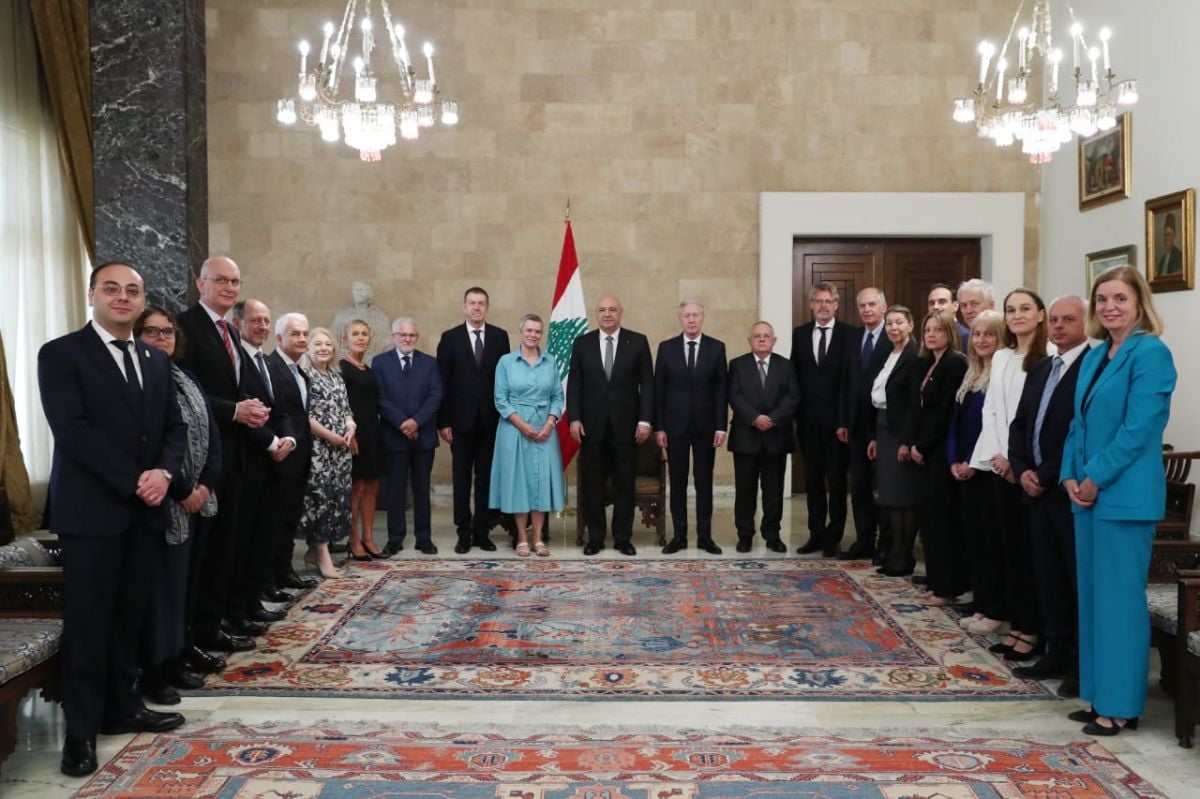
The ambassadors of the European Union and several member states, during a meeting with the President of the Republic, Joseph Aoun, on July 10, 2025. Photo: Presidency of the Republic.






BEIRUT — The European Union said on Thursday it is allocating more than $600 million from its previous financial commitment to support areas affected by the 13-month war in Lebanon between Hezbollah and Israel. The sum is nearly half of its overall budget in Lebanon, which exceeds $ 1 billion.
The announcement followed meetings between EU and member state ambassadors with President Joseph Aoun, Prime Minister Nawaf Salam and Parliament Speaker Nabih Berri on July 10, 11 and 17, respectively.
In a statement, the ambassadors "underscored the substantial and ongoing support from the EU and its member states to Lebanon, including in areas affected by the conflict across the country."
"Beyond humanitarian aid, most of this funding supports essential sectors such as education, healthcare, social protection, water and sanitation, agriculture, while also contributing to economic recovery by creating jobs and supporting the private sector," the statement added.
The EU has also allocated "additional funds to mitigate the impact of the conflict on the country’s security and stability." These include bolstering the Lebanese Army's capabilities and deployment in the south, clearing debris and unexploded munitions and strengthening border management. "A significant portion of this support is not included in the $600 million package, the statement detailed.
The ambassadors also stressed "the crucial role of UNIFIL in maintaining stability and security in the south, a role that will remain indispensable in the future."
hey also called on "all parties to fully implement United Nations Security Council Resolution 1701, notably by ensuring the state’s monopoly over weapons, and to respect the November 2024 cease-fire mechanism."
As every year, the U.N. Security Council is expected in August to decide whether it will renew UNIFIL's mandate.
A ceasefire went into effect on Nov. 27, 2024, after 13 months of war between Hezbollah and Israel. However, Israel has continued near-daily strikes in Lebanon and continues to occupy Lebanese territory in southern Lebanon.
The truce deal stipulated that Hezbollah withdraws its fighters north of the Litani River, about 30 kilometers from the Israeli border, with only the Lebanese Army and U.N. peacekeepers deployed in the sector. Israel, for its part, was supposed to fully withdraw its troops from Lebanon and cease its attacks.
Economic recovery
The ambassadors also discussed with Lebanese officials the government’s commitment to long-delayed financial, judicial and governance reforms aimed at stabilizing the economy.
They welcomed steps taken since the start of the year, including Parliament’s approval of a banking secrecy law and the appointment of officials to key judicial and regulatory posts.
But the diplomats emphasized the urgent need for Parliament to approve a bank resolution law that meets international standards. They also pressed the government to draft and adopt a comprehensive strategy for distributing financial sector losses – the so-called GAP Law – and sought updates on the draft law for judicial independence and a new media law.
Lebanon has been mired in a deep economic crisis since 2019. Restructuring its collapsed banking sector – a key demand of the international community – remains stalled amid a political and financial deadlock, blocking progress on talks with the International Monetary Fund for a much-needed bailout package.

 Evening recap: Netanyahu announces West Bank offensive; 7 killed in Jordan church shooting; tents burned in south Lebanon
 US strike on Iran this weekend? ‘Absolutely,’ says Barrack; ‘I have no idea,’ says Trump