


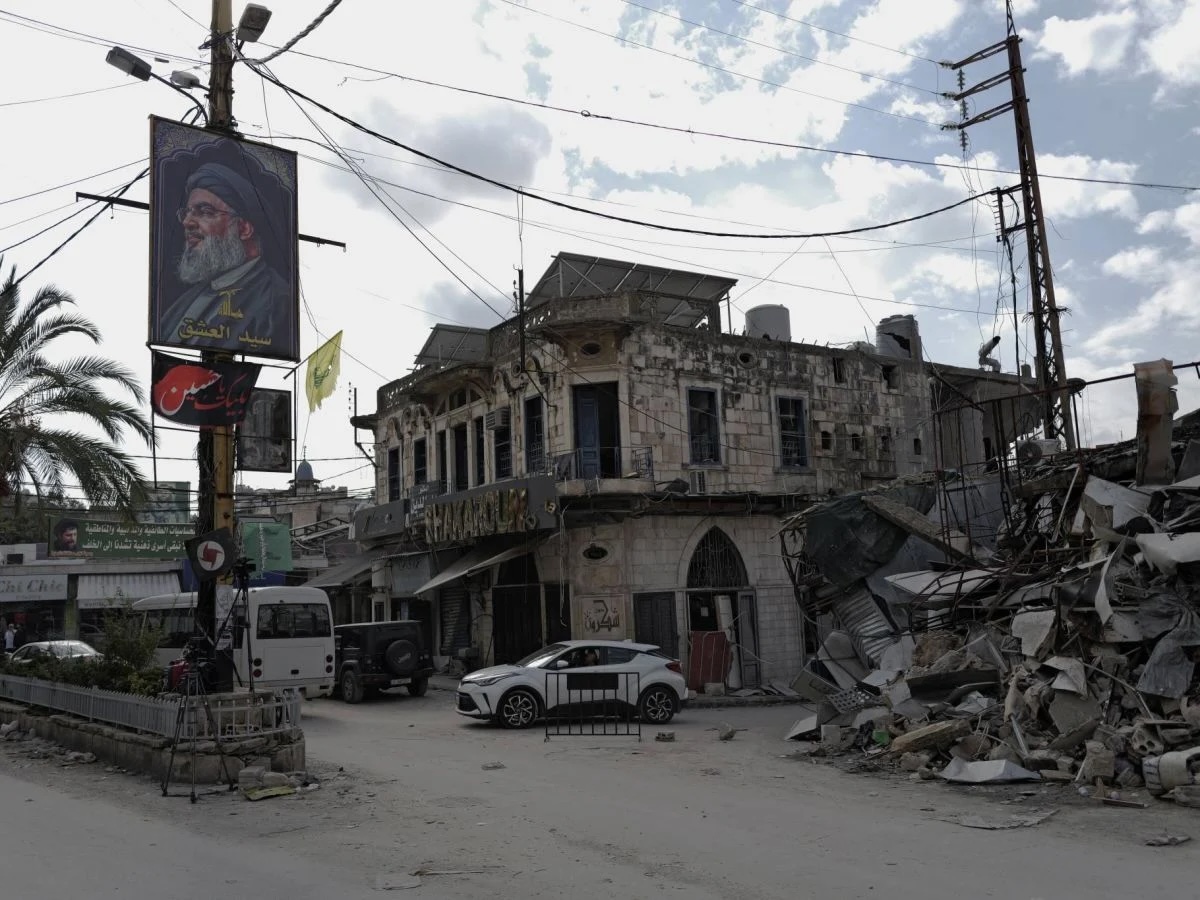
A portrait of the former Hezbollah leader Hassan Nasrallah stands in Nabatieh Square, facing the rubble of the old destroyed souk, on Nov. 29, 2024, in southern Lebanon. (Credit: Matthieu Karam/L’Orient Today)






BEIRUT — Social Affairs Minister Haneen Sayed toured Nabatieh, the capital of the southern Lebanese governorate of the same name, on Monday, to meet with municipal and governorate officials and affirm Beirut's support for the city that was heavily bombed by Israel during last year's war.
Sayed's first stop was the Nabatieh government buildings, where she met with Governor Howayda Turk, Amal Movement MPs Hani Kobeissi and Nasser Jaber, as well as Ali Kanso, who attended the meeting as a representative of Hezbollah MP Mohammad Raad. She then toured Natabieh's historic souq (market), which sustained significant damage in Israeli strikes.
The souq tour involved several local officials, union representatives and Economy and Trade Minister Amer Bsat. During the tour, Bsat promised the arrival of social aid, emphasizing that “reforms will bring foreign aid, fostering the reconstruction of the South and Nabatieh.”
Sayed told reporters that the ministry is working to strengthen aid programs for people who were affected by Israeli aggression on the country. She mentioned in particular the ESSN-AMAN program for the South, a social safety net financed by the World Bank, serving the country's poorest households.
Sayed had made a statement on July 8 saying that she hoped to see the government increase its contribution to the ESSN-AMAN program fivefold in 2026.
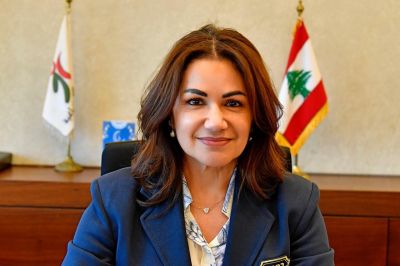
“The economic situation is bad, but our government has decided, with the means available, to provide support to the southern regions, especially those affected by the latest war,” she said, adding that the ministry was in “direct contact with citizens so they feel we are by their side and that there is cooperation between them and the state.”
According to the minister, six ministry centers were destroyed by Israeli bombings and 35 others damaged, stressing the need to rebuild and rehabilitate them to provide social services. She then said the ministry is working on an “economic integration program” to help citizens enter the job market “through training and internships.”
Nabatieh Governor Howayda Turk spoke of the importance of conducting a sufficient assessment of war damage in order to effectively meet the population's needs.
MP Jaber called for “facilitating administrative procedures for people with disabilities and increasing the allowances granted to them by the ministry.” MP Kobeissi, for his part, called on the minister to “closely monitor the work of associations in order to put an end to the chaos in this field,” and Kanso called for “the issuance of ministry cards for war-wounded and an increase in the $40 allowance granted to people with disabilities.”
$145 in financial aid
Speaking from Jebshit (Nabatieh district), Hanine Sayed announced that 150,000 Lebanese in the region will receive financial assistance of $145 per month for three months. This support is part of an initial phase of direct aid targeting families affected by the autumn war.
“We’re trying to reach as many beneficiaries as possible. We’re aware of the heavy burdens residents of these areas are carrying,” she said during a press conference held at the local Social Development Services Center. She added that “after the three-month period, the families will be automatically enrolled in the ESSN-AMAN program — one of Lebanon’s largest social protection initiatives — which provides long-term monthly support to the most vulnerable households.”
Sayed stressed the importance of “maintaining coordination between the Ministry of Social Affairs, municipalities, and local authorities to ensure a swift response to the population’s needs and to improve the efficiency of social services and programs in the South.”
She also announced the launch of a ministerial response plan to address the issue of Syrian displacement, though she did not provide further details.
The World Bank estimates the total bill for damage in regions hit by Israeli bombardments in Lebanon is at least $6.8 billion, with economic losses estimated at $7.2 billion. These estimates cover the period from Oct. 8, 2023, when the war began, until Dec. 20, 2024.
The Israeli army continues to bomb southern Lebanon almost daily despite the cease-fire in place since Nov. 27. At the end of June, the World Bank announced it had approved $250 million in funding to support reconstruction in Lebanon, through the Lebanon Emergency Assistance Project (LEAP).
Some donor countries, including the United States, are making reconstruction funding conditional on the disarmament of Hezbollah across Lebanon, and not just south of the Litani River.
 7 p.m. recap: Houthis threaten Riyadh, Netanyahu talks of prolonged war against Hezbollah'; Israel arrests 2 men in Syria