


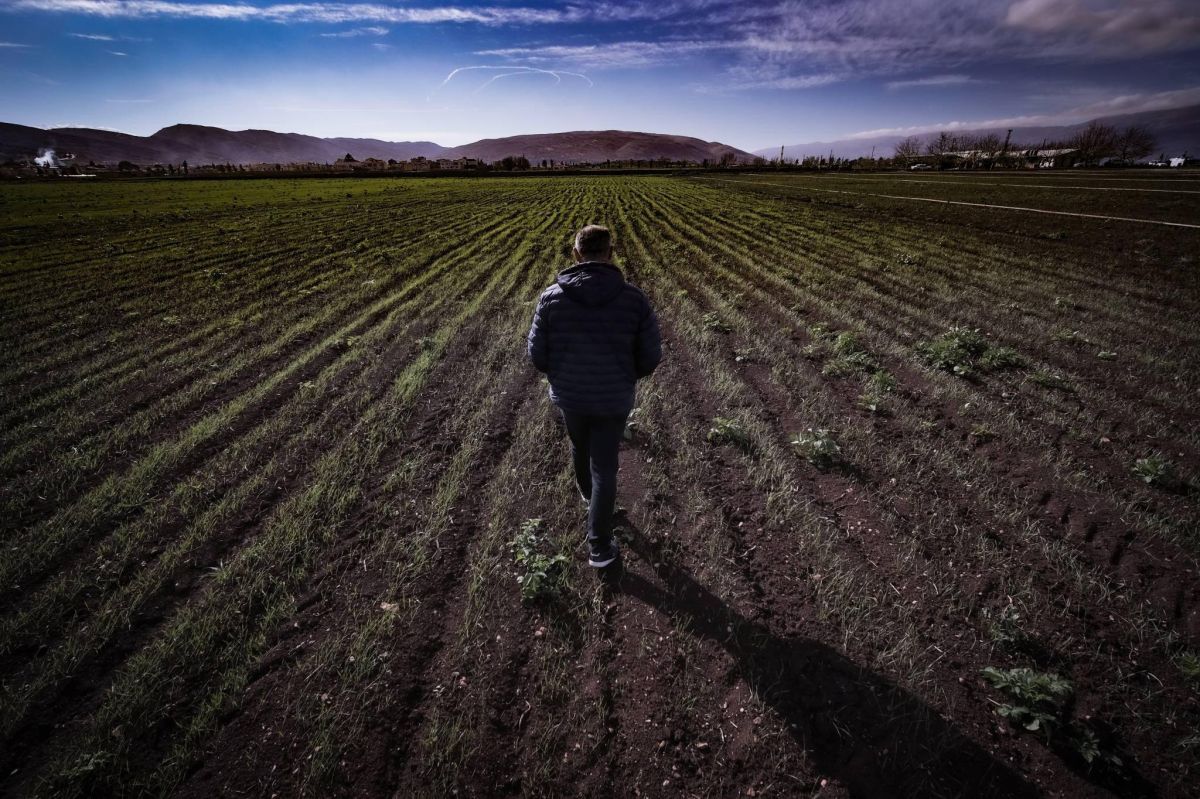
Farmland in Lebanon's Bekaa Valley, an agriculture hub (Credit: João Sousa/L’Orient Today)






BEIRUT — The head of the National Farmers’ Union has warned that the prices of some vegetables could triple after July 15 compared to their current levels, citing this year's weather conditions as well as economic, security and political factors, according to comments published Friday by local newspaper Ad-Diyar.
Lebanon experienced an exceptionally dry winter this year. According to Meteo-Liban data, just 268.4 millimeters of rain fell in Zahle compared to 741.8 mm the year before. The 30-year seasonal average is 668 mm.
The union leader, Ibrahim Tarshishi, pointed out “the prices of vegetables and fruits are witnessing a remarkable increase even though they do not cover the cost of production, and the reason is due to several factors, including climate and lack of water, in addition to economic, security and political factors, most notably the closure of Arab markets against agricultural exports."
Saudi Arabia suspended the import of fruits and vegetables from Lebanon in April 2021, following the discovery of more than five million Captagon pills hidden in inbound Lebanese fruit. While no trade bans were imposed by the rest of the Gulf, Saudi Arabia is the transit hub for goods heading to those states, which meant substantial additional losses of revenue for Lebanon. The price of a kilo of cherries reached LL900,000 (around 10 dollars) that year.
Lebanese farmers were again thrown into uncertainty during the 12-day Israel-Iran war last month, during which Iran threatened to close the Bab al-Mandab and Hormuz straits, through which Lebanon sends its produce to Gulf states.
Too hot, too cold
In February, temperatures plunged to near-freezing levels in Lebanon, with snow falling at 200 meters altitude and even a few flakes falling in Beirut.
"Cherries are among the Lebanese crops that were damaged by a cold wave, which affected 75 percent of the cherry season, and the quantities in the markets represent the remaining 25 percent of the total production of that fruit. This led to the rise in the prices of cherries in the markets as a result of the high demand for it, in contrast to the low supply," he explained.
However, even during these cold days, the amount of precipitation was limited and thus, Lebanon remained far from reaching the seasonal average.
Tarshishi pointed out that the prices of onions, melons, potatoes, cucumbers, cowpeas and tomatoes are below 50 percent of the cost of production.
The head of the National Farmers’ Union expected that prices will rise later, "especially since many farmers will destroy their crops in light of the low financial return compared to the cost of production, which will necessitate, after July 15, raising the prices of these agricultural products by three times more than the current ones."
According to Tarshishi, the increased prices can be attributed to several factors. Farmers had to reduce the amount of land they can cultivate, due to water scarcities and the cost of pumping water up from the wells and have already incurred financial losses that reduce their ability to run their farms up to normal standards.
The quality and quantity of what farmers are able to grow is also hindered by extremely high temperature and closures of land-based export routes makes transporting their produce more expensive.
Tarshishi criticized diesel suppliers of whom he said 90 percent were hoarding fuel imports and storing it in their warehouses "in the hope that the price will rise later." Even the little diesel that is delivered to distributors, manufacturers and generator owners, is being hoarded by those parties as well, he said, leaving farmers with a shortage.

 7 p.m. recap: 1 person killed near border with Lebanon; 200 kilos of explosives carried by mules; Riyadh shuts its airspace