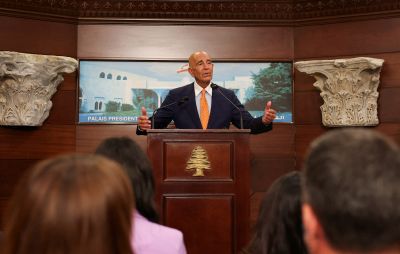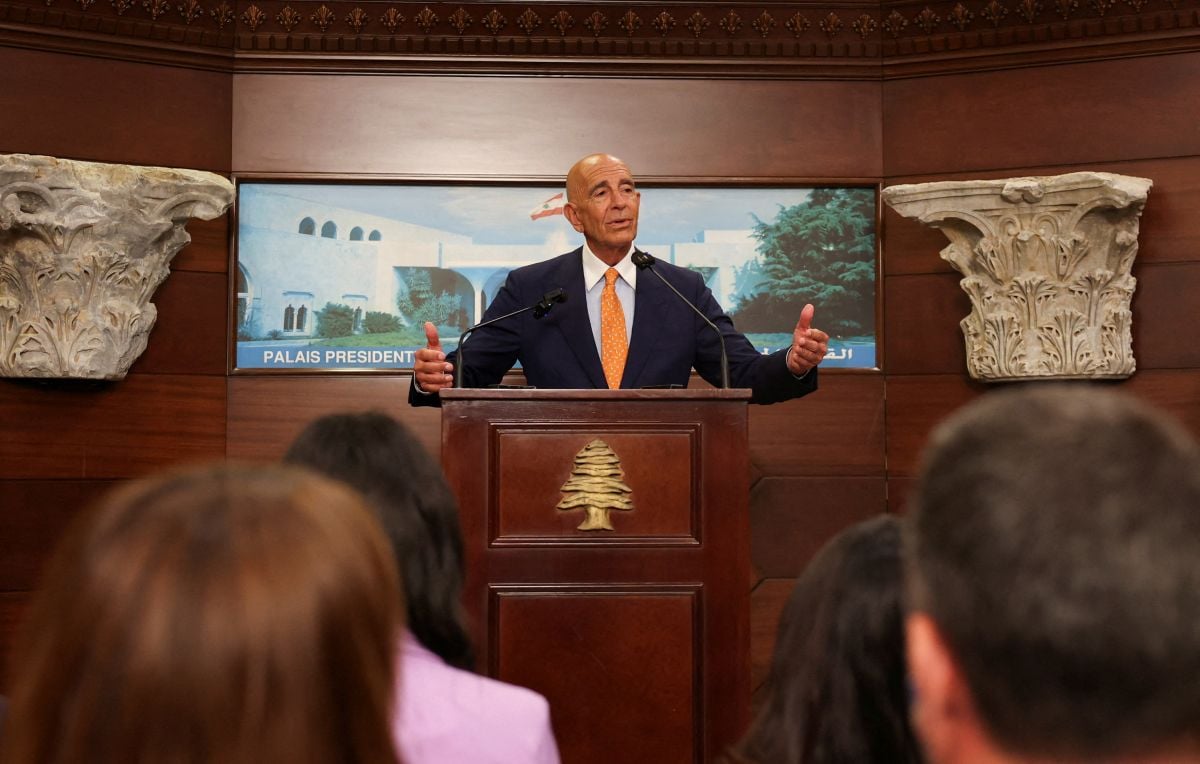
The American envoy Tom Barrack at a press briefing at the Baabda Palace, Monday, July 7, 2025. (Credit: Mohammad Azakir/Reuters)






In a calmer atmosphere than expected, U.S. envoy Tom Barrack wrapped up his meetings in Beirut on Monday with optimism.
After talks with President Joseph Aoun, Prime Minister Nawaf Salam, Parliament Speaker Nabih Berri, and Foreign Minister Joe Rajji, Barrack expressed satisfaction with Lebanon’s response to the U.S. roadmap calling for Hezbollah’s disarmament.
“I am satisfied and grateful,” Barrack said. He stressed that Lebanon was not bound by a U.S.-imposed timeline for the group’s disarmament, countering earlier reports. “Israel does not want war with Lebanon, nor to occupy it,” he added. “Both countries want the same thing: a de-escalation agreement, cessation of hostilities, and a path toward peace.”
A response amended under pressure
Barrack’s tone stood in sharp contrast to the buildup ahead of his visit and the messaging of his predecessor, Morgan Ortagus, which had portrayed Lebanon as facing a stark choice: accept U.S. terms or risk renewed Israeli escalation.
Instead, his visit opened a window for negotiation — a chance to discuss how Lebanon might engage with regional shifts, resolve the weapons issue, end Israeli airstrikes, secure an Israeli withdrawal, and move toward border demarcation and long-term stability.
Before Barrack’s arrival, Lebanon’s three top leaders had already been in contact with him. On the eve of his visit, Israel had stepped up pressure with heavy bombing in South Lebanon and the Bekaa.
When Lebanon’s initial response leaked to the press, it was deemed insufficient by the U.S., particularly for not explicitly referencing the state's monopoly over arms. The Americans asked for revisions.
Key points in Lebanon’s initial response:
– A commitment to implementing the cease-fire under U.N. Resolution 1701.
– Renewal of the U.N. peacekeeping force (UNIFIL) mandate and support for the Lebanese Army.
– Dismantling Hezbollah’s infrastructure south of the Litani River as part of strengthening state authority.
– Israeli withdrawal from disputed areas, including the Shebaa Farms and Kfar Shuba Hills, and demands for the release of Lebanese detainees.
– Implementation of the Taif Agreement and Resolution 1701.
– Reactivation of monitoring mechanisms and calls for the U.S. to pressure Israel to halt violations.
– Arab sponsorship for Lebanese-Syrian normalization and the return of Syrian refugees.
– Adherence to the government’s policy statement on sovereignty, reforms, and the rule of law.
– Continued financial and economic reforms.
– Focus on reconstruction.
– Dismantling Palestinian weapons inside and outside refugee camps.
Following the U.S. request, Lebanon revised its response to explicitly affirm the state's exclusive authority over weapons throughout the country — not just in the South — and reaffirmed that decisions of war and peace rest with the state, per the Constitution, the Taif Agreement and the government’s declaration.
Hezbollah’s position and internal negotiations
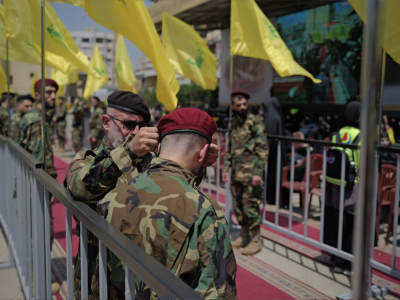
Hezbollah initially rejected any suggestion of surrendering its arsenal, insisting disarmament must result from internal dialogue and a defense strategy.
With Lebanon aiming to present a unified stance from its three presidents, intense consultations took place Sunday night. Negotiations involved Hussein Khalil, Hezbollah leader Naim Qassem’s political adviser; MP Mohammad Raad, head of Hezbollah’s parliamentary bloc; and Ali Hassan Khalil, Berri’s aide and a senior Amal figure.
The final version, which reaffirmed the state’s monopoly over arms, was delivered to Barrack, who welcomed it. However, questions remain over Hezbollah’s actual commitment. Some observers believe Berri has tactically distanced himself from Hezbollah while still coordinating to prevent internal tensions — a move aimed at keeping open a path to negotiations with Washington.
'The process must start from within Lebanon'
“This new framework gives us a path forward,” Barrack said from Baabda Palace. “Everyone is tired and exhausted. Each party must be willing to give something up.”
He stressed that the U.S. was not pursuing regime change: “If you want change, we’re here to help. If you don’t, that’s fine — but the rest of the region is moving quickly, and you risk being left behind. That’s the message from Secretary of State Marco Rubio and President Trump.”
After Baabda, Barrack met Berri at Ain al-Tineh, with U.S. Ambassador Lisa Johnson also attending. Berri described the meeting as “good and constructive,” and said it prioritized Lebanon’s sovereignty, people’s concerns, and Hezbollah’s position.
Barrack also met Salam at the Grand Serail. Following the meeting, the prime minister said the envoy received a document reflecting the positions of both Aoun and Berri. The text calls for an end to hostilities and reaffirms that only the state holds authority over war and peace.
Salam added that “Hezbollah is an integral part of the state” and that its MPs supported the government’s policy statement. He underscored that the monopoly on weapons and extending state authority are long-standing national principles since the Taif Accord. “As for the Israeli strikes in the South and the Bekaa, they’re condemned by everyone,” he said.
He dismissed claims of a “troika” decision-making structure, calling it instead a process of consultation and communication among the three presidents. However, the Lebanese Forces’ Samir Geagea criticized the handling of the issue outside the full Cabinet.
Next steps
The U.S. and Israel are expected to review Lebanon’s response and provide feedback in the coming days. While Barrack’s tone was conciliatory, his core objective remains clear: to secure a clear plan and timeline for Hezbollah’s disarmament, in exchange for U.S. pressure on Israel to cease violations and begin withdrawal from southern Lebanon.
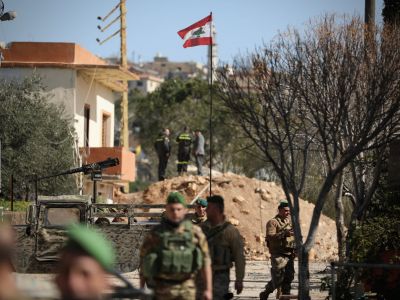
Still, Israeli military action continued. On Monday, an Israeli drone strike in Deir Kifa, in the Sour district, killed one person. Two more strikes hit Beit Lif in Bint Jbeil.