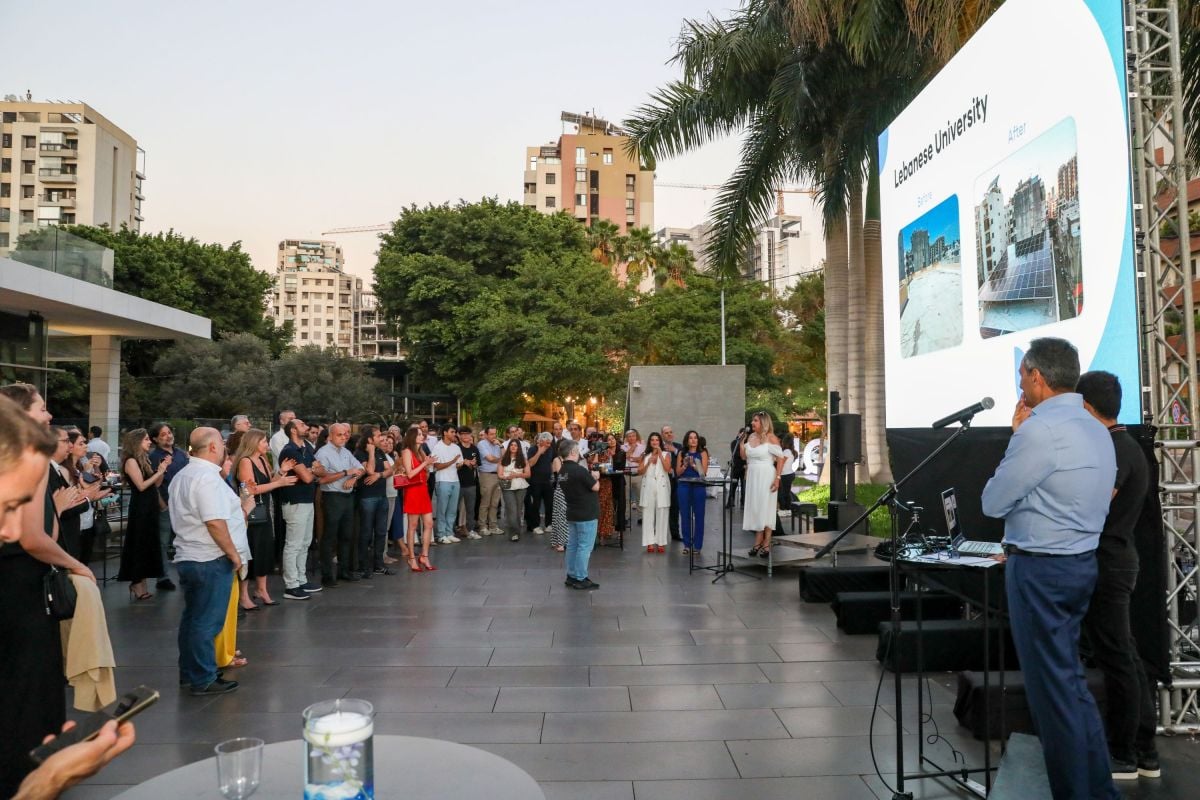
Launch of the charity association giv-e on Thursday, June 19, 2025, at Qubic Square Gardens in Sin al-Fil, with the participation of the Dean of the Faculty of Agronomy of the Lebanese University.






Everything begins with a belief, almost a given: infrastructure constitutes a form of power. In the business world, there is often discussion about "bottleneck," those bottlenecks that hinder performance. And what if we transpose this idea to another universe, that of education? That's exactly what Rony Rashed, entrepreneur and founder of the association Giv-e, did. Its official launch took place on June 19 at Qubic Square Gardens, in Sin al-Fil, in the presence of the dean of the Faculty of Agronomy at the Lebanese University.
By observing reality in Lebanon, he makes a hard but clear observation: the talent was there, but access – to learning, tools, opportunities – was not. Worse, it was sometimes completely absent. Schools without computers, students learning Excel on a blackboard.
This is where Giv-e (give to education) was born, a charitable association dedicated to promoting access to better education through infrastructure projects, and founded on a very clear principle: providing a quality educational environment to reveal talents.
"Here is a story of possibilities, with a decision: that of giving," said Rashed. "Imagine a student full of ambition ... but without a laboratory. A school full of dreams ... but without electricity. This is the reality of Lebanon today! And this is where our story begins: in the gaps. Not a lack of talent, but a lack of infrastructure. Talent is waiting for opportunity. They are scientists, poets, programmers, teachers waiting for us to take a step towards them."
In a small village like Hrajel, a digitization project transformed a school. "A small project, but a huge impact," the founder stated. The establishment did not have internet in all its rooms. Thanks to Giv-e, connection points have been installed throughout the establishment. Today, access to the web has brought science into the classroom.
Projects are multiplying
Rashed used the example of the Faculty of Agronomy at Lebanese University in Dekwaneh. There, students faced a critical problem: how to conduct scientific experiments requiring refrigeration without constant electricity? Thanks to Giv-e, one hundred solar panels were installed, generating 60 kilowatts of clean energy. Today, these young people have electricity 24/7.
Projects are multiplying: the Sacred Heart schools of Hadeth, the Antonine sisters in Dekwaneh, as well as the Lebanese University. Giv-e has already set up two computer labs, a complete digital infrastructure, and solar solutions that allow students to practice their knowledge. Each year, nearly 1,850 pupils and students directly benefit from these installations. And this number is set to grow.
But beyond the numbers, Giv-e carries a vision: that of a solidarity community. Rashed dreams of a network of 10,000 "friends" of Giv-e, in Lebanon and abroad, for an individual contribution of only $100 a year. According to him, "there are so many people who want to help, but don't know how." He distanced himself from the traditional conception of philanthropy. His vision is based on another principle: that of collective commitment. He aspires to mobilize people to support others. His goal is to build a community of action in solidarity, a chain of hope where everyone can be an agent of change.
"We hope to achieve this. It cannot be done overnight, but as it grows, the impact could be immense. The advantage of this association is that the 'friends' see the concrete results of their commitment," he said.
This philosophy is based on four essential pillars that define the DNA of Giv-e. The first is sustainable impact: each project leaves a mark, year after year. The second is transparency and visibility. "Infrastructure offers double visibility: it is both concrete and transparent." The third pillar is what Rashed called "skin in the game." "We don't help someone who doesn't want to help themselves," he stated. Each beneficiary must participate, in their own way and according to their abilities, in the project. Otherwise, it does not happen. It was a non-negotiable condition for the success of the project. Finally, the fourth pillar is the platform of collective action, the famous "Many Helping Many."
And after? The ambition is immense, but it remains grounded in reality. The association seeks to expand its projects to all regions of Lebanon, including those that are difficult to access today, like the south, due to the security situation. It wants to reinforce inclusion by creating infrastructures adapted for students with specific needs. It also aims to target public schools, often forgotten, to get them back on their feet. And why not, one day, create a Giv-e school or a Giv-e technological institute for young people without access? "We have a lot of talent in this country. What's missing are the springboards. The structures that allow you to leap towards the sky. We build those launching ramps," said Rashed.
To join the community of Giv-e "friends" – whose slogan is: It is only when you give that you truly become – and take part in the solidarity platform Many Helping Many, visit www.giv-e.org and follow the association on Instagram (www.instagram.com/giv_e_org) to stay informed and get involved concretely.
This article was originally published in French in L'Orient-Le Jour.