





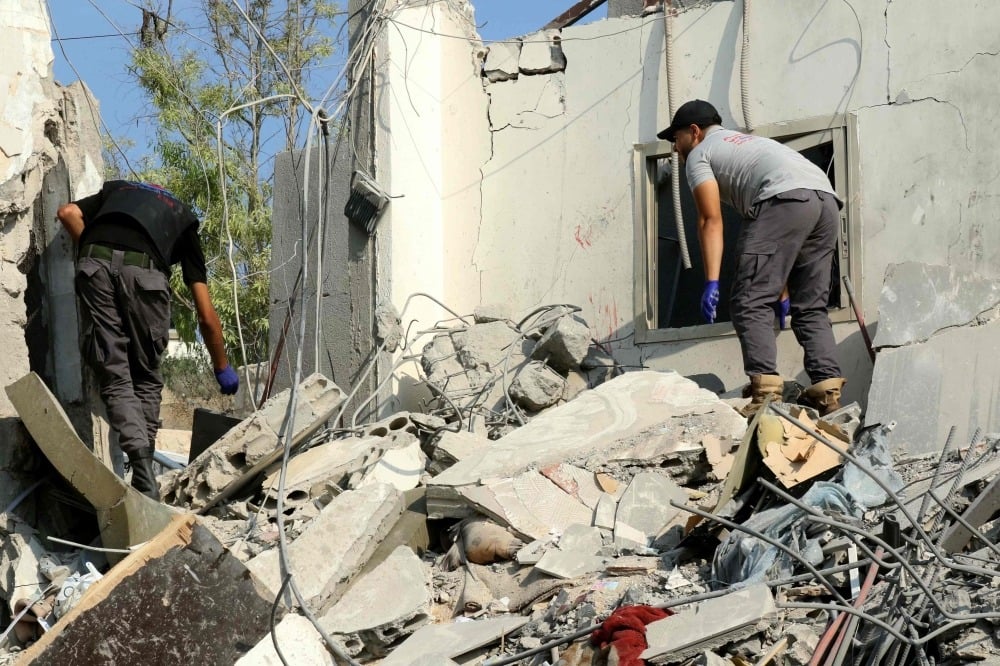
First responders search for survivors among the rubble following an Israeli airstrike that targeted a house in the village of Ansar, in southern Lebanon, on Aug. 15, 2026. (Credit: Mahmoud Zayyat/AFP)






SOUTH LEBANON/NABATIEH — Mohammad is among the residents who returned to his village of Ansar, in the Nabatieh district, after the relatively calm period that followed the announcement of a cease-fire last June. But an Israeli strike at dawn on Saturday that killed seven people, most of them from the same family and including four children, prompted him to leave again.
“We woke up to the sound of explosions shaking the house. I gathered my wife and children in a small room to shelter them, where they spent a restless night. When day broke and we learned that an entire family had been wiped out, we made the decision without delay to return to an apartment we had rented in a safer area at the start of this war,” he said.
The Ansar strike triggered a new wave of exodus among residents who had returned home after being displaced the first time during this conflict, which began on March 2 between Hezbollah and Israel and led to the occupation of dozens of towns and villages in the South. The road from Nabatieh to Saida was congested with cars throughout Saturday.
Israel's strike on Ansar, the deadliest since the cease-fire, killed seven people, including a mother and her four children, shocking the entire country. Among the victims identified are Ali Samir Hajj Hassan, from the Bekaa Valley, whom Israel identified as a commander in Hezbollah's al-Radwan force, and his family: his wife Zeinab Nassereddine, and their children Hassan, Zahraa, Abbas, and Hussein.
In the other deadly strike of the day, which hit a building in Deir Zahrani, killing a father and son (displaced from Mais al-Jabal), as well as the building's owner and a passerby, one victim was identified: Hassan Harkous, an employee at Sheikh Ragheb Harb Hospital. According to the Israeli army, the target of this attack was a commander in the Badr unit of the Hezbollah militia-party.
'Anyone who isn't afraid is crazy'
Abou Samih, in his 70s and a father of five, feared for his grandchildren, several of whom were sleeping at his house that night.
“Anyone who isn't afraid is crazy,” he told our correspondent.
He described life for residents in southern Lebanon as being marked for months by constant fear of renewed bombings, with no real moments of calm. For him, “the worst may be yet to come.”
“Two of my daughters-in-law have already packed up and returned to safer regions with their children,” he said.
Unlike the other witnesses, Ihsan Assi did not hear the explosions that night because her house is far from the building that was struck.
“I woke up in the morning listening to news of the night,” she said. She described scenes of panic, with neighbors wondering whether they should stay or leave. “Three of my neighbors have already left for fear of renewed strikes,” she said, noting the deep psychological impact of repeated displacement on residents.
At the height of the war, the number of people displaced from southern Lebanon exceeded one million. It was the second mass exodus in less than three years, following the start of the previous war between Israel and Hezbollah between September and November 2024. However, after the relative calm of recent weeks, many had begun a cautious return home under precarious conditions.

 Evening recap: Netanyahu announces West Bank offensive; 7 killed in Jordan church shooting; tents burned in south Lebanon
 US strike on Iran this weekend? ‘Absolutely,’ says Barrack; ‘I have no idea,’ says Trump