







Lebanese Foreign Minister Joe Rajji during an interview with LBCI channel, on May 21, 2025. (Credit: Lebanese Foreign Affairs Ministry's press office)






BEIRUT — Foreign Minister, Joe Rajji, told the news channel Sky News Arabia on Tuesday that Lebanon will indirectly benefit from the lifting of sanctions against Syria, according to the Foreign Affairs Ministry.
On Monday, President Donald Trump formally dismantled U.S. sanctions against Syria, hoping to reintegrate the war-battered country into the global economy.
Rajji said that the lifting of sanctions help Damascus economically, accelerate its reconstruction process and bring prosperity to the country.
Lifting sanctions on Syria could, in theory, also unlock the project launched in summer 2021 by Washington, aimed at enabling Lebanon to import Egyptian gas and electricity produced in Jordan.
"The reconstruction will go beyond Syria's borders to reflect positively on Lebanon. Beirut will indirectly benefit from these developments", he said, noting that “improved economic conditions in Syria will lead to a decrease in smuggling on the border with Lebanon.”
Regarding smuggling at the Lebanese-Syrian border, he said that this issue is "difficult because of the long border and the geographical overlap between the Syrian and Lebanese sides, in addition to the lack of sufficient resources."
Rajji emphasized that "the Lebanese Army is exerting all efforts and working tirelessly to secure border and combat the smuggling of people, drugs, fuel and goods." "There is no country in the world that can control its borders 100 percent, but we are trying to achieve this as much as possible," he said.
The minister also said that the Lebanese-Syrian relationship has not been healthy for decades, and that "all the regimes and authorities that succeeded Syria did not recognize an independent state called Lebanon."
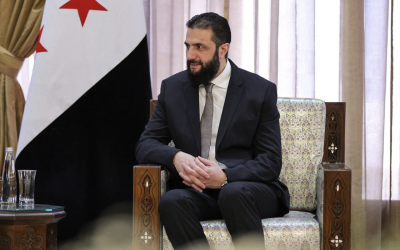
In December 2024, a rebel offensive, led by Islamist group Hay'at Tahrir al-Sham (HTS), ended decades of Assad rule in Syria. The leader of HTS, Ahmad al-Sharaa, later became Syria's president.
“Diplomatic representation was absent at the time between the two countries because Damascus did not recognize Lebanon's sovereignty,” Rajji said. "This was the case with the border demarcation file and other contentious issues."
“When there are two strong and capable states, these borders become strong and not fragile, and that's what we are working on,” he noted.
Syria ready for demarcation
Rajji also noted that the new administration in Syria "affirms its readiness to work with Beirut to demarcate and stabilize the border between the two countries."
At the end of March, the Lebanese and Syrian defense ministers agreed to enhance security and military coordination along their common border, which is 330 kilometers long and notoriously porous, and signed an agreement in principle for its demarcation. In February and March, sporadic clashes had occurred between Lebanese clans and the Syrian authorities at the border.
Regarding documents recently handed over to Lebanon by France, Rajji said that these are “confidential documents, which include a French determination of the border" between the two countries.
“These documents are maps dating back to the 1920s and 1930s, during the French mandate in the region,” he said. "Looking at these maps requires specialists and is a technical subject", he added.
According to Rajji, "France's handing over these documents and maps to Lebanon and Syria has two important significance: "First, the technical importance that helps stabilize and demarcate the border, and the political importance that Syria is now ready to cooperate with Lebanon to demarcate the border between the two countries."
The minister also said that he handed over the French documents to the Lebanese Defense Ministry, where a technical body specialized in border demarcation is studying them in detail.
According to Rajji, the demarcation process is complex and time-consuming, and a joint Syrian-Lebanese technical committee is needed to deal with the issue.
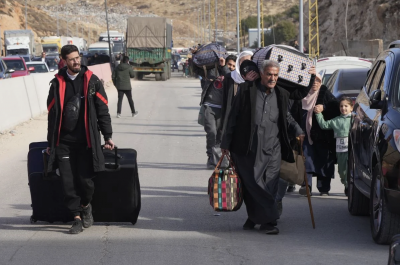
“The issue of border demarcation is a priority for the Lebanese authorities, in addition to other files, such as the return of displaced Syrians and the file of Lebanese missing persons in Syria,” he said.
