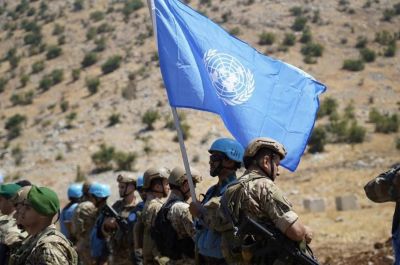
Lebanese soldiers and UNIFIL forces in Kfar Shouba on Aug. 26, 2024. (Credit: Mohammad Yassin/L'Orient-Le Jour)






Returning from a mission in Lebanon — and briefly in Syria — the U.N. Under-Secretary-General for Peace Operations, Jean-Pierre Lacroix, painted a mixed picture of the situation in southern Lebanon, stating, "There have been concrete advances, but we are still a long way off."
While there has been progress on the ground, continuous violations of Resolution 1701, creeping instability, and budgetary pressure threatens the effectiveness of the United Nations Interim Force in Lebanon (UNIFIL).
Amid increased tensions between Israel and Hezbollah, and ahead of UNIFIL’s mandate renewal by the Security Council in August, the message delivered from New York was clear: the U.N. presence in southern Lebanon remains essential.
"UNIFIL has worked very hard in recent months following the cessation of hostilities. We see tangible results on the ground," said Lacroix at a press conference. "The Lebanese Armed Forces have strengthened their deployment south of the Litani with direct support from UNIFIL. Weapons caches have been identified, communication routes restored, and liaison with the Israel Defense Forces remains crucial."
These efforts are part of the phased — and still incomplete — implementation of Resolution 1701, adopted in 2006 to establish a cease-fire between Israel and Hezbollah. But Lacroix did not shy away from the obstacles. "There’s a lot to be done. Violations continue. The full implementation of Resolution 1701 is far from achieved," he stated.
An unequivocal official Lebanese request
Faced with these challenges, Lebanese authorities have vigorously reaffirmed their commitment to UNIFIL. Unanimously, according to Lacroix, they have expressed their support for maintaining the mission. "The president, the prime minister, the speaker of parliament, ministers, the high military command ... All have been extremely clear: UNIFIL is necessary. It plays a critical, irreplaceable role," said Lacroix.
This support was formalized by the sending, Wednesday, June 25, of an official letter from the Lebanese government to the U.N. secretary-general, requesting the renewal of UNIFIL’s mandate without any modification. A source close to the Foreign Ministry said that Lebanon relied on the exact text adopted during the previous renewal in 2024.
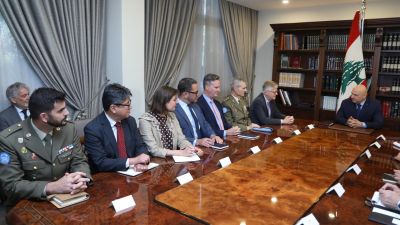
This action comes as the southern border of Lebanon experiences an intensification of armed incidents, often unclaimed, but fueling a near-permanent tension between Hezbollah and Israel. UNIFIL appeared as one of the last remaining diplomatic and operational safeguards.
A tense change of command
This mission of Lacroix also took place at a moment of transition at the head of UNIFIL. Spanish General Aroldo Lázaro Sáenz, in post since 2022, completed his mandate. His actions, praised as exemplary, were warmly applauded at a farewell reception organized by Lebanese authorities. He was replaced by Italian General Diodato Abagnara.
"General Lázaro led UNIFIL during an extremely difficult period. His calm, determination, and ability to maintain dialogue with all parties were invaluable," said Lacroix. "We are happy to welcome General Abagnara, with whom we have already started working closely."
The specter of the budget crisis
But behind these words of recognition and this diplomatic momentum, a shadow loomed: that of funding. U.N. peacekeeping operations are today facing a major liquidity crisis that could hamper their operation or even lead to operational reductions.
"We have informed Lebanese authorities that contingency plans are under study for the 2025-2026 budget cycle. If they had to be implemented, it would only be for financial reasons. We face a severe budget constraint," stated Lacroix. In other words: without adequate funding, even a vital mission like UNIFIL could see its capabilities diminished.
As diplomats work behind the scenes in New York, the question became urgent: Is the international community ready to preserve one of the last bulwarks against regional conflagration?
This article was originally published in French in L'Orient-Le Jour.