





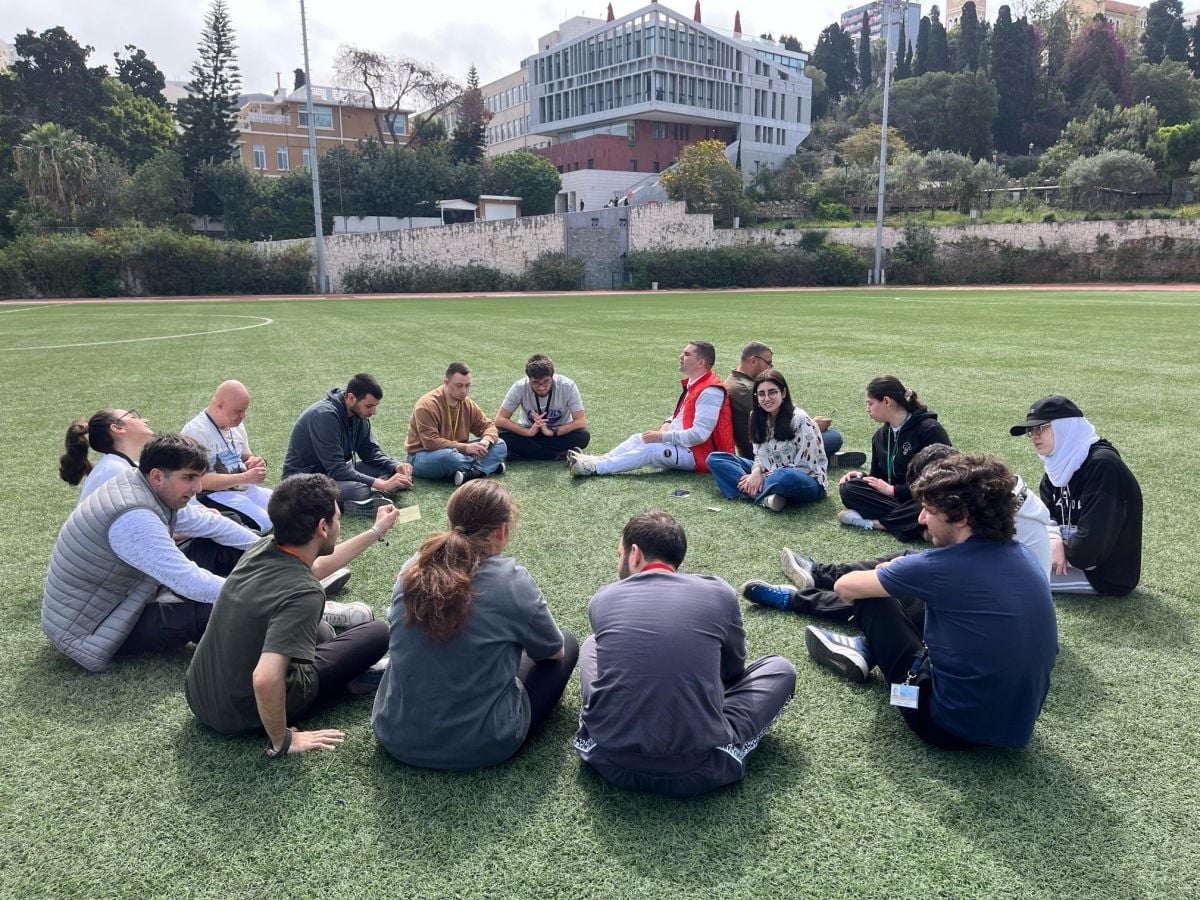
Next Step trains participants on their rights, their safety, and key skills for independent living. (Credit: AUB.)






Smiling, Mohammad Jaafar seems very proud of his life and the adult he has become today. At 47 years old, the man is extremely happy to finally receive his diploma at the ceremony scheduled for July 3 and to move on to the next stage of his life to fulfill his lifelong dream: to spread his wings and live independently.
A reward well deserved, especially as it crowns three years of training in the Next Step program at the American University of Beirut (AUB). During these years, he persevered and learned, thanks to personalized and adapted support from a multidisciplinary team, to gain autonomy, prepare to enter the job market, and acquire essential life skills to become an independent, confident, and productive member of the community.
It was only four years ago that his family discovered the Next Step program. Despite the many challenges he has faced in his life, Mohammad, stronger than his disability which makes him "vulnerable" and "dependent" in the eyes of others, joined the program with the hope of becoming an active member of society someday. "I am very happy to be with my friends at AUB. I love my teachers. I particularly like the art teacher who helped me discover hidden talents in me," he replies when asked about what he enjoyed most during his course.

"I worked in a hair salon. I also had an internship at the Radisson Blu Hotel in Verdun. I worked at the reception, restaurant, and kitchen," he recounts. This professional integration was made possible thanks to the guidance and support of his teachers.
Lama Wattar, on the other hand, was part of the first cohort of the Next Step program and graduated in 2020. She now serves on the board of directors of the Lebanese Down Syndrome Association (LDSA). She also works there as a data entry manager. Lama explains she gained assurance and confidence after participating in the Next Step program. "The program helped me strengthen my life skills, gain confidence, become independent, and learn how to be a productive employee. The training helped me consolidate my English skills. I also learned computing, but I particularly enjoyed the drama class," she says.
Launched in 2016 under the auspices of the Continuing Education Center at the American University of Beirut, the program aims to help young people and adults with various intellectual disabilities gain autonomy and build their own life path, as highlighted by Mona Agha Maktabi, program director. "It is an inclusive university program with academic and professional orientation, based on the American life-centered education model, but adapted to the culture and needs of the students," she says.
Spanning three years, it also provides functional and professional training, and thus the knowledge and skills necessary to become effective, autonomous, and productive individuals in careers that match their tastes and strengths, with a particular focus on daily, community, personal, and social life skills.
"Through interactive and student-centered sessions, we educate them about their rights, their safety, how to act in different situations, and how to protect themselves. We also teach them to solve certain problems, control their emotions, and everything related to daily life," explains Markella Assaad, a specialized educator in the program.
The professional orientation part of the program targets all employment-related skills. Thus, these young people undergo internships and a professional immersion of 9 to 12 hours, with rotations in different companies that allow them to face the real world of work.

Unlike regular university students, they benefit from supervision provided by a placement director — the specialized educator — who ensures the successful implementation in the professional environment.
Discrimination persists
Initially, not fully convinced that disabled people have their place in the company, employers are today more inclined to welcome people with intellectual disabilities into their structures, especially after the introduction of the concept of CSR (corporate social responsibility). "Despite this improvement, a lot of progress remains to be made, especially since access to employment is still relatively limited," emphasizes Maktabi, before highlighting that "even when recruited, these individuals are sometimes underpaid."
This is why an employment advisor accompanies the students hired at their workplace once or twice a month to ensure they apply all the skills acquired during the three years of the program.
"Unfortunately, there is a preconceived idea in our society that these individuals will never be productive and could be dangerous. However, when you get to know and work with them, you realize they are among the most transparent, loving, and caring people," she insists.
"You cannot imagine how happy our students were when they had the opportunity to vote in the municipal elections a few weeks ago! During Christmas and Ramadan, they were so proud to prepare and distribute food packages to those in need. This allowed them to feel they contribute to society, just like other citizens," she added, while pointing out that one of the challenges they face in their work is that "some parents themselves do not believe in their son or daughter's capabilities."
"Even when they believe in them, they sometimes fear enrolling them in companies after graduation, thinking society will not treat them fairly," she confesses.
Unfortunately, and just as an example, some insurance companies refuse to issue insurance policies to people with specific needs, while banks sometimes deny them the right to open an account. Just a few weeks ago, the Minister of Public Health, Dr. Rakan Nassereddine, granted them medical coverage in public health facilities. This highlights the long path that remains to be covered.
This article was originally published in French by L'Orient-le Jour.

 Evening recap: Netanyahu announces West Bank offensive; 7 killed in Jordan church shooting; tents burned in south Lebanon
 US strike on Iran this weekend? ‘Absolutely,’ says Barrack; ‘I have no idea,’ says Trump