






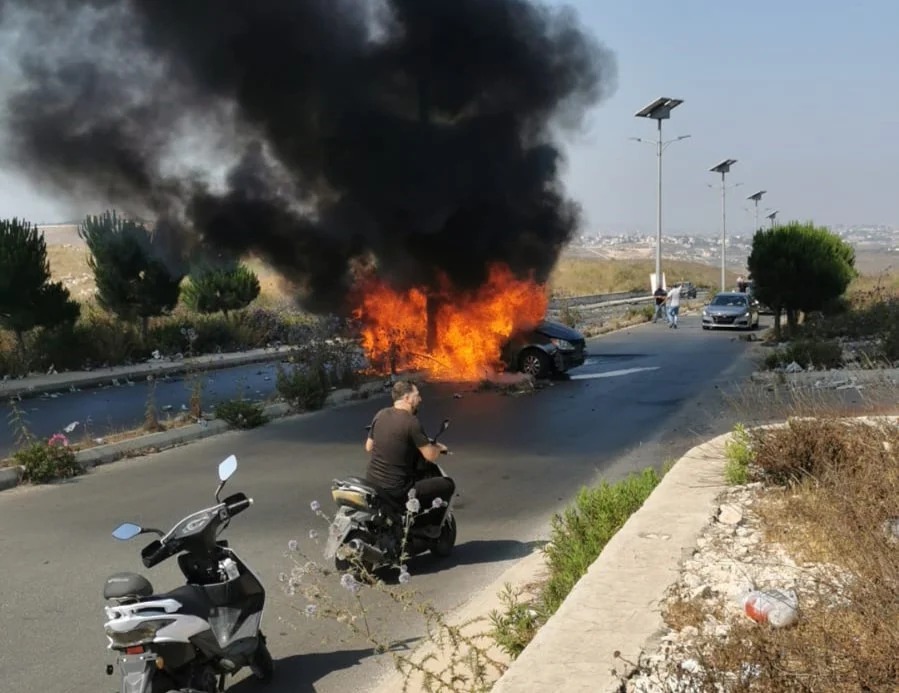
The vehicle destroyed by an Israeli drone strike in the Nabatieh district on June 26, 2025. (Courtesy of Muntasser Abdallah/ L'Orient Today)






BEIRUT — The Israeli army released a statement Wednesday sayings its bombing of a car driving in southern Lebanon's Nabatieh district the day previous had killed the head of a key financial system within Hezbollah.
The attack killed Haitham Abdallah Bakri and his two sons, Mohammad and Abdallah — all three of whom were claimed as martyrs by Hezbollah — as they were driving in the Kfar Dajjal region. They had reportedly been traveling from their hometown of Sir al-Gharbiyeh, in Nabatieh district, to Bakri's currency exchange shop in Ghobeiri, in the southern suburbs of Beirut.
The Israeli statement said Bakri was the head of the "al-Sadiq" exchange network, alleging that he was a "key figure responsible for facilitating financial transfer from Iran's Quds Force to Hezbollah."
According to the Israeli army, Bakri's role "enabled the militant group to fund its military operations, including the purchase of weapons, production capabilities, and the payment of salaries to operatives."

The Israeli army said it believed Bakri's death would be "a significant blow to the group’s operations."
Hezbollah announced that the funeral of the three family members will take place in their hometown on Wednesday at 5 p.m., and hailed them as "martyrs on the path to Jerusalem," without providing any further details as to the nature of their membership within the party.

The attack took place as the Israeli army continues to carry out daily strikes on southern Lebanon, and occasionally the Bekaa, despite the cease-fire in place since November 2024, which ended more than 13 months of war with Hezbollah. Israel has violated the ceasefire over 2,000 times since signing the truce agreement and killed nearly 200 people.
Crackdowns on Hezbollah financing continues
The strike also comes amid the continued deterioration of Hezbollah’s military and financial situation. The group has faced significant challenges, especially following the fall of Bashar al-Assad’s regime in Syria in December 2024, which severed a key supply line between Tehran and Hezbollah.
Over the weekend, the Israeli army confirmed the killing of Behnam Shahriyari in Iran, who was responsible for managing the financial systems that enabled the flow of money to the Quds Force and its affiliates, including Hezbollah.
The assassination took place during the final hours of the 12-day war that Israel launched against Iran on June 13, prompting Tehran to retaliate with a series of ballistic missile attacks against Israel, before a U.S.-brokered cease-fire was reached — and firmly imposed by Trump — on Tuesday.
In May, the U.S. State Department's "Rewards for Justice" (RFJ) program announced on Monday it was offering a reward of up to $10 million for information leading to the disruption of Hezbollah's financial networks.
Several Hezbollah members are under U.S. sanctions, including two senior officials and two financial facilitators targeted in the most recent sanctions announced on May 15 for their roles in coordinating transfers to the Iran-backed party.
On March 28, five individuals and three entities were designated as involved in a Lebanon-based sanctions evasion network supporting Hezbollah's financial operations, according to a statement by the U.S. Treasury.
In April 2024, in Beit Meri, north of Beirut, the body of currency exchanger Mohammad Srour, 57, was found amid a crime scene containing silencers, gloves, and chemicals to erase evidence, with cash scattered around him, seemingly ruling out robbery as a motive. Bassam Mawlawi, interior minister at the time, had stated that the way the crime was executed led security agencies to suspect Mossad's involvement.