






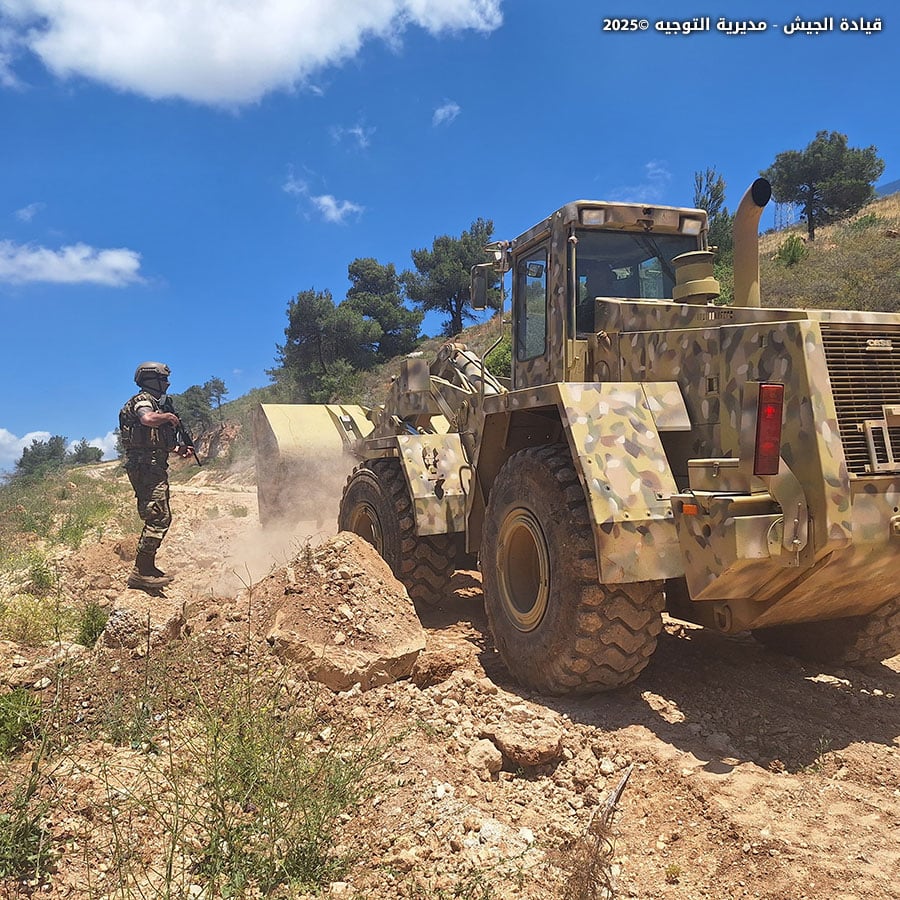
A Lebanese Army bulldozer backfilling excavation work by the Israeli army near Odaisseh in southern Lebanon, on May 29, 2025. Photo by the Lebanese Army on X.






BEIRUT — The Israeli army carried out multiple incursions into Lebanese territory on Wednesday, despite the cease-fire agreement reached in late November.
According to reporting by L'Orient Today's correspondent in the area, Israeli soldiers crossed the border near the town of Kfar Kila, in the Marjayoun district, advancing toward destroyed homes on the eastern edge of the village.
Earlier in the day, dozens of Israeli soldiers, accompanied by two bulldozers, entered an area known as Bekr Sheaib, east of Blida, also in the Marjayoun district. The troops crossed the Blue Line and began excavation work at a site where the Lebanese Army had recently filled in a trench. The Israeli unit later withdrew south of the Blue Line.
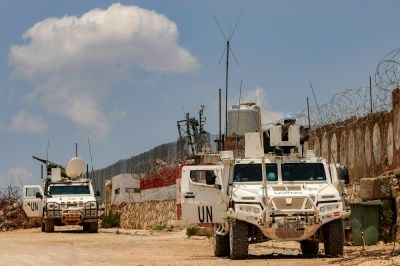
On Tuesday night around 10 p.m., an Israeli unit — supported by two military vehicles and a bulldozer — crossed the technical barrier to advance into the Kroum al-Mrah area, east of Meis al-Jabal. The Lebanese Army deployed reinforcements shortly after the incursion.
The previous night, Israeli soldiers had also crossed the Blue Line in the same area. At the end of May, a trench was dug at Kroum al-Mrah and flanked with a mound of earth. The Lebanese Army refilled the trench the following day.
Low-altitude flights and mock raids
Simultaneously on Wednesday morning, Israeli fighter jets conducted low-altitude flights over multiple regions of southern Lebanon, including areas as far north as Saida and parts of the Bekaa Valley, according to L'Orient Today's correspondents.
Israeli surveillance drones were also spotted flying above several towns and villages, including Yohmor al-Shaqif, Kfar Tibnit, Arnoun, Zawtar Sharqieh and Gharbieh, Qaaqaaiyet al-Jisr (all in the Nabatieh district), Aaba (Hasbaya), the Houjeir Valley, Breqaa, Zrarieh (Saida), and Sour al-Gharbieh (Sour). Mock raids were reported over the central sector of the border.
Since the cease-fire between Hezbollah and Israel took effect on Nov. 27, at least 174 people have been killed by Israeli strikes or gunfire inside Lebanese territory, according to L'Orient Today's tally.
Despite the agreement, which ended over a year of intermittent clashes — including two months of open war with Hezbollah — Israel has continued its operations. Under the terms of the cease-fire, Hezbollah was required to withdraw its fighters north of the Litani River, roughly 30 kilometers from the border, and dismantle all military infrastructure south of the river. Israel, in turn, was to pull back all its forces from Lebanese territory but has maintained five positions it considers “strategic” along the border.


