







The IMF logo at the entrance of the Fund's headquarters in Washington. (Credit: AFP archive photo.)






BEIRUT — The IMF delegation, led by Ernesto Ramirez-Rigo, arrived in Beirut on May 28 for a week of meetings about reforms. They have started their final talks with Lebanese officials before leaving on Thursday.
A comprehensive meeting reviewing the week is scheduled for Thursday morning at the Grand Serail, according to our information.
Few concrete details have emerged from the talks conducted so far by the mission chief for Lebanon and the IMF experts. The mission chief reiterated, after a meeting at the Baabda Palace with President Aoun, "the IMF's willingness to assist the Lebanese state in the process of economic and financial reforms that it has already initiated, which add to its support in recent years."
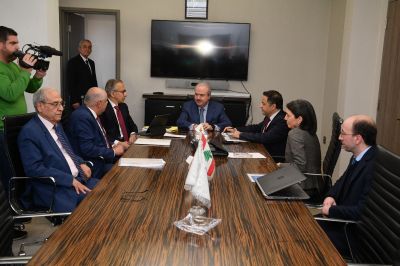
The official also stated that the financial organization "gives great importance to the Lebanese file, especially since the measures taken by the government to initiate financial reforms." A measured statement, suggesting that the organization considers the authorities to be working to move things forward – a position that contrasts, at least so far, with the more critical statements made previously, notably during the final months of Nagib Mikati's government mandate.
'Facilitating the mission' of the IMF
Facing Ernesto Ramirez-Rigo, President Aoun affirmed that the Lebanese state "will provide all necessary support to the IMF delegation to facilitate its mission in Lebanon, given the circumstances the country is going through." He also highlighted the cooperation between the government and Parliament to complete the reforms, "which answer a Lebanese need before being a demand of the international community."
The delegation, accompanied by the IMF’s resident representative in Lebanon, Federico Lima, also went to the Grand Serail to report to Prime Minister Nawaf Salam. According to a brief statement, "the discussions focused on the state of ongoing negotiations and exchanges with the different Lebanese parties, as well as on the necessary reforms to move towards an agreement with the IMF."
An equally brief statement, mentioning discussions on "the financial and economic situation and the IMF's work agenda in Lebanon," was also released after the delegation's visit to Ain al-Tineh to meet with Parliament Speaker Nabih Berri.
The delegation did not revisit Finance Minister Yassine Jaber, whom they had already met in recent days. The minister led a group of Lebanese representatives to Washington in April for a previous session of meetings with officials from the International Monetary Fund, the World Bank, and other stakeholders closely following the Lebanese file. The minister is currently in Cairo, where he participated in the annual conference of the Metac, the IMF’s technical arm focused on assistance missions in the region, according to a statement from his ministry.
He also held a working meeting with his Egyptian counterpart, Ahmad Kouchouk, to examine the basis for bilateral cooperation in several vital economic and financial areas and announced the holding of the joint Lebanese Egyptian commission meetings on July 5 in Cairo, which several ministers from both countries will attend.
The delegation finally met with members of economic organizations, the main representatives of employers in Lebanon, at the Chamber of Commerce of Beirut and Mount Lebanon. According to the Association of Industrialists, "the discussions mainly focused on issues related to reforms, including the restructuring of the banking sector, the reduction of the financial deficit, and certain conditions necessary to achieve a rapid financial situation recovery and sustainable economic growth."
The organization, which had previously advocated certain approaches to absorb Lebanon's losses that were not deemed feasible by the IMF, reiterated to the delegation "the importance of restarting economic growth, rebuilding deposits, and preserving the banking sector, these elements constituting the basis of the awaited reforms."
Plunged into an unprecedented crisis since 2019, Lebanon renewed its request for access to an IMF financial assistance program last February. This step allowed the revival of a process initially started in 2020, but which never materialized, largely due to the resistance of a segment of the political and banking class to any solution that did not place the entirety — or the majority — of the accumulated financial losses burden on the state, and thus on the taxpayer. The dynamics seem to have changed since the arrival of the Aoun-Salam tandem, although nothing is finalized yet.
