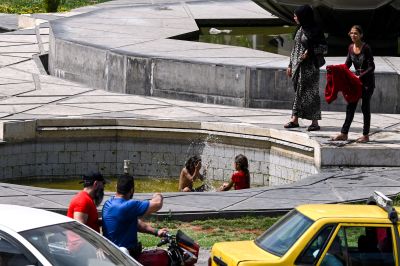
Children playing in a fountain at Sabaa Bahrat Square in Damascus, May 20, 2025. (Credit: Louai Beshara / AFP)






Syrian Interior Ministry “reorganized” to fight drug and human trafficking amid easing sanctions and rapprochement with the West
Syrian authorities announced on Saturday a “reorganization” of the Interior Ministry, notably to combat drug and human trafficking, in the context of improving relations with the West and the gradual easing of sanctions against Damascus.
Syria welcomed the formal lifting of U.S. sanctions, which should allow the return of investments to revive an economy drained after more than 13 years of civil war. President Donald Trump surprised many by announcing, during a visit to Riyadh on May 13, the lifting of American sanctions, saying he wanted to “give the new authorities in Damascus a chance for greatness.” He also met the next day with Interim Syrian President Ahmad al-Sharaa, who led the coalition of radical Islamist rebel groups that ousted President Bashar al-Assad in December.
“The Syrian Arab Republic welcomes the U.S. government’s decision to lift the sanctions imposed on Syria and its people for many years,” said Syrian Foreign Minister Assaad al-Chaibani. “This is a positive step in the right direction to reduce economic and humanitarian suffering,” he added.
Syria, ruled by the Assad clan for several decades, has been subject to international sanctions since 1979. These sanctions were tightened after Bashar al-Assad’s regime violently repressed pro-democracy protests in 2011, which sparked the war.
‘Tourism police’
On Saturday, Syrian Interior Ministry spokesperson Noureddine al-Baba said that more than eight million people were wanted by the intelligence and security services of Bashar al-Assad’s former regime. He also announced the “reorganization” of the ministry and the creation of new departments, including a border security agency responsible for fighting “in particular drug and human trafficking networks.” Syria has also initiated talks with Lebanon on delimiting the porous and trafficked land border between the two countries. Clashes in recent months between Syrian security forces and armed elements in Lebanon, members of “Shiite clans” living near the border, were mainly linked to smuggling operations, according to the Lebanese army.
Within the Interior Ministry, a tourism police unit will be responsible for securing the country’s tourist sites, some of which are UNESCO World Heritage sites.
International sanctions are the main obstacle to the revival of Syria’s economy, and their lifting will enable the return of investments. The Sharaa government is working to secure funds to rebuild the country devastated by the war that has killed over half a million people, displaced millions, and destroyed infrastructure.
For Syrian Finance Minister Mohammad Barnieh, lifting sanctions will help reconstruction and infrastructure modernization, and “pave the way for the return of investments.”
While visiting Turkey, President Sharaa met in Istanbul with U.S. envoy to Syria Thomas Barrack, who said in a statement that the meeting aimed “to implement President Trump’s bold decision to open the way to peace and prosperity in Syria.” Sharaa also met on Saturday with Turkish President Recep Tayyip Erdogan in Istanbul, according to the state news agency Anadolu, which did not specify the content of their discussions.
‘Important priorities’
The U.S. State Department has granted a waiver under the 2020 “Caesar Act,” which imposed severe sanctions on any entity or company cooperating with Bashar al-Assad’s ousted regime. The exemption is valid for 180 days, said Secretary of State Marco Rubio, who stated the lifting of sanctions should enable “investments favorable to stability.”
After meeting with Chaibani in Damascus on Saturday, UN Special Envoy for Syria Geir Pedersen called for “continued strong support from the international community and regional actors” to Syria. However, Rubio emphasized that Washington now expects “rapid action from the Syrian government on important political priorities,” referring to respect for minority rights and progress toward democracy.
On May 20, the European Union announced the lifting of all economic sanctions against Syria imposed under the Assad regime. This sanction relief primarily affects the Syrian banking system, which had been barred from the international capital markets. It also includes the unfreezing of assets of the Syrian central bank.
In December, the United States dropped a $10 million reward offer for the arrest of Ahmad al-Sharaa, dating back to 2017. Sharaa was the leader of Hayat Tahrir al-Sham (HTS), the former Syrian branch of al-Qaeda, which has been dissolved along with all other armed factions by the new government.