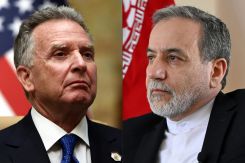
Middle East envoy, Steve Witkoff (left), and the head of diplomacy, Abbas Araghchi. AFP.






Iranian and American officials are set to meet on Sunday in Oman for a new round of discussions regarding Tehran’s nuclear program, following growing opposition from American leaders to the enrichment of Iranian uranium.
Iran and the United States, which have not had diplomatic relations since 1980, have held three rounds of talks since April 12 on the sensitive issue of Iran’s nuclear program, mediated by Oman. As with previous meetings, the American delegation will be led by Middle East envoy Steve Witkoff, while Iran’s Foreign Minister Abbas Araghchi will lead the negotiations on the Iranian side.
On Friday, Mr. Araghchi reported “progress” in the previous discussions, stating, “The further we go, the more consultations and reviews are needed, and the delegations need more time to examine the issues raised.” Meanwhile, U.S. Vice President JD Vance said on Wednesday that the talks were on the “right track.”
The U.S.-Iranian talks aim to reach a new agreement to prevent Iran from acquiring nuclear weapons, a goal Tehran has always denied pursuing, in exchange for lifting sanctions that have crippled its economy. A 2015 agreement between Iran and the major powers to regulate its nuclear program in exchange for lifting international sanctions became obsolete after the U.S. withdrew in 2018 during President Donald Trump’s first term.
Western countries, especially the U.S., have long suspected Iran of seeking nuclear weapons, a claim Tehran consistently denies, insisting that its nuclear program is for civilian purposes.
‘Dismantling’
Iran is currently enriching uranium to 60%, far beyond the 3.67% limit set by the 2015 agreement, with a 90% enrichment level necessary for military use. Its stockpiles of fissile material are a major concern for Western powers.
In an interview broadcast on Friday, Steve Witkoff stated that the Trump administration would oppose any enrichment, after initially suggesting flexibility regarding Iran’s maintaining a low-level enrichment of uranium for civilian purposes. “This means dismantling, banning militarization, and Natanz, Fordo, and Isfahan – their three enrichment facilities – must be dismantled,” he told the conservative Breitbart News. Witkoff further added about the talks, “If they are not productive on Sunday, they will not continue, and we will have to take another path.”
The talks are taking place amid careful scrutiny of key aspects of Tehran’s nuclear program, particularly its stock of enriched uranium and the pace of its enrichment activities. European governments are questioning whether to trigger a mechanism provided by the 2015 agreement that allows for the reinstatement of UN sanctions if Iran fails to meet its commitments, an option that expires in October.
Israeli Prime Minister Benjamin Netanyahu, who opposes the talks between Iran and the U.S., has called for the dismantling of Tehran’s nuclear facilities and the cessation of its ballistic missile program as part of a credible agreement. For its part, Tehran insists that the talks should focus solely on the nuclear issue and the lifting of sanctions, excluding any discussions on military arsenals. Sunday’s meeting in Oman comes just days before a regional tour by President Trump, which will take him to Saudi Arabia, Qatar and the United Arab Emirates.