






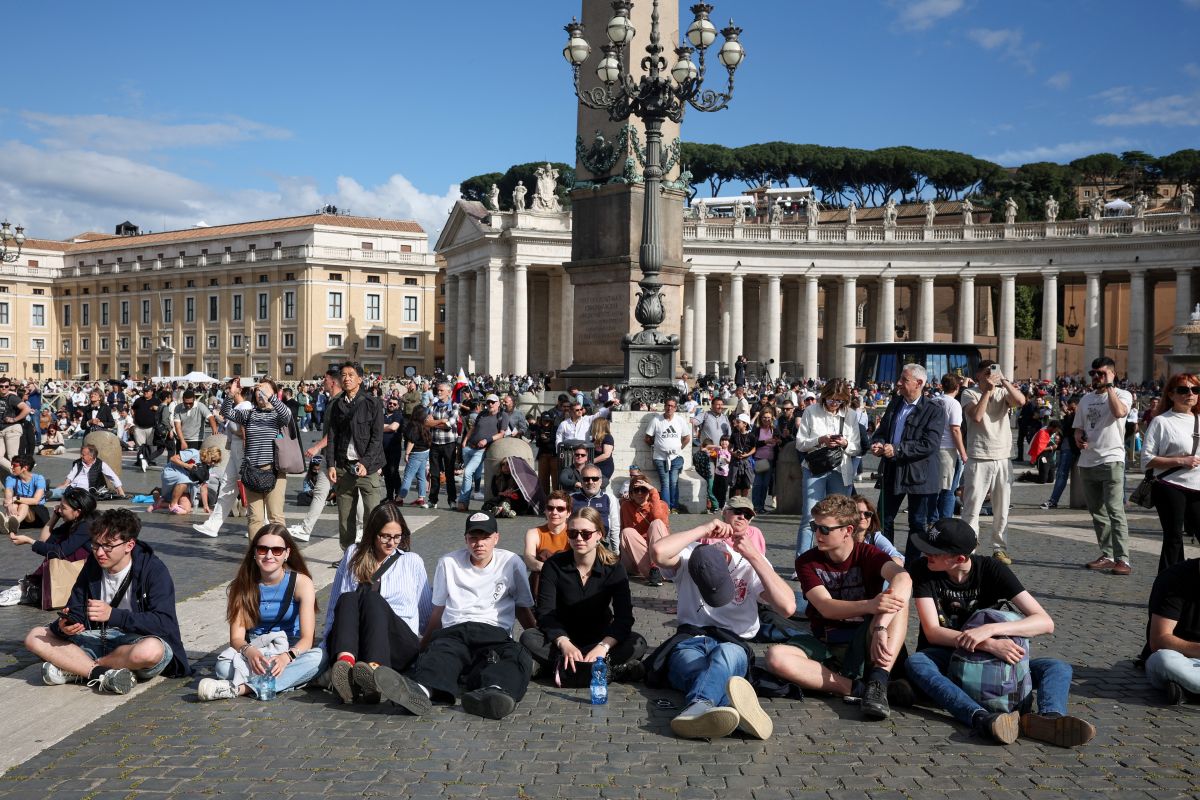
People are sitting at St. Peter's Square on the first day of the conclave to elect the new pope, in Vatican City, on May 7, 2025. (Credit: Marko Djurica/Reuters)






Thousands of people are expected at St. Peter's Square starting Wednesday to witness the election of Pope Francis' successor. The Vatican is responsible for organizing the ceremony at its own expense, on which it remains discreet, while the Italian state, since the Lateran Treaty of 1929, covers part of the costs related to security.
In 2005, the death of Pope John Paul II and the election of his successor, Benedict XVI, cost the Vatican 7 million euros, according to the financial report published by the Holy See. However, from year to year, the Vatican shows varying degrees of transparency regarding its accounts, whose deficit continues to worsen.
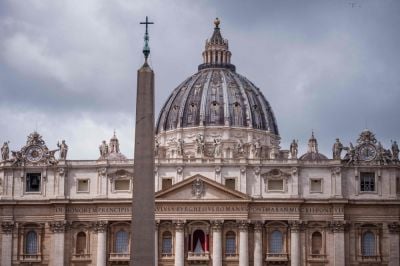
Thus, after Benedict XVI's historic resignation in 2013, the Holy See did not detail the cost of the conclave that resulted in Francis's election. It simply reported a deficit of 24 million euros that year.
11,900 security personnel
But Rome's mayor at the time, Gianni Alemanno, requested the state to aid the municipality and estimated the costs at 4.5 million euros for reinforced public transport, increased expenses for municipal agents and especially the costs related to the security of visitors, whether in the city of Rome or within the Vatican, which is independent.
Since the Lateran Treaty signed in 1929 by the Vatican and Italy, then led by fascist dictator Benito Mussolini, it is the responsibility of the Italian police, alongside the Vatican gendarmerie, to ensure security around the Vatican and in St. Peter's Square, where the name of Francis's successor will be announced at the conclave's conclusion.
This time, the ultraconservative government of Giorgia Meloni has already taken steps: It signed, the day after Francis' death on April 21, a decree releasing funds to mobilize Italian civil protection, responsible for "mobility, assistance and hospitality," especially for foreign delegations, "until the election of the new sovereign pontiff [pope]," alongside the Italian police under the authority of the prefect of Rome.
The total cost for the Italian state has not yet been "estimated," as civil protection minister Nello Musumeci indicated at the end of April, "but a measure has already been adopted for the first five million euros."
The government recalled that in 2005, 11,900 security agents, 1,000 firefighters and 5,000 officials worked during the funerals and then the conclave.
But alongside these costs, the city of Rome and its merchants can expect positive returns: According to the consumer protection association Codacons, "prices in Rome" for hotels and accommodations reached "stratospheric levels" during Francis's funerals, ranging from 200 to 2,000 euros per room near the Vatican, compared to 170 to 780 under normal conditions during this already highly touristic period.
Chronic deficit
The Holy See did not want to comment on the costs of the conclave opening Wednesday, with its spokesperson Matteo Bruni simply reminding that there will be no "sponsor" advertising. The chamberlain cardinal, American Kevin Farrell, responsible for current affairs since Francis's death, "takes care of everything," he added.
Among other things, it is necessary to bring cardinals and their assistants from around the world, accommodate them, feed them, provide laundry services, set up the Sistine Chapel for the conclave or St. Peter's Square for the funerals and then the proclamation of the new pope.
However, the finances of the Holy See are already precarious: Although the Vatican reports its accounts with much irregularity, it mentioned a deficit for the Roman Curia (central government) of about 30 million euros in 2022, for 769 million euros in revenue.
Keen to bring order to Vatican finances and fight against fraud, Pope Francis created the powerful Secretariat for the Economy in 2014. In 2022, its prefect, Spanish priest Juan Antonio Guerrero, explained that it undertakes to sell "20-25 million euros" of the immense Vatican estate each year.
However, the micro-state continues to suffer from a decrease in donations from the faithful and inconsistent financial investments, while its operating expenses, particularly personnel costs, increase. Its image has also been tarnished by embezzlement scandals, notably involving the influential Cardinal Becciu, who is prohibited from voting in the conclave opening Wednesday.
This article was translated from L'Orient-Le Jour.

